
Greater pipefish
Syngnathus acus
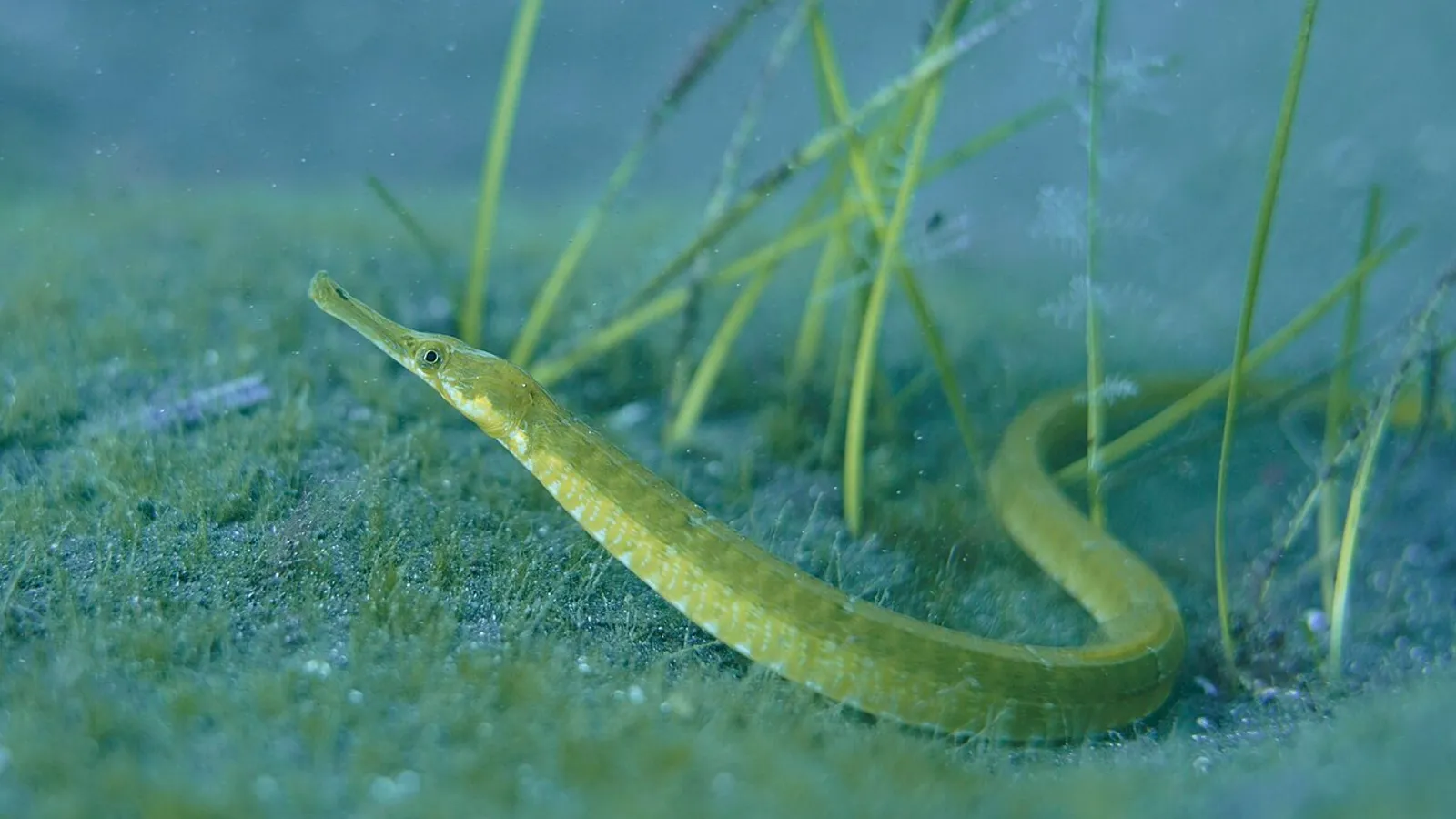
— Where the name comes from
Syngnathus is “fused jaws”, from sýn and gnáthos: the snout is a rigid tube of fused bones with a minute mouth at the tip that works as a pipette. Acus means “needle”. The Italian name translates the look of it: a rigid thread thirty centimetres long standing upright among the weed, not moving.
— Facts
- Group
- Fish · Actinopterygii · Chondrichthyes
- Order
- Pipefishes and seahorses
- Habitat
- Seagrass beds, weed, coastal sandy bottoms
- Range
- The eastern Atlantic and the Mediterranean
- Size
- 30–45 cm, 10–20 g
- Diet
- Small crustaceans sucked in one at a time
- Lifespan
- 5 years
— Characteristics
- 01
The body is sheathed in bony rings and barely bends at all.
- 02
It swims with the dorsal fin alone, vibrating very fast.
- 03
It hangs motionless and vertical among the seagrass, indistinguishable from it.
— What sets it apart
Here too it is the male that is pregnant, and his is no simple pouch. The eggs, laid by the female into a ventral brood pouch, are surrounded by a tissue rich in blood vessels that supplies oxygen and nutrients and regulates the salinity of the internal fluid: genetic analysis has shown that the same genes are switched on there that in mammals govern the placenta and immune tolerance of the embryo. Two very distant groups invented pregnancy with the same set of instructions, and in one of them the males did it.
