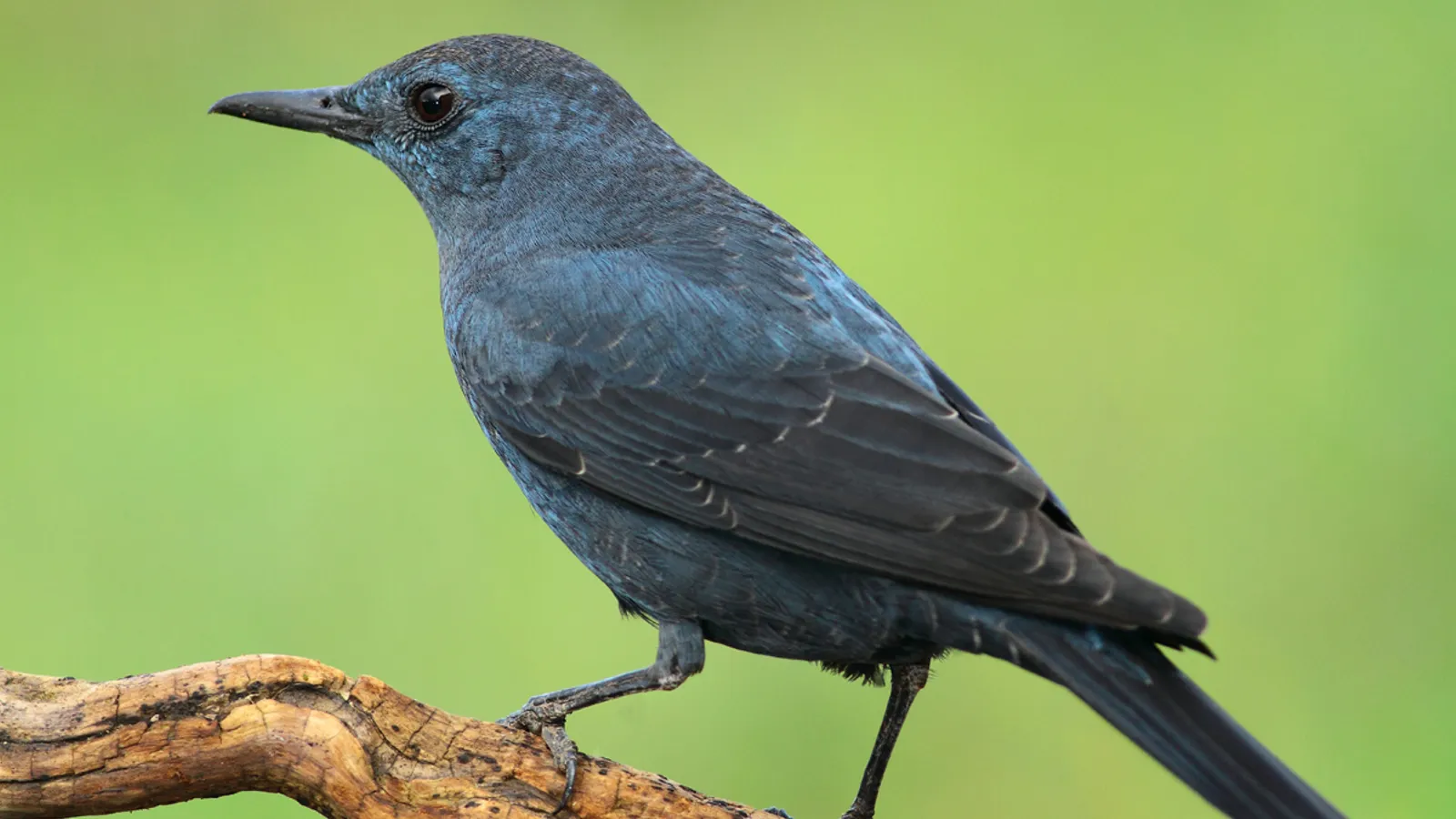
Blue rock thrush
Monticola solitarius
— Where the name comes from
Monticola is Latin, “mountain-dweller”; solitarius means “solitary”. The name comes from far back: in the Latin Bible the psalmist compares himself to a passer solitarius in tecto, a solitary sparrow on the roof. It is not a sparrow but a relative of the thrushes, and the name entered Italian literature through Leopardi’s poem.
— Facts
- Group
- Birds · Aves
- Order
- Passerines
- Habitat
- Rocky coasts, cliffs, gorges, old villages and bell towers
- Range
- Southern Europe, North Africa, Asia to Japan and Indonesia
- Size
- 21–23 cm, 37–70 g
- Diet
- Insects, spiders, small lizards, berries
- Lifespan
- A few years
— Characteristics
- 01
The male is slate blue, the female brown and finely barred.
- 02
It sings from a high perch, a bell tower or a crag, with a melancholy whistle.
- 03
It lives in isolated pairs, rarely in groups.
— What sets it apart
“From the top of the ancient tower, solitary sparrow, you go singing to the countryside”: in Il passero solitario Leopardi sees himself in a bird that keeps apart while the others celebrate. According to the most widely held reading, the poet, from the bell tower of Recanati, had exactly this species in mind, with its song repeated from on high and its habit of keeping to itself. In Malta, where it is called merill, it is the national bird.