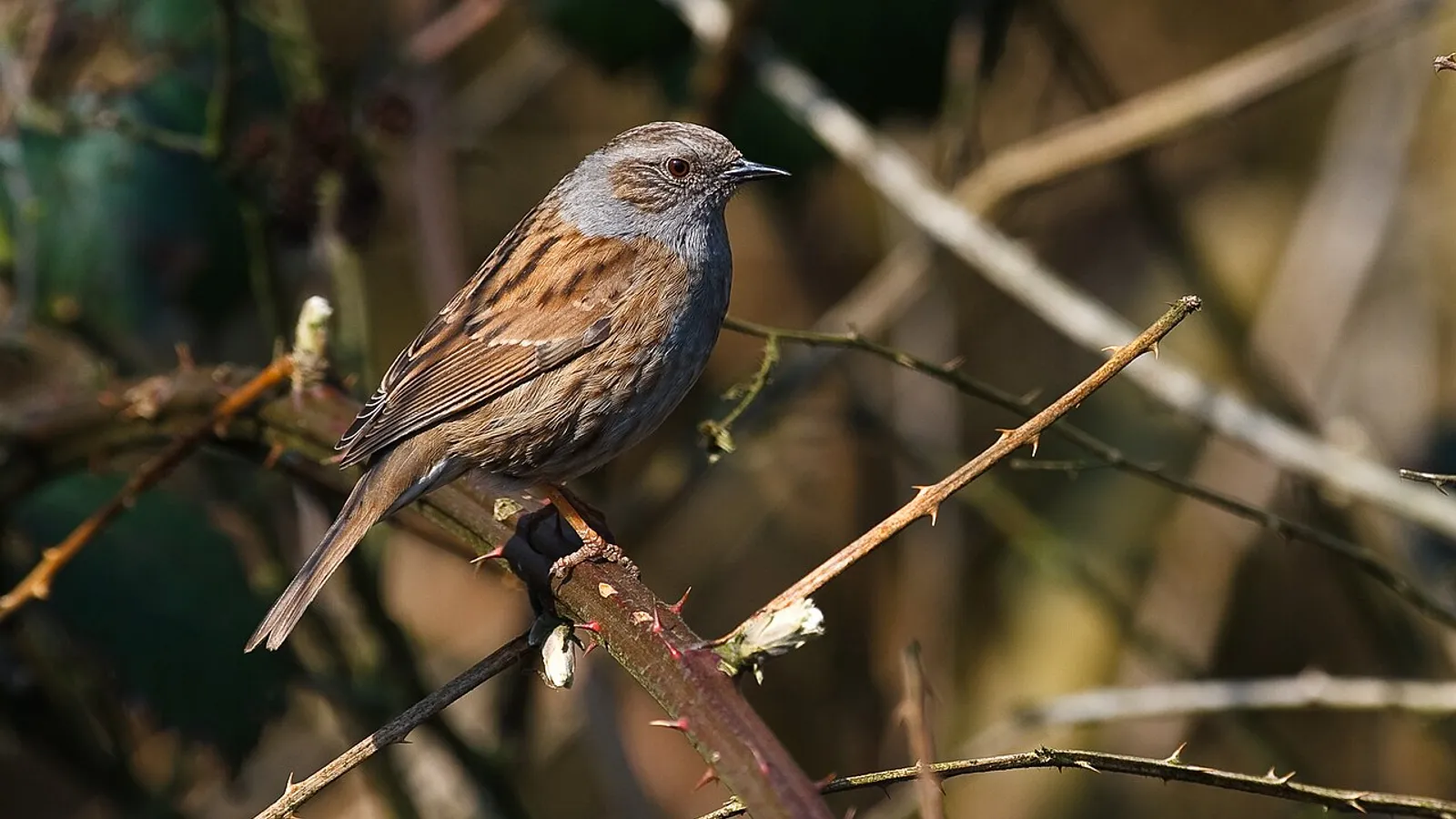
Dunnock
Prunella modularis
— Where the name comes from
Prunella is the Latinised diminutive of the German Braunelle, “little brown one”. Modularis comes from the Latin modulari, “to sing, to modulate”, for its warbling song. It is not a sparrow but an accentor, of a family of its own; the Italian scopaiola comes from scope, the heather shrubs where it often hides.
— Facts
- Group
- Birds · Aves
- Order
- Passerines
- Habitat
- Undergrowth, mountain scrub, hedges, gardens
- Range
- Europe and western Asia; in Italy it breeds in the mountains and winters everywhere
- Size
- 13–14 cm, 16–25 g
- Diet
- Insects and spiders in summer, small seeds in winter
- Lifespan
- A few years, about 11 the record
— Characteristics
- 01
It is brown and grey, unobtrusive, and easily mistaken for a sparrow.
- 02
It forages on the ground with nervous little steps, creeping among the leaves.
- 03
During courtship it flicks its wings, one at a time.
— What sets it apart
Behind a nondescript look it hides an extremely complicated love life. In the 1980s the ecologist Nick Davies studied it in the Cambridge Botanic Garden and found in a single population monogamous pairs, females with two males, males with two females, and groups of several males and several females. When two males share a female, each one, before mating, pecks at her cloaca until she ejects the rival’s sperm. The males then help feed the chicks in proportion to how much access they had to the female.