Great grey shrike
Lanius excubitor
— Where the name comes from
Lanius in Latin means “butcher”, and it is the name of the whole shrike genus. Excubitor is the “sentinel”, the soldier on watch: it spends hours at the top of a lone tree or a post, keeping an eye on the ground around it.
— Facts
- Group
- Birds · Aves
- Order
- Passerines
- Habitat
- Open country with scattered trees, heath, bogs, woodland edges
- Range
- Northern and central Europe, Asia; rare in Italy in winter
- Size
- 22–26 cm, 48–81 g
- Diet
- Large insects, voles, small birds, lizards
- Lifespan
- A few years
— Characteristics
- 01
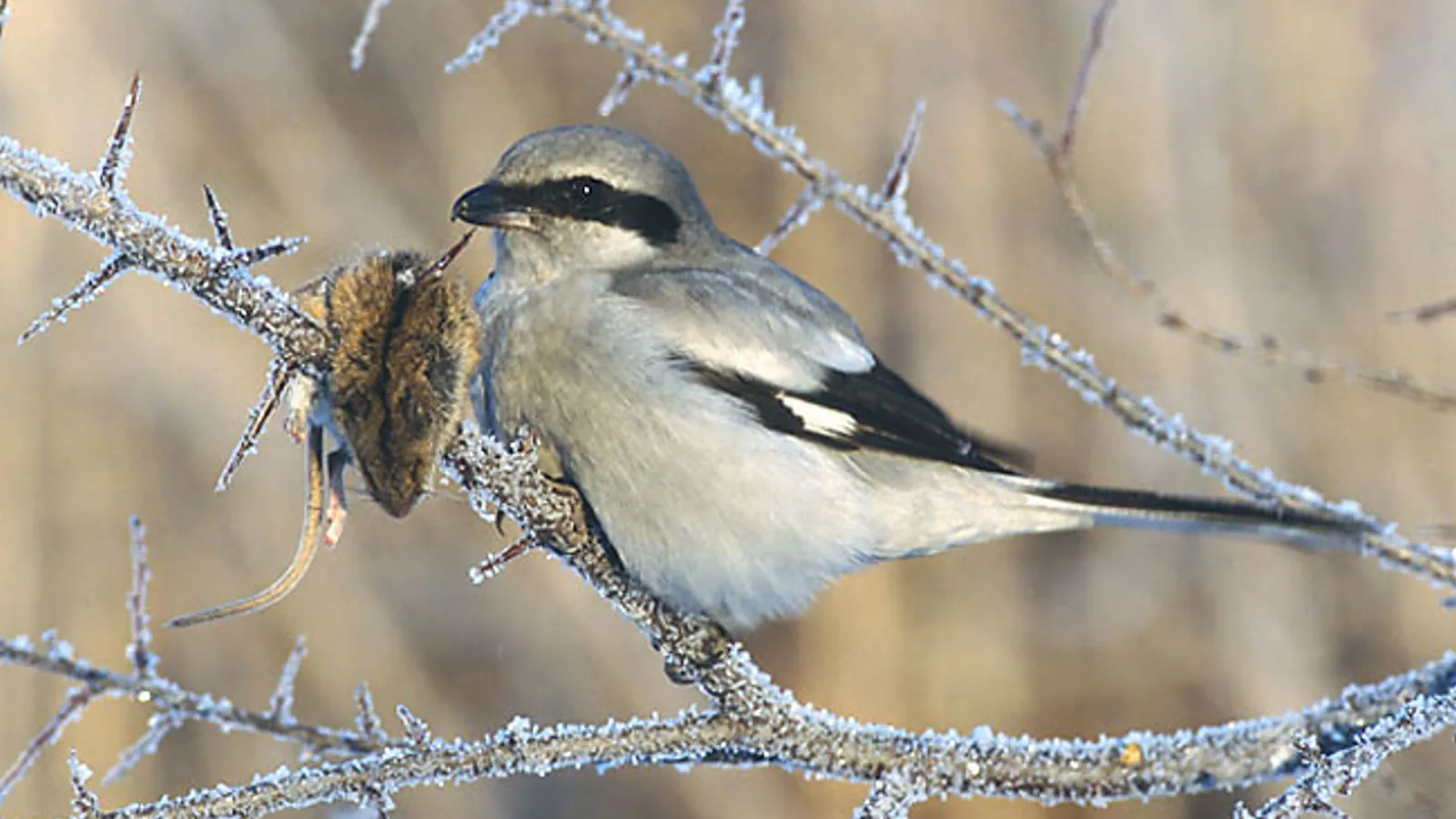
It has a black mask over its eyes and a hooked bill like a raptor’s.
- 02
It hunts from a perch and sometimes hovers like a kestrel.
- 03
It impales its prey on thorns and barbed wire.
— What sets it apart
It has a raptor’s bill but a sparrow’s feet, too weak to hold prey still while it tears it apart. It has solved the problem by using the landscape as a vice: it impales voles, lizards and large insects on bramble thorns and barbed-wire spikes, and tears them by pulling. Those same thorns become larders, where the prey hang for days. In an American species it has been seen that poisonous grasshoppers are left impaled for a couple of days before being eaten, the time it takes for the toxins to break down.