King bird-of-paradise
Cicinnurus regius
— Where the name comes from
Cicinnurus joins the Greek kíkinnos, “curl”, and ourá, “tail”: from the tail spring two long, thin wires ending in two coiled emerald-green discs. Regius means “royal”. The Italian paradisea comes from the name European merchants gave these birds: the skins arrived without legs, and people believed they lived on the wing, in paradise.
— Facts
- Group
- Birds · Aves
- Order
- Passerines
- Habitat
- Lowland rainforest and forest edges
- Range
- New Guinea, the Aru Islands, Salawati and Misool
- Size
- 16 cm without the tail wires, about 50 g
- Diet
- Fruit, insects and other arthropods
- Lifespan
- Not precisely known
— Characteristics
- 01
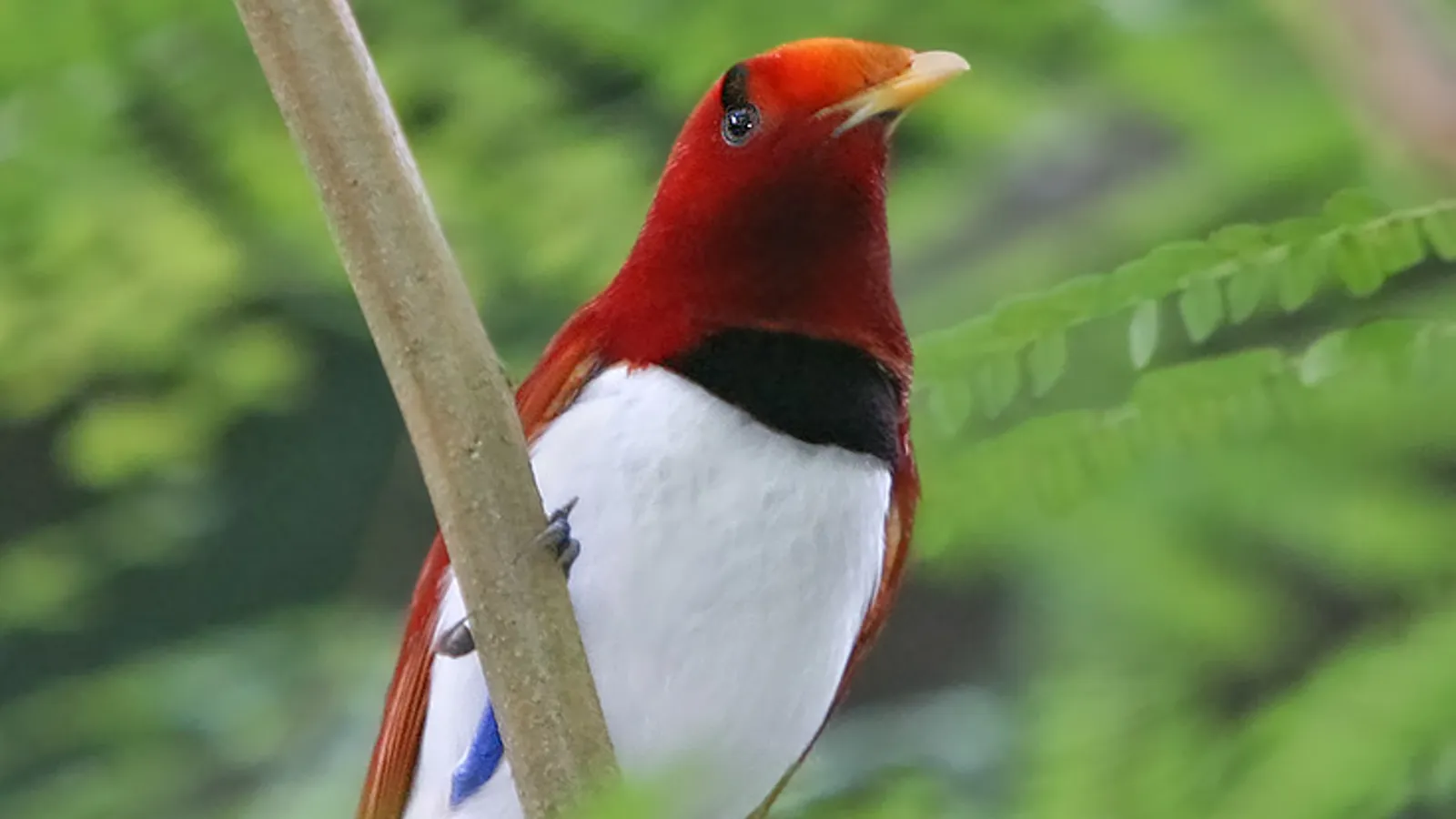
The male is crimson with a white breast and cobalt-blue legs.
- 02
It is the smallest bird-of-paradise.
- 03
In display it hangs upside down and swings its tail wires.
— What sets it apart
It was the first bird-of-paradise Alfred Russel Wallace saw alive, in the Aru Islands in 1857, and in his book The Malay Archipelago he described the thrill of holding a bird no European had ever observed in the wild. He also reflected on how strange it was that such beauty should live and die in the forests for thousands of years with no one to look at it. In display the male puffs out two fans of grey-green feathers at the sides of his breast, opens his wings, and then lets himself dangle upside down from the branch, swinging the two emerald discs of his tail.