
Sunda pangolin
Manis javanica
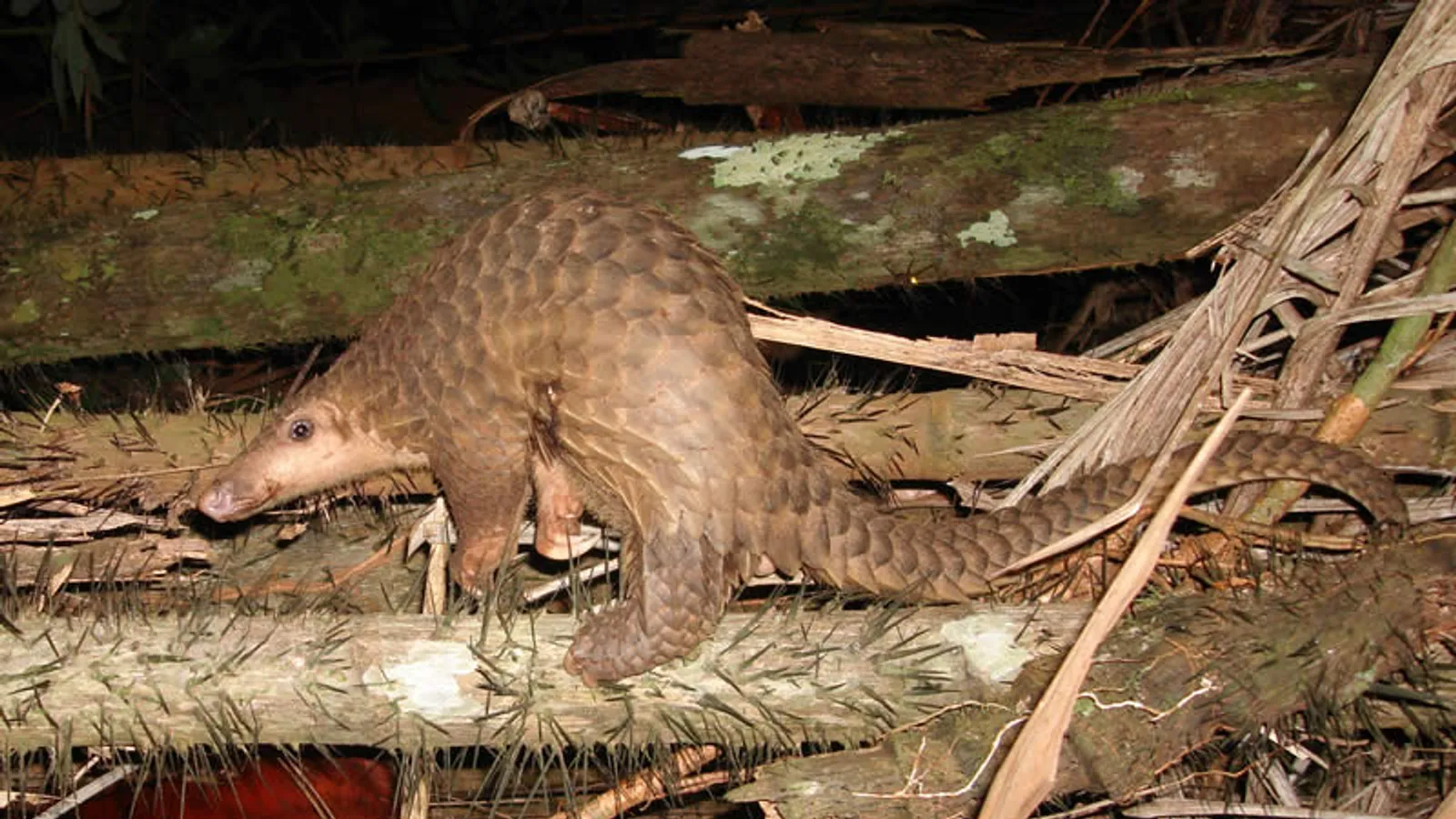
— Where the name comes from
Manis comes from the Latin manes, the spirits of the dead: Linnaeus chose that name for a nocturnal, silent animal of spectral appearance. Pangolin comes instead from the Malay peng-guling, “the one that rolls up” — which is exactly what it does when threatened, closing into a sphere no predator can prise open. Javanica names Java.
— Facts
- Group
- Mammals · Mammalia
- Order
- Pangolins
- Habitat
- Primary and secondary forest, plantations, gardens
- Range
- South-East Asia: Thailand, Malaysia, Indonesia, Vietnam, Laos
- Size
- 40–65 cm of body plus a nearly equal tail, 4.5–14 kg
- Diet
- Insectivore — ants and termites, up to seventy million a year
- Lifespan
- Unknown in the wild, over 19 years in captivity
— Characteristics
- 01
The scales are keratin, the same substance as our nails and hair.
- 02
It has no teeth: it swallows pebbles that grind the insects in a muscular stomach.
- 03
Its tongue is longer than its body and anchors to the pelvis, not to the hyoid bone.
— What sets it apart
It is the most trafficked mammal in the world, and the reason is a chemical superstition: its scales are made of keratin, that is of exactly the same substance as our fingernails, and eating them has the therapeutic value of eating one’s own fingers. On that misunderstanding rests a trade that has taken over a million animals in a decade. The perfect defence against a leopard — rolling into an armoured ball — becomes, faced with a human being, the easiest way to be picked up off the ground.
