
Common hermit crab
Pagurus bernhardus
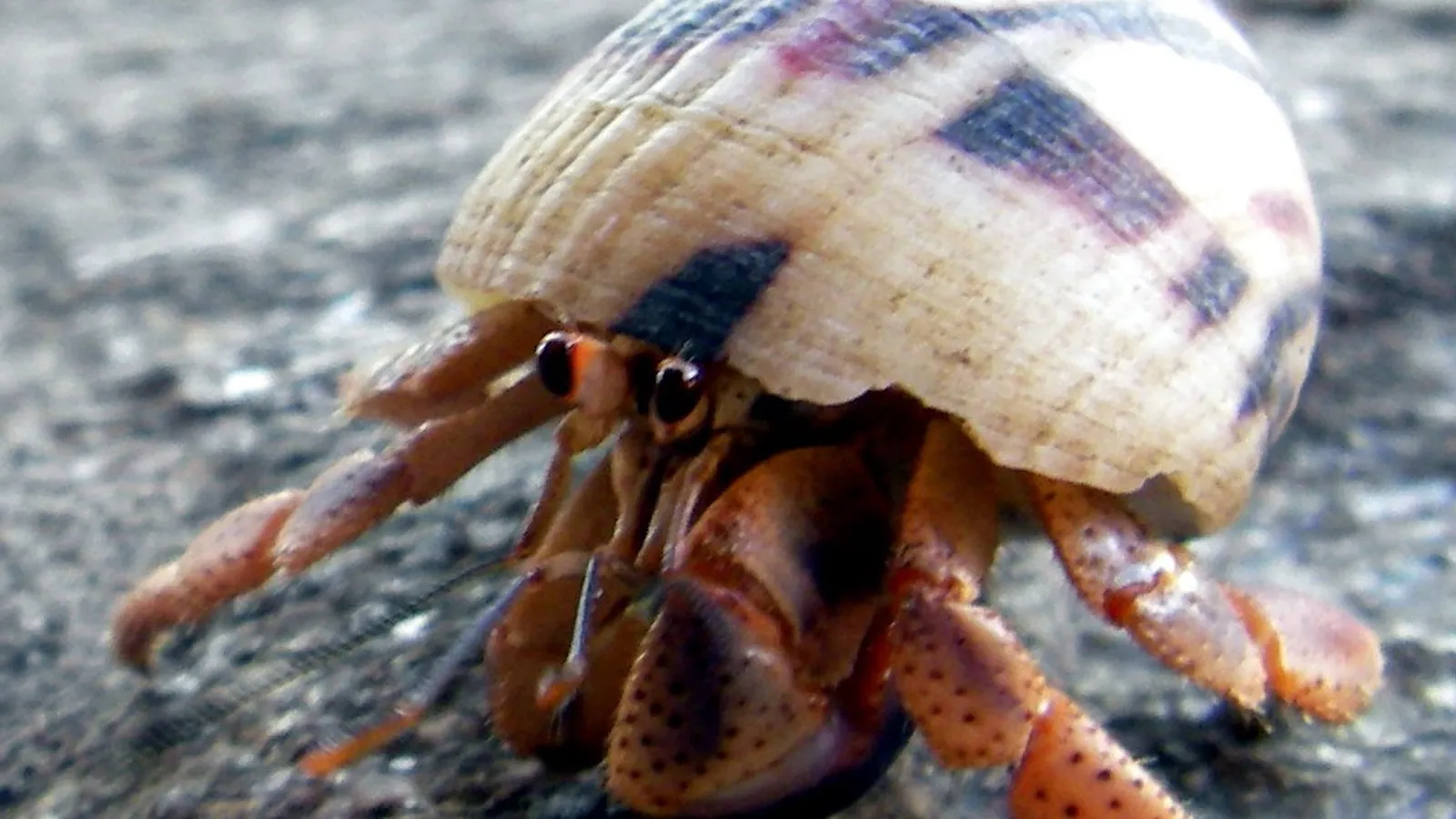
— Where the name comes from
Pagurus comes from the Greek págouros, a hard-shelled crab. Bernhardus is Saint Bernard, and with him the idea of the hermit enters the name: in English it is the hermit crab, in French bernard-l’ermite, in Italian bernardo l’eremita. The animal that lives alone in a borrowed cell was christened with the vocabulary of monks, and the same image occurred to half of Europe.
— Facts
- Group
- Crustaceans · Malacostraca · Maxillopoda
- Order
- Crabs, lobsters and shrimps
- Habitat
- Sandy and rocky coastal bottoms, down to 140 metres
- Range
- North-eastern Atlantic, North Sea, western Mediterranean
- Size
- Up to 10 cm
- Diet
- Detritus, carrion, small invertebrates
- Lifespan
- Up to 10 years
— Characteristics
- 01
The abdomen is soft, asymmetrical and curved to fit the shell’s whorls.
- 02
It changes house as it grows, trying the empty shells it finds.
- 03
It often carries a sea anemone that defends it in exchange for transport.
— What sets it apart
When shells are scarce they form a queue. If a hermit crab finds one too large for itself, it waits beside it; another arrives, and another, and they line up by decreasing size holding on to one another — until one turns up big enough for the vacant shell. At that moment they all move house at once, each into the shell left by the one ahead, and in seconds the queue empties. Biologists call it a vacancy chain, and it is one of the few synchronised property markets in the animal kingdom.
