
Great bustard
Otis tarda
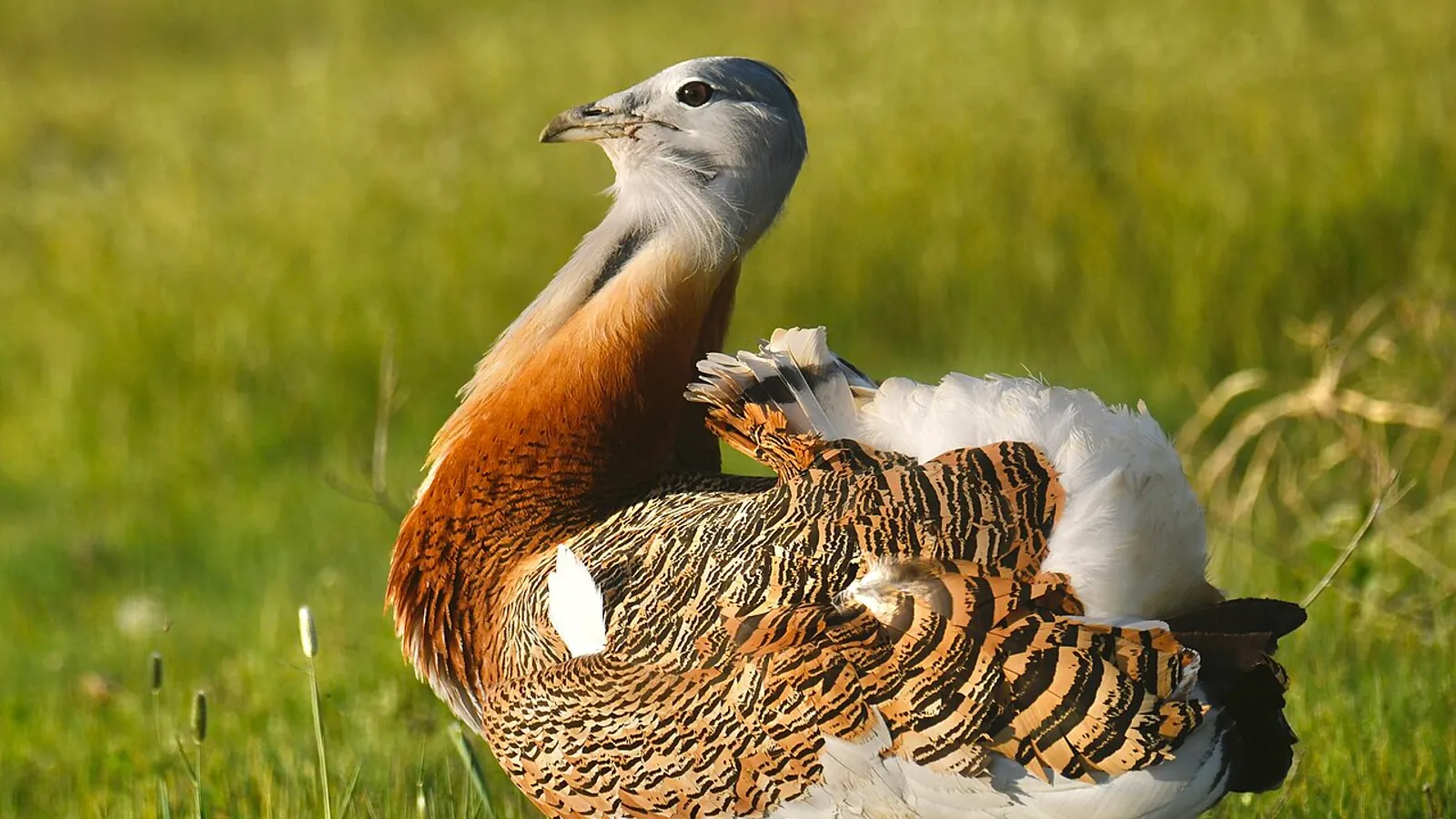
— Where the name comes from
Pliny called it avis tarda, “the slow bird”, and from that contracted pair of words come the Italian otarda, the Spanish avutarda and the French outarde. The judgement was wrong: it walks slowly, but it is the heaviest flying animal in the world and in the air it moves at a considerable speed. Otis is the Greek name of the same species.
— Facts
- Group
- Birds · Aves
- Order
- Bustards
- Habitat
- Steppe, extensive cereal farming, open pasture
- Range
- Iberia, central and eastern Europe, Asia as far as Mongolia
- Size
- 90–105 cm, wingspan 210–250 cm, males 10–16 kg
- Diet
- Grasses, legumes, seeds, insects, small vertebrates
- Lifespan
- 15 years in the wild
— Characteristics
- 01
The male weighs two or three times as much as the female.
- 02
In display he turns his plumage inside out and becomes a white ball.
- 03
It never perches in a tree: it lives and nests entirely on the ground.
— What sets it apart
The males medicate themselves, with a poison. In spring they eat blister beetles of the genus Meloe, insects containing cantharidin — the substance of so-called Spanish fly, toxic in minute doses — and they do so far more than the females and precisely in the weeks when they must display. The hypothesis, supported by droppings analysis, is that they use it to clear their guts of parasites and present themselves at the lek in better condition: an animal that accepts a little poisoning in order to look healthier than it is.
