
Virginia opossum
Didelphis virginiana
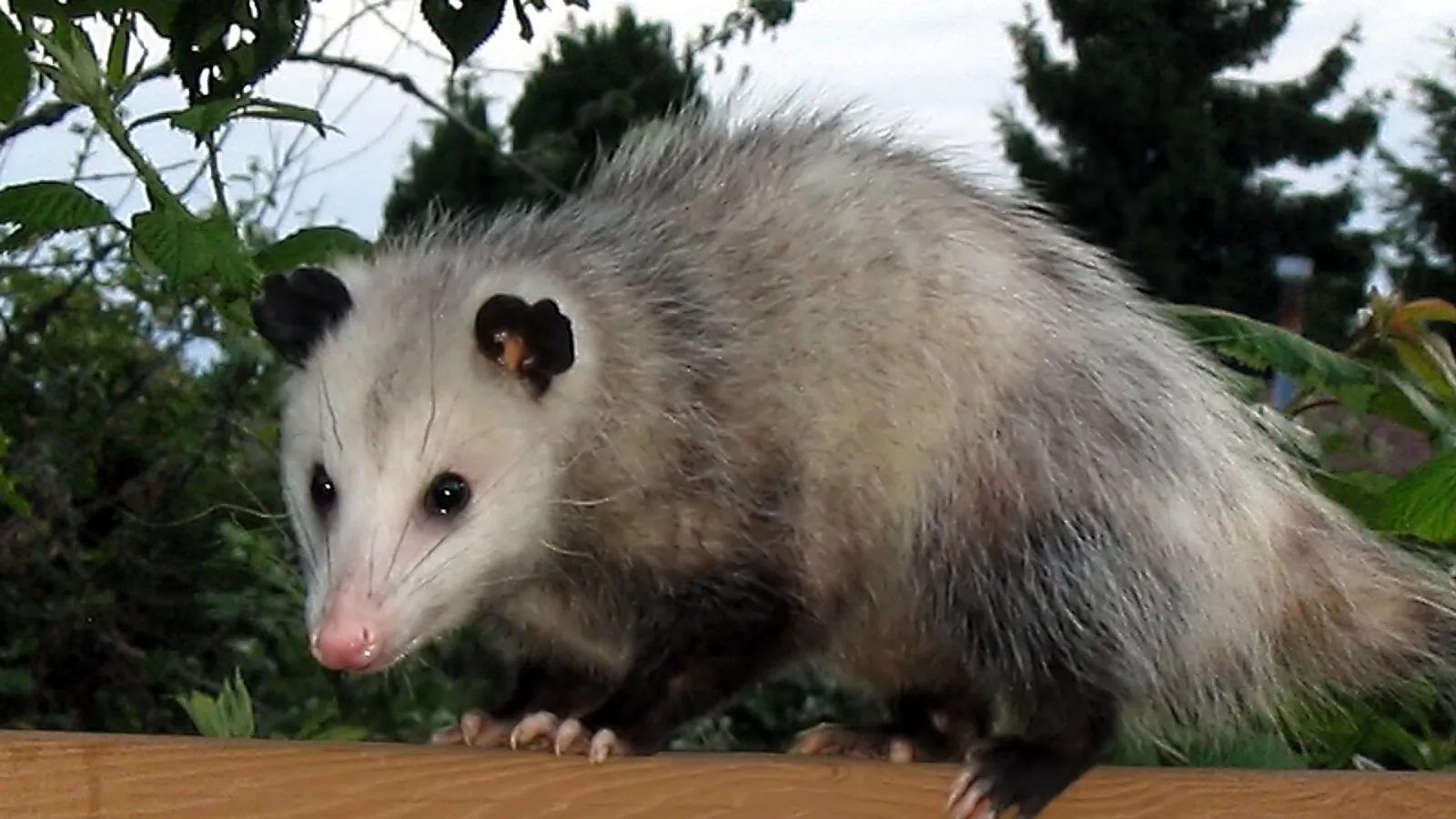
— Where the name comes from
Didelphis is Greek, di-, “double”, and delphýs, “womb”: female marsupials do indeed have two uteri and two lateral vaginas, and Linnaeus caught the fact in the name. Opossum comes instead from the Powhatan Algonquian apasum, “white animal”: it was one of the first indigenous American words to enter English, recorded by the Virginia colonists as early as 1610.
— Facts
- Group
- Mammals · Mammalia
- Order
- American opossums
- Habitat
- Woodland, fields, wetlands, suburbs and city centres
- Range
- North America, from Costa Rica to southern Canada, spreading northwards
- Size
- 35–50 cm long plus 25–35 of tail, 2–6 kg
- Diet
- Omnivore — insects, carrion, fruit, eggs, refuse
- Lifespan
- 2–4 years
— Characteristics
- 01
It is the only marsupial living north of Mexico.
- 02
It has fifty teeth, more than any other land mammal in North America.
- 03
Its blood contains a protein that neutralises the venom of many snakes, rattlesnakes included.
— What sets it apart
Playing dead is not an act. Faced with a serious threat the opossum enters an involuntary catatonic state: it falls onto its side, stiffens its legs, the mouth stays open and the anal glands release a fluid that smells of carrion. It cannot break off the performance at will — it lasts from a few minutes to several hours, and meanwhile the animal is vulnerable to everything. Its best defence is a faint it does not control, and it works because almost no predator eats what it finds already dead.
