
Greylag goose
Anser anser
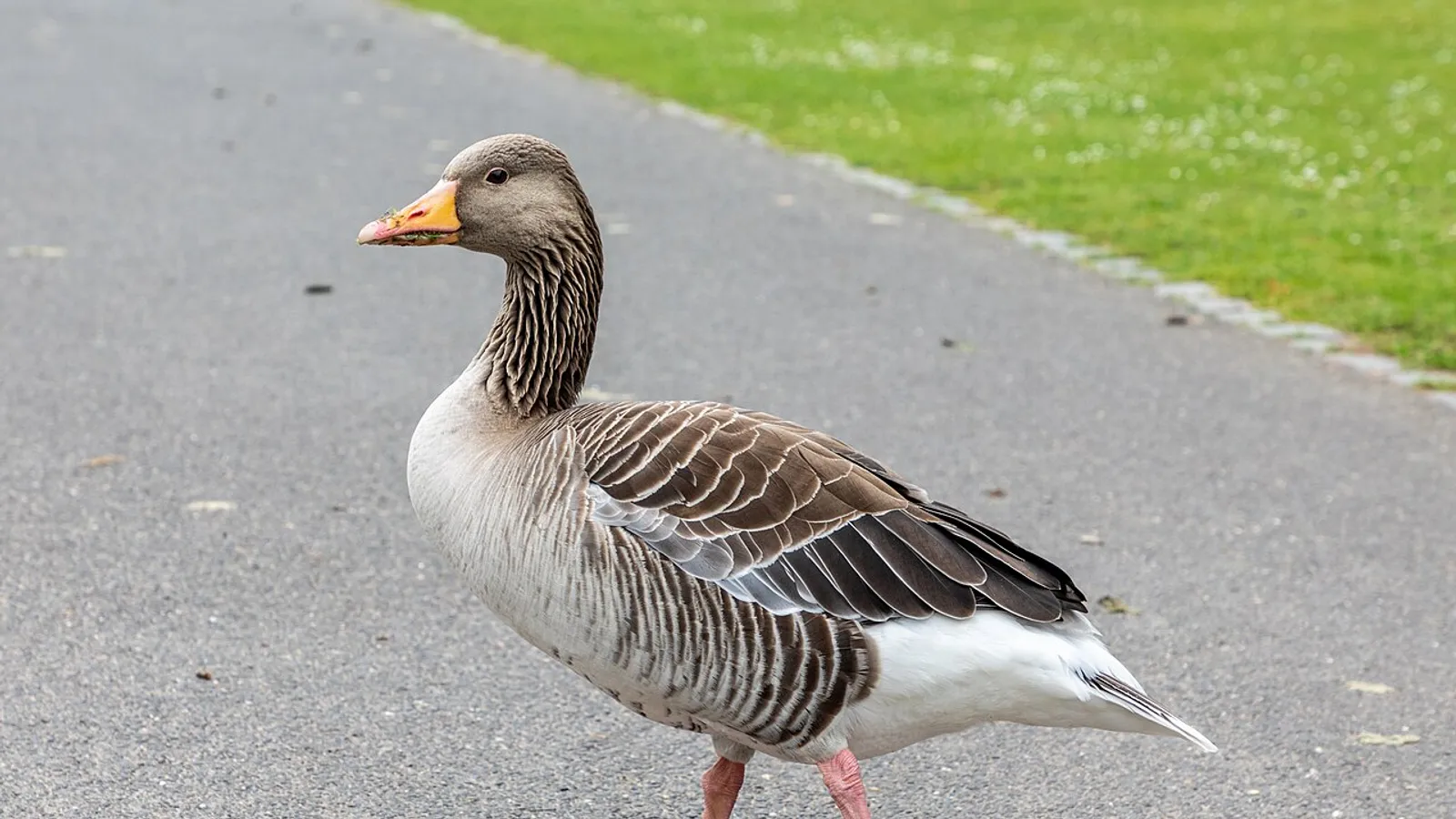
— Where the name comes from
Anser is the goose in Latin, from the same Indo-European root as the Greek chḗn, the German Gans and the English goose: a word that has come through five thousand years almost unchanged, a sign that this animal has lived near human houses since long before written history. The binomial repeats it twice, as Linnaeus did with species he regarded as the founders of their genus.
— Facts
- Group
- Birds · Aves
- Order
- Waterfowl
- Habitat
- Marshes, lakes, reedbeds, flooded meadows, stubble fields
- Range
- Europe and temperate Asia; winters around the Mediterranean and in southern Asia
- Size
- 74–91 cm, wingspan 149–168 cm, 2.5–4.1 kg
- Diet
- Grasses, roots, shoots, cereals
- Lifespan
- 17 years in the wild
— Characteristics
- 01
It is the ancestor of nearly all domestic geese.
- 02
It flies in a V, the birds taking turns at the front.
- 03
Pairs last for life and the young stay with their parents for a year.
— What sets it apart
Konrad Lorenz spent his life with these geese and drew from them the idea of imprinting: a gosling just out of the egg follows the first moving thing it sees and treats it as its mother for ever, even if that thing is a man in rubber boots. The photographs of Lorenz swimming in an Austrian lake with a line of geese behind him went round the world and won him a Nobel Prize. Two thousand years earlier, according to Livy, it had been the geese sacred to Juno that saved the Capitol from the Gauls by waking the garrison with their racket.
