Barnacle goose
Branta leucopsis
— Where the name comes from
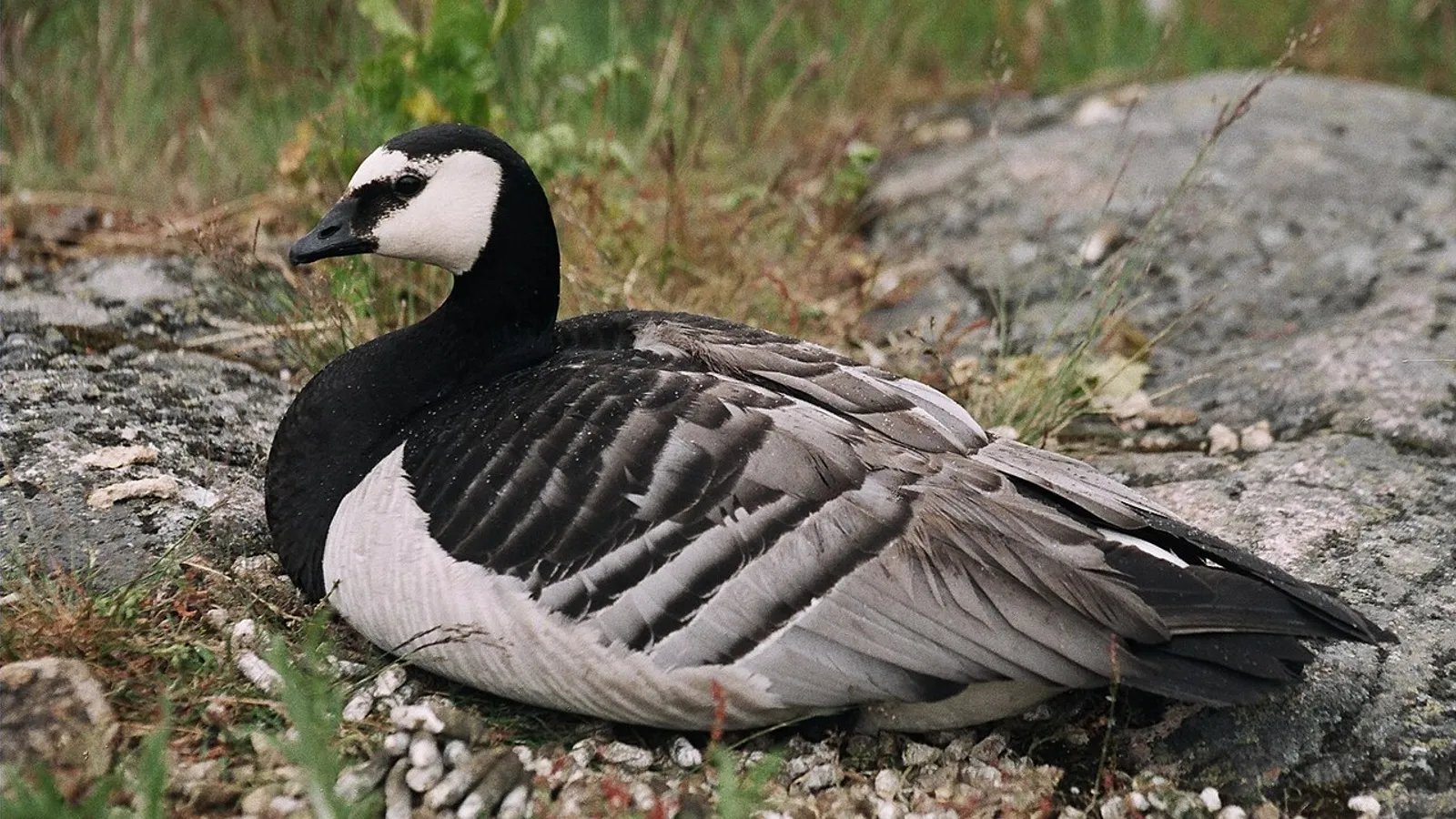
Branta is the Latinised form of an Old Norse name, brandgás, “burnt goose”, for its black neck and breast. Leucopsis is Greek, leukós, “white”, and ópsis, “face”, like the Italian facciabianca. In English it is the barnacle goose, and behind that name lies one of the strangest beliefs of the Middle Ages.
— Facts
- Group
- Birds · Aves
- Order
- Waterfowl
- Habitat
- Arctic cliffs for nesting; coastal grassland and pasture in winter
- Range
- Greenland, Svalbard and the Russian Arctic; winters in Scotland, Ireland, the Netherlands and Germany
- Size
- 58–70 cm, wingspan 130–145 cm, 1.2–2.2 kg
- Diet
- Grasses, leaves, roots, seeds
- Lifespan
- Up to 25 years
— Characteristics
- 01
It nests on cliff ledges to escape Arctic foxes and bears.
- 02
A few days after hatching the goslings leap into the void to reach the grazing grounds.
- 03
It travels in noisy flocks that yap like distant dogs.
— What sets it apart
In the Middle Ages nobody had ever seen its nest, because it breeds in the Arctic, and people believed it grew from barnacles, the shelled crustaceans clinging to drifting timber, whose feathery filaments really did look like little birds in formation. In the twelfth century Gerald of Wales swore he had seen hundreds of them hanging from a log. The legend had a practical advantage: a goose born of the sea was not meat, and could be eaten in Lent. In 1215 Pope Innocent III had to forbid it explicitly.