
Greater rhea
Rhea americana
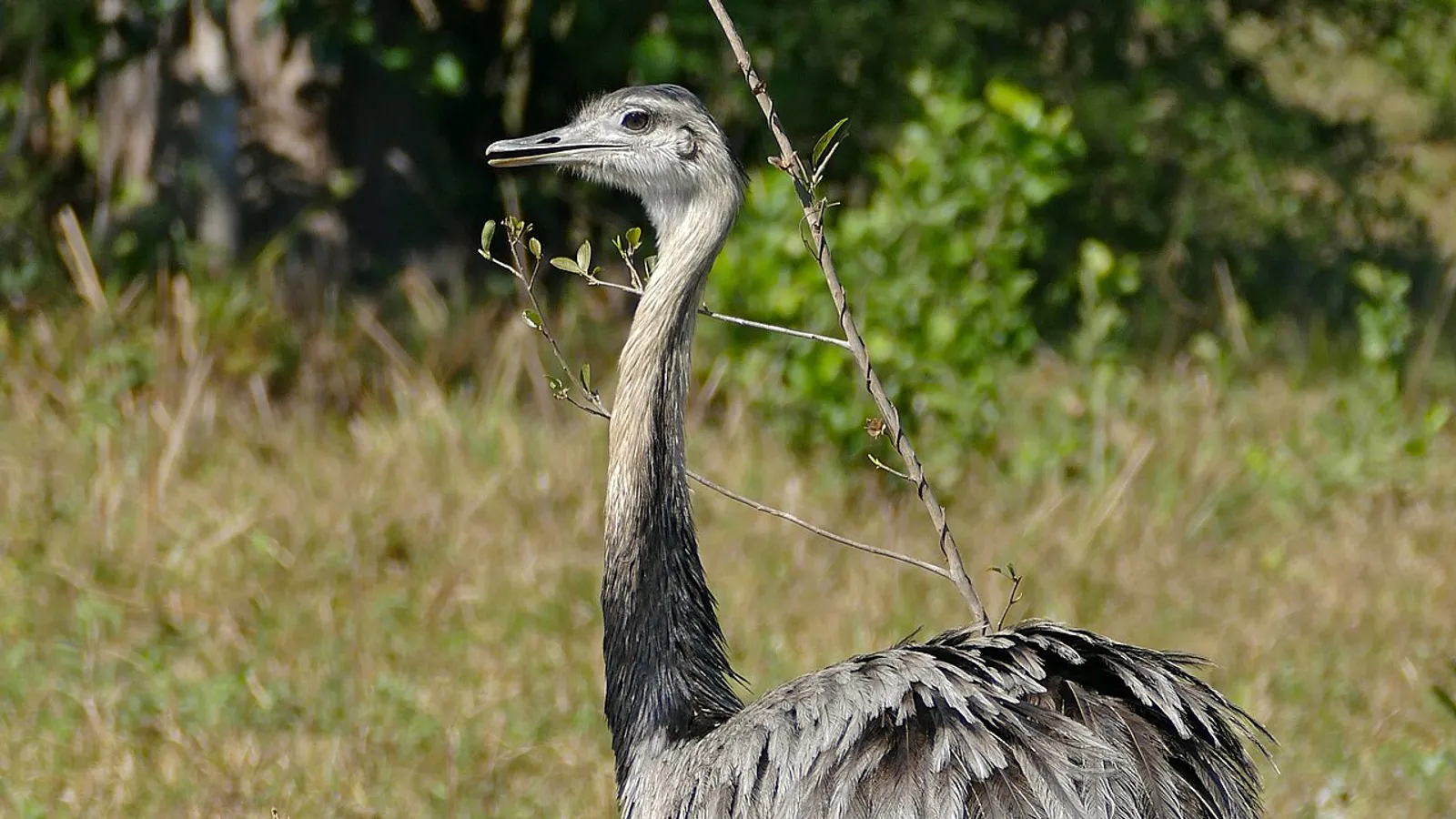
— Where the name comes from
Rhea is the Titaness who was mother to Zeus, and the naturalist who gave the genus her name in 1752 did not say why: it is one of the most illustrious and least justified scientific names in existence. The common name comes instead from the Guaraní ñandú, and it is what this animal has carried from the beginning, long before anyone arrived with Greek mythology in his luggage.
— Facts
- Group
- Birds · Aves
- Order
- Rheas
- Habitat
- Pampas, open savannah, farmland
- Range
- Brazil, Bolivia, Paraguay, Uruguay, Argentina
- Size
- 130–170 cm tall, 20–27 kg
- Diet
- Broad leaves, seeds, roots, insects, small vertebrates
- Lifespan
- 15 years in the wild
— Characteristics
- 01
It runs at sixty kilometres an hour, using its wings as rudders.
- 02
It has three toes on each foot, against the ostrich’s two.
- 03
It swallows stones and even metal objects, which stay in the gizzard.
— What sets it apart
The male does the whole of family life. He courts a group of females, scrapes a hollow in the ground and persuades them to lay in it one after another, then drives them off: he incubates up to fifty eggs that are not his for six weeks and raises the chicks alone for half a year, becoming so aggressive that he keeps even the mothers away. The females meanwhile go to another male and start again. It is one of the most inverted breeding systems among birds, and it has worked for millions of years.
