
Reeves's muntjac
Muntiacus reevesi
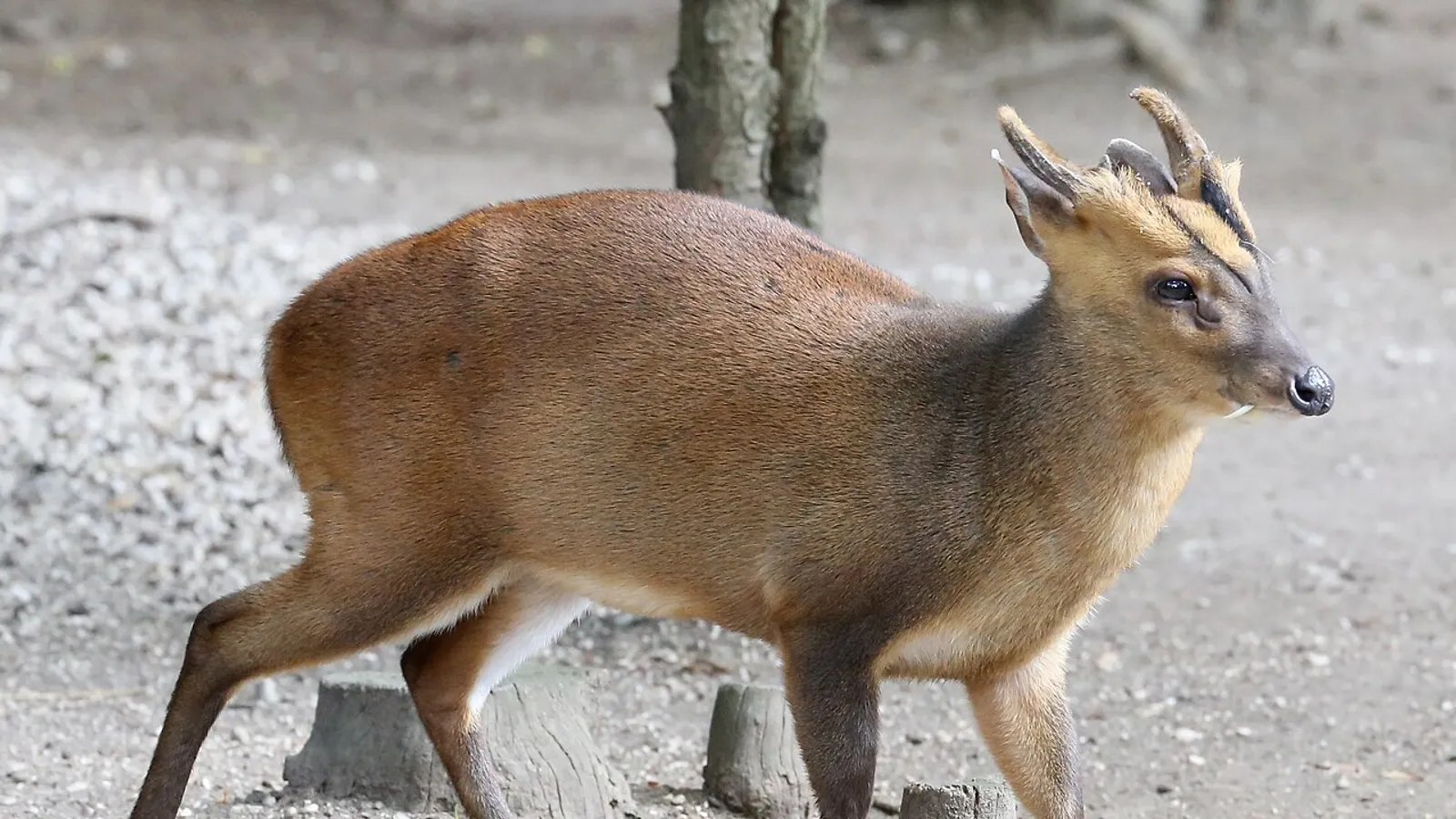
— Where the name comes from
Muntiacus latinises muncang, the Sundanese name of the animal in Java. Reevesi recalls John Reeves, a tea inspector for the East India Company at Canton in the 19th century, who sent hundreds of Chinese drawings and specimens to England. The English name, barking deer, describes the call: a dry repeated bark that can go on for an hour.
— Facts
- Group
- Mammals · Mammalia
- Order
- Even-toed ungulates
- Habitat
- Dense undergrowth, bushland, scrub, suburban gardens
- Range
- South-eastern China and Taiwan; naturalised in Britain since 1925
- Size
- 70–113 cm of body, 10–18 kg
- Diet
- Herbivore — shoots, leaves, fruit, fungi, bark
- Lifespan
- 12–13 years
— Characteristics
- 01
The male has tiny antlers on long bony pedicles and, in addition, two protruding canines.
- 02
It has no breeding season: females can conceive at any time of year.
- 03
It belongs to a very ancient lineage: muntjacs are among the most primitive living deer.
— What sets it apart
It holds both the lowest and the highest chromosome count in the same genus. This species has 46; the Indian muntjac, its very close relative, has 6 in the female and 7 in the male — the absolute minimum among all mammals. The two animals resemble one another closely enough to be confused in the field, and their genomes hold the same information packed in radically different ways, because in the Indian muntjac the chromosomes have fused in series. It is the textbook example of how little chromosome number tells us about a species.
