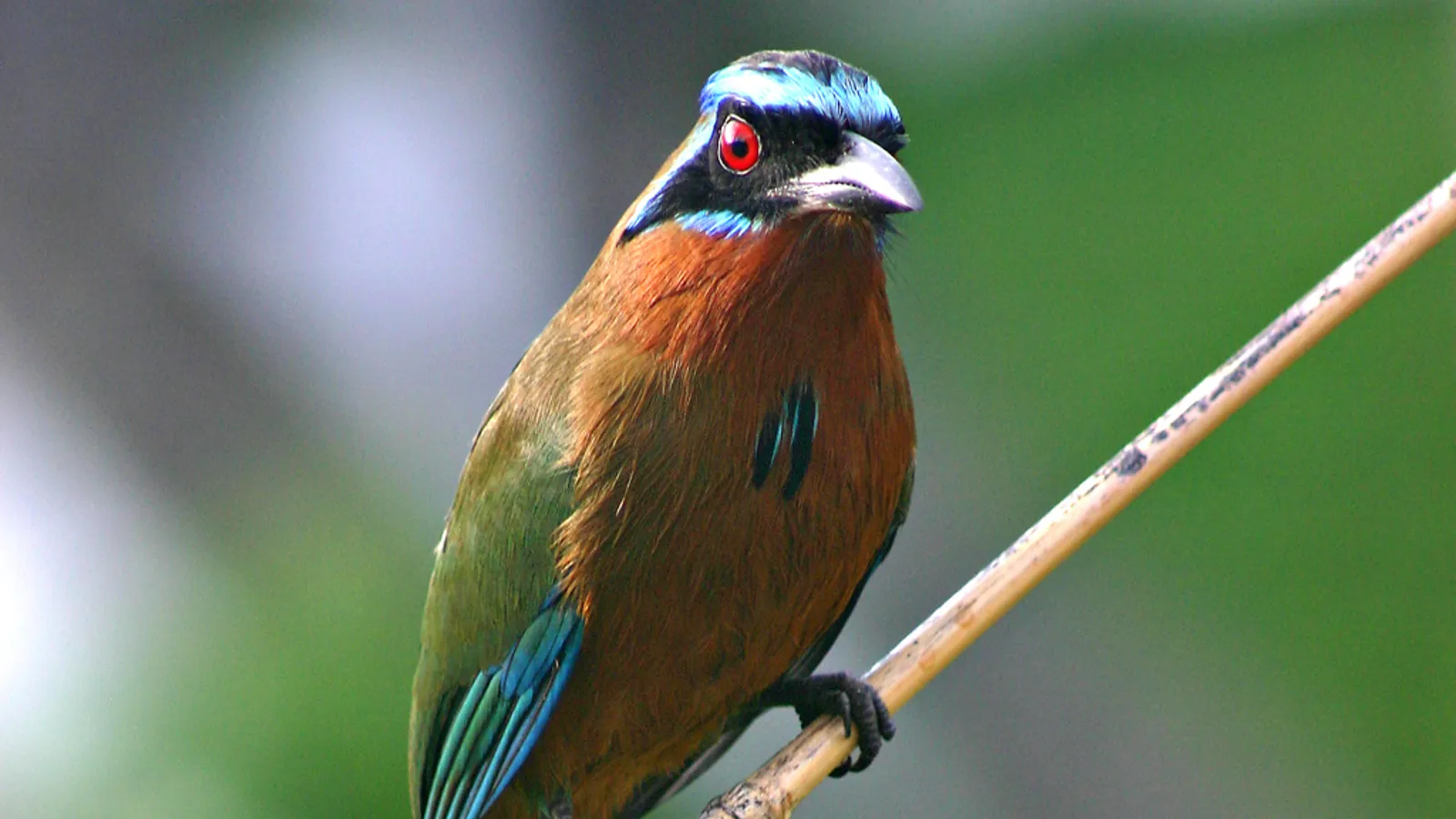
Amazonian motmot
Momotus momota
— Where the name comes from
Momotus and motmot both come from the call, a low, hollow double hoot that in the forest sounds like “mot-mot”. It is one of the rare cases in which the scientific name is pure onomatopoeia, and the binomial repeats it twice, as if imitating the call.
— Facts
- Group
- Birds · Aves
- Order
- Rollers and kingfishers
- Habitat
- Rainforest and humid woodland, plantations too
- Range
- South America, above all the Amazon basin
- Size
- 38–43 cm including tail, 100–150 g
- Diet
- Large insects, lizards, frogs, fruit
- Lifespan
- Over 10 years in captivity
— Characteristics
- 01
The two central tail feathers end in a bare-shafted paddle, like two rackets.
- 02
It swings its tail back and forth like a pendulum.
- 03
It nests in tunnels dug into the ground.
— What sets it apart
For a long time the motmot was believed to pluck the barbs from its tail feathers to make the rackets. It does not: the barbs on that stretch are weakly attached and fall off on their own through rubbing and preening. The swinging of the tail has a precise meaning too: in a related species it has been shown that the motmot wags it when it spots a predator, as if telling it “I have seen you, there is no point trying”.