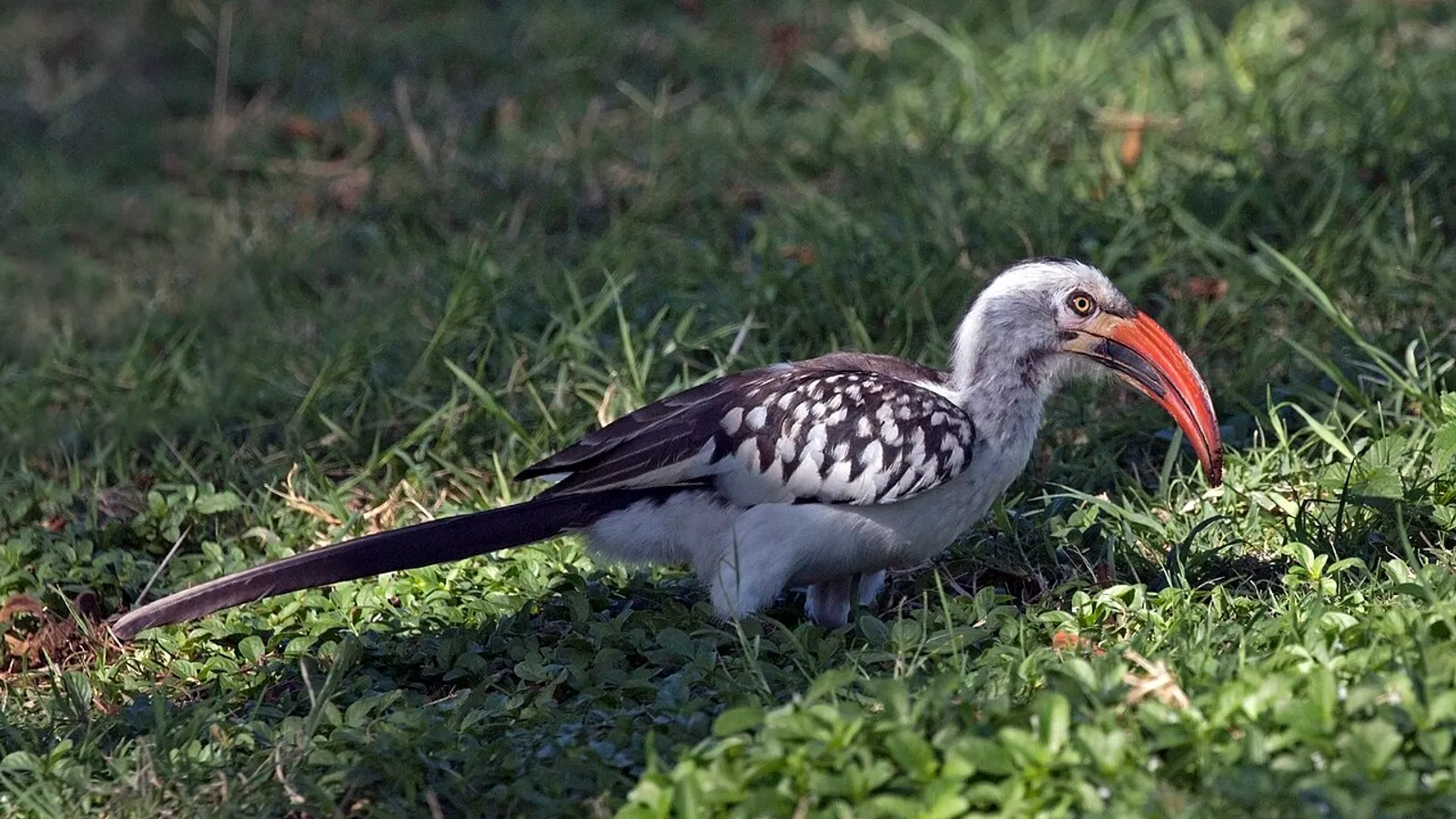
Northern red-billed hornbill
Tockus erythrorhynchus
— Where the name comes from
Tockus comes from the call, a series of ever-faster “tok-tok” notes with which the pair answer each other. Erythrorhynchus is Greek, erythrós, “red”, and rhýnchos, “beak”. The Italian buceretto is the diminutive of bucero, hornbill: one of the smallest hornbills, a relative of the great hornbill but with a bill that has no casque.
— Facts
- Group
- Birds · Aves
- Order
- Hornbills
- Habitat
- Dry savannah, acacia scrub, semi-desert
- Range
- Sub-Saharan Africa, from Senegal to Ethiopia and Tanzania
- Size
- 35–42 cm, 90–200 g
- Diet
- Insects, seeds, small vertebrates, eggs
- Lifespan
- Over 10 years
— Characteristics
- 01
It forages by walking on the ground, rummaging through dung and sand.
- 02
It has a curved red bill, very long for its body.
- 03
Zazu, the king’s adviser in The Lion King, is a red-billed hornbill.
— What sets it apart
The female has herself walled in alive. Having chosen a hole in a tree, she narrows the entrance with mud, chewed food and droppings until only a slit remains, and stays shut inside for weeks: she lays, broods, and meanwhile moults all her flight feathers, which grow back before she comes out. Throughout that time the male feeds her by passing food through the slit, and later feeds the chicks too. When the mother breaks the wall to get out, the young seal it again from inside and wait a little longer.