
Siberian musk deer
Moschus moschiferus
— Where the name comes from
Here the animal’s name has produced a word we all use daily. Moschus comes from the Greek móschos, from the Persian mušk, from the Sanskrit muṣká, meaning “testicle”: the male’s scent pouch resembles a scrotum. From that root descend musk as a perfume, the nutmeg (noce moscata) and the muscat grape and wine. Every time we say “muscat” we are naming, unawares, the gland of a Siberian deer.
— Facts
- Group
- Mammals · Mammalia
- Order
- Even-toed ungulates
- Habitat
- Montane coniferous forest with dense understorey, taiga
- Range
- Southern Siberia, Mongolia, north-eastern China, Korea
- Size
- 86–100 cm of body, 11–18 kg
- Diet
- Herbivore — lichens above all, then needles, leaves, shoots
- Lifespan
- 10–14 years
— Characteristics
- 01
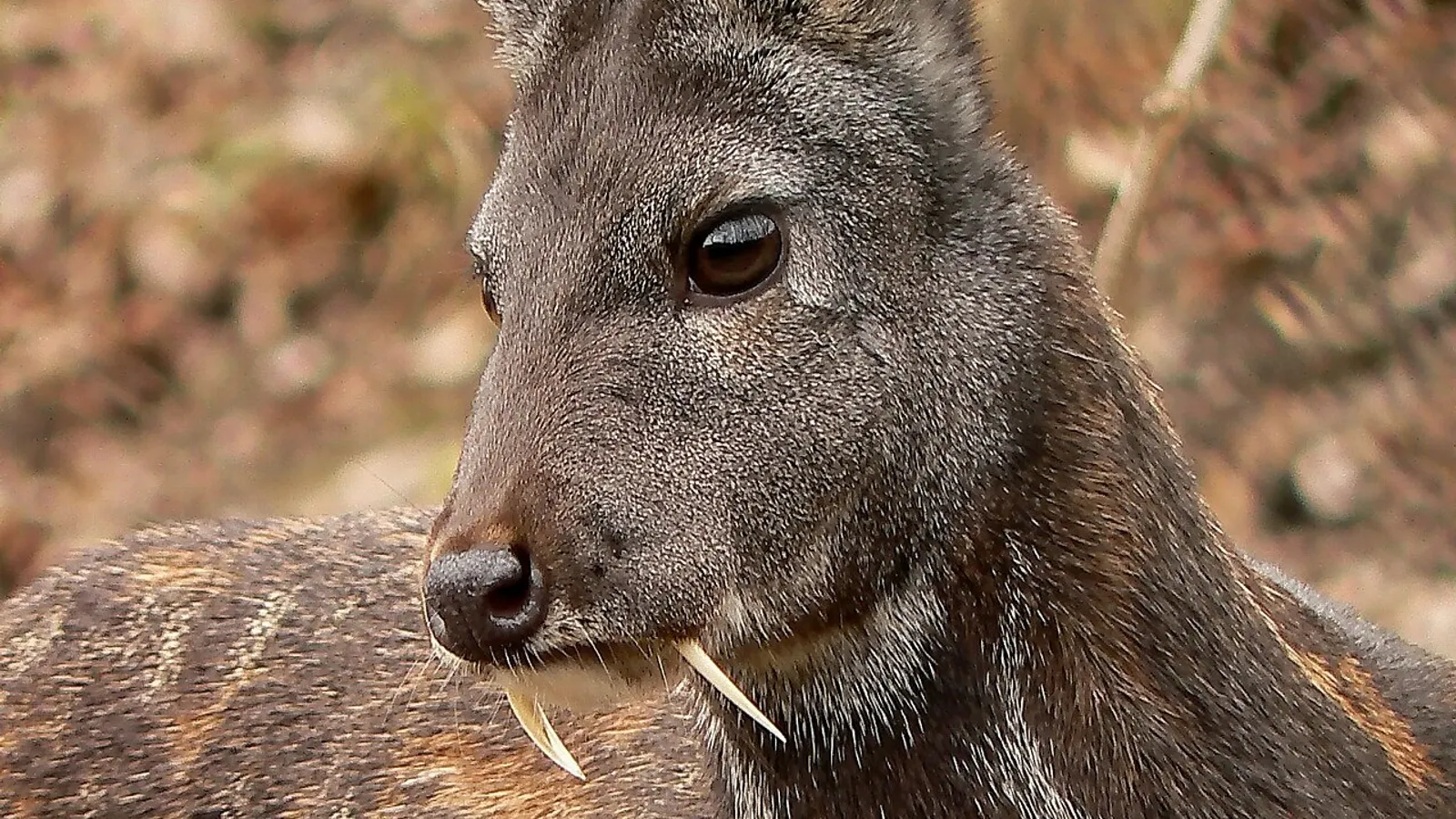
It has no antlers: instead the male has two canines protruding up to ten centimetres.
- 02
It is not a true deer: it belongs to a family of its own, the Moschidae.
- 03
Its hind legs are far longer than the front ones and make it bound like a hare.
— What sets it apart
A kilo of its gland’s secretion has in some years been worth more than a kilo of gold, and to obtain it the male must be killed: the dried grains of forty or fifty animals are needed. Perfumery consumed them in millions for centuries, until chemistry learnt to synthesise the musk molecules — muscone has been made in the laboratory since the 1930s, and no industrial perfume now uses the real thing. Poaching, however, has not stopped: the value has shifted from perfumery to traditional medicine.
