Housefly
Musca domestica
— Where the name comes from
Musca is one of the oldest words Europe possesses: the same imitative root for the hum gives the Greek myîa, the Sanskrit makṣikā, the Lithuanian musė. Nobody invented it by looking at the animal — they invented it by listening to it, and the sound has stayed identical for six thousand years. Domestica adds the only thing it adds: that it lives where we live.
— Facts
- Group
- Insects · Insecta
- Order
- Flies
- Habitat
- Anywhere there are human beings: houses, stables, markets, dumps
- Range
- The whole world, from the tropics to the inhabited polar circles
- Size
- 6–7 mm long, 13–15 mm wingspan
- Diet
- Sugary liquids and decaying organic matter
- Lifespan
- 15–30 days as an adult
— Characteristics
- 01
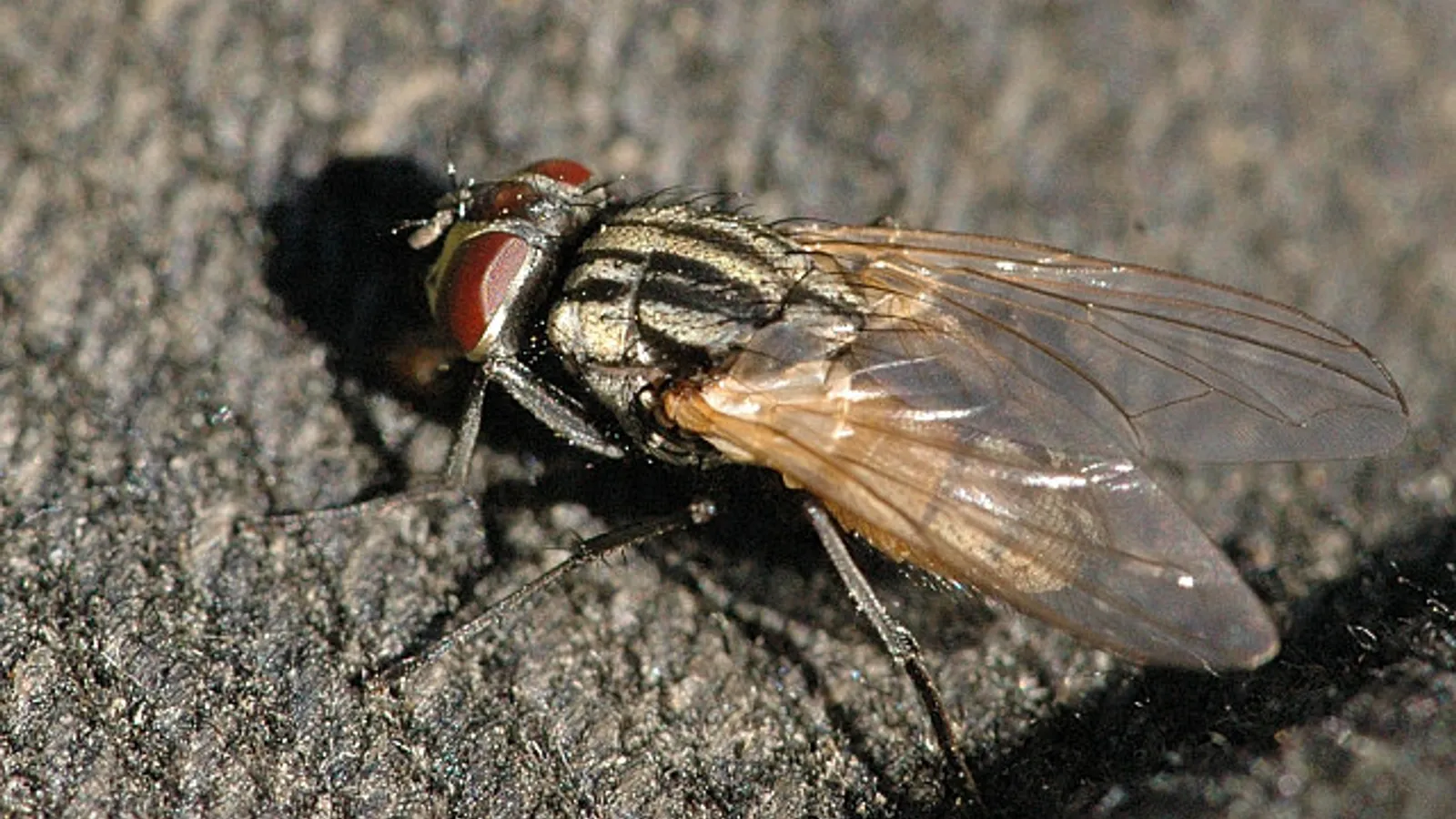
It has no mandibles: it sucks, and dissolves solid food before eating it.
- 02
It tastes with its feet, which carry receptors for flavour.
- 03
A compound eye gives it almost three hundred and sixty degrees of vision.
— What sets it apart
To eat anything solid it must first dissolve it, and it dissolves it by regurgitating saliva and digestive juices onto it: digestion begins outside the body. That is also why it is so efficient at carrying disease — every meal leaves behind a drop of whatever it had in its stomach shortly before. The second pair of wings is gone: it has shrunk into two halteres, tiny clubs that oscillate hundreds of times a second and work as gyroscopes. That is the invention that names the whole order of Diptera, “two wings”, and that lets a fly turn ninety degrees in thirty milliseconds.