
Common fruit fly
Drosophila melanogaster
— Where the name comes from
Drosophila means “dew-lover”, from drósos, dew, and phílos, friend: a charming and mistaken name, because what it loves is not dew but fermenting fruit juice. Melanogaster is “black-bellied”, from mélas and gastḗr. Black-bellied dew-lover sounds like the title of a poem, and is instead the animal on which we worked out how genes function.
— Facts
- Group
- Insects · Insecta
- Order
- Flies
- Habitat
- Ripe or rotting fruit, cellars, kitchens, vineyards
- Range
- Cosmopolitan, originally from sub-Saharan Africa
- Size
- 2.5–3 mm; the female slightly larger than the male
- Diet
- Yeasts growing on fermenting fruit
- Lifespan
- 40–50 days; one generation every ten days
— Characteristics
- 01
It has only four pairs of chromosomes, which is why it became famous.
- 02
It goes from egg to adult in nine or ten days at 25 °C.
- 03
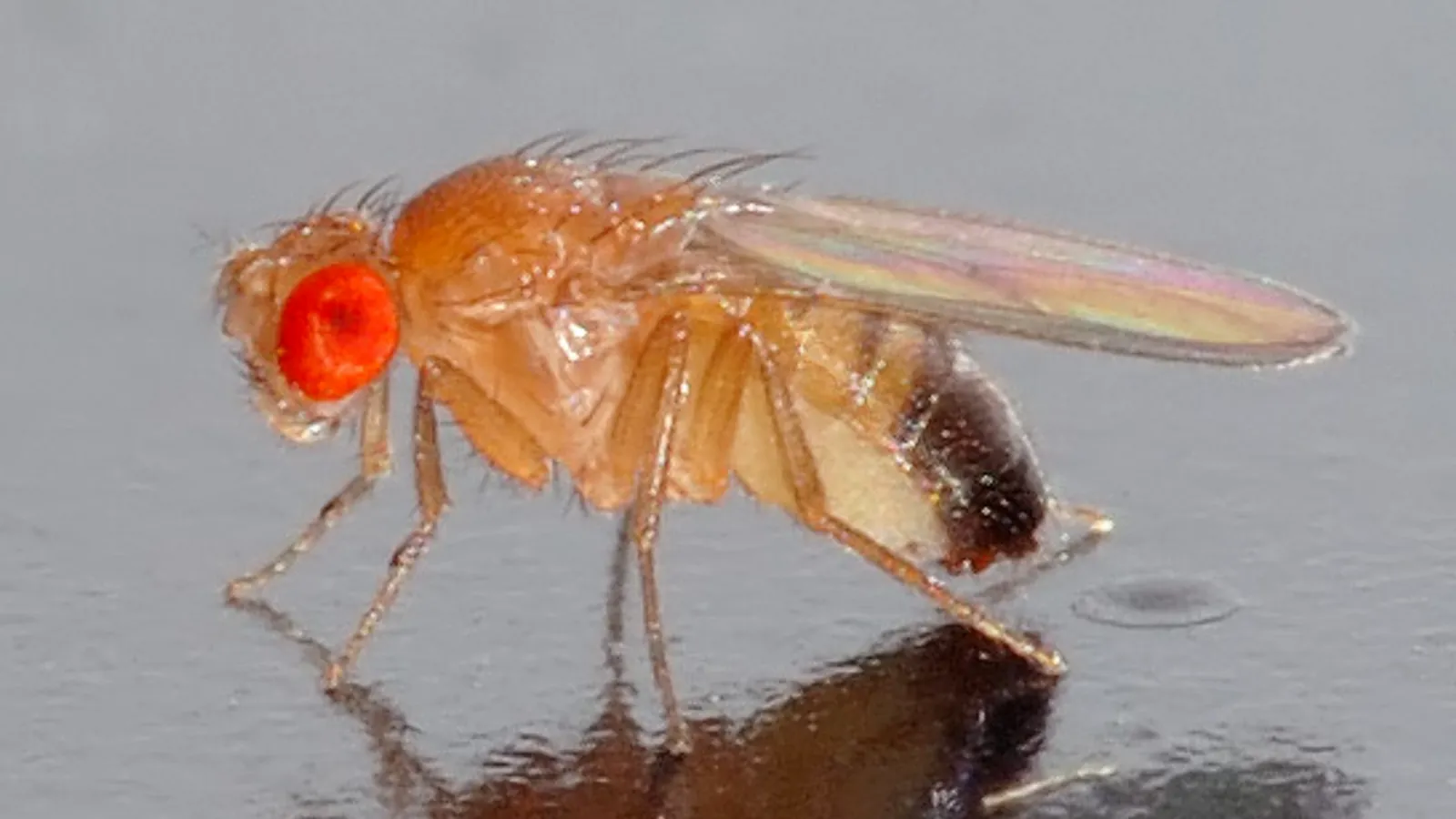
Its red eyes are the trait on which classical genetics was founded.
— What sets it apart
In 1910 Thomas Hunt Morgan found in a jar a male with white eyes instead of red, and realised that the trait was inherited together with sex: it was the first experimental proof that genes sit on chromosomes. Out of that fly have come six Nobel prizes and much of what we know about heredity, embryonic development and the biological clock. Roughly sixty per cent of human disease-related genes have a recognisable counterpart in this three-millimetre animal, which is why studying it still pays.
