
Pill millipede
Glomeris marginata
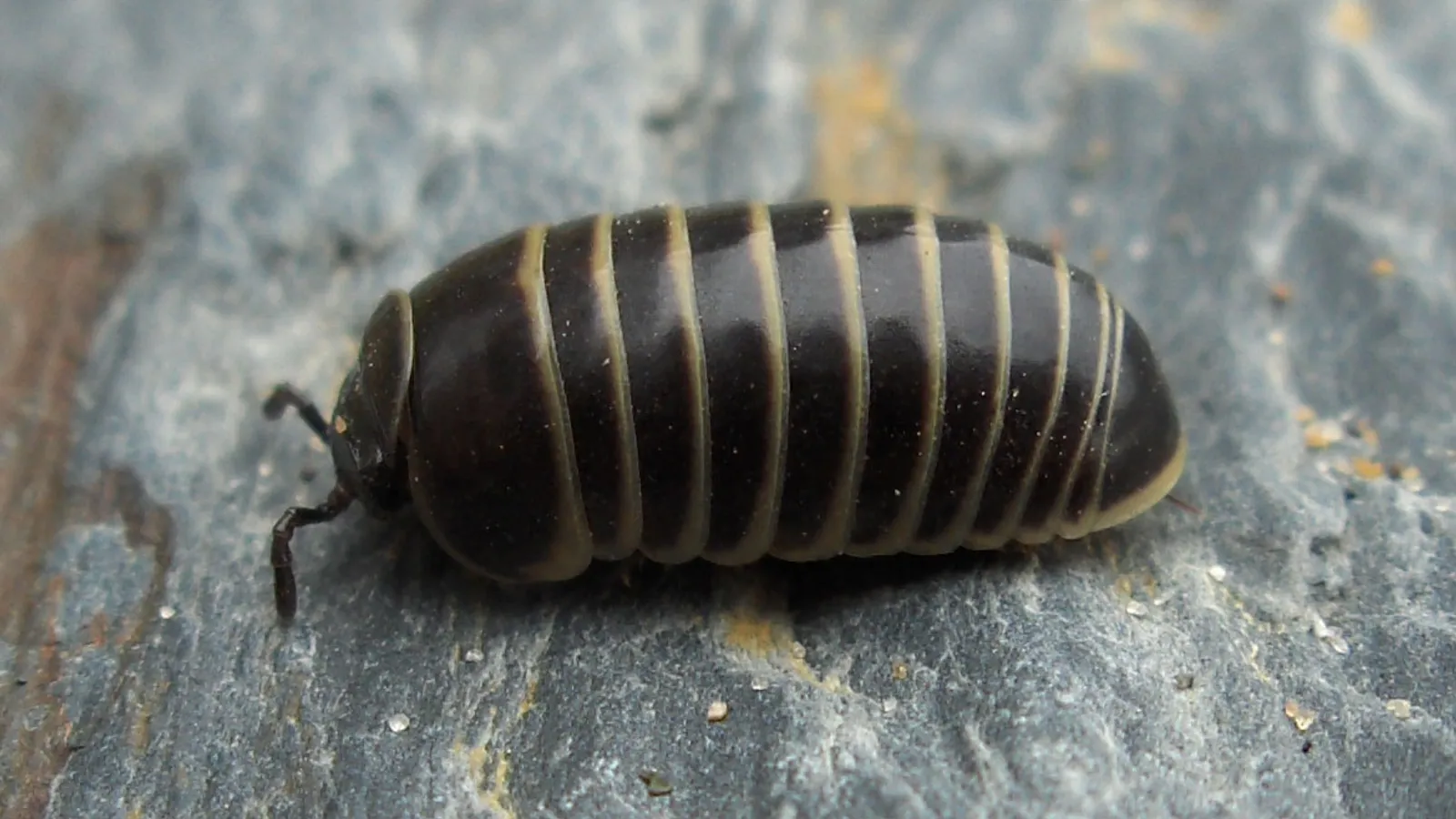
— Where the name comes from
Glomeris comes from the Latin glomus, a ball of thread: which is exactly what this animal becomes when touched, a glossy and perfectly closed sphere. Marginata is the pale border edging each dorsal plate. Anyone finding it under a stone almost always mistakes it for a woodlouse, which rolls up the same way — and it is instead a millipede, with two pairs of legs per segment rather than one.
— Facts
- Group
- Myriapods · Myriapoda
- Order
- Pill millipedes
- Habitat
- Leaf litter of broadleaf woodland and limestone soils
- Range
- Western and central Europe
- Size
- 7–20 mm
- Diet
- Dead leaves, especially those already attacked by fungi
- Lifespan
- 5–7 years
— Characteristics
- 01
It closes into a perfect sphere with no opening left.
- 02
It resembles a woodlouse but is not a crustacean.
- 03
It ejects a sticky fluid that immobilises spiders.
— What sets it apart
It is a textbook case of convergence: two animals from very distant groups — a land crustacean and a myriapod — solved the same problem the same way, by rolling into a ball, and became nearly indistinguishable to the naked eye. One counts the legs per group of segments to tell which is which. Its chemical defence, though, is its own: it secretes drops of a viscous fluid that hardens within seconds and glues shut the legs and jaws of a spider, sometimes immobilising it to death.
