
Mauve stinger jellyfish
Pelagia noctiluca
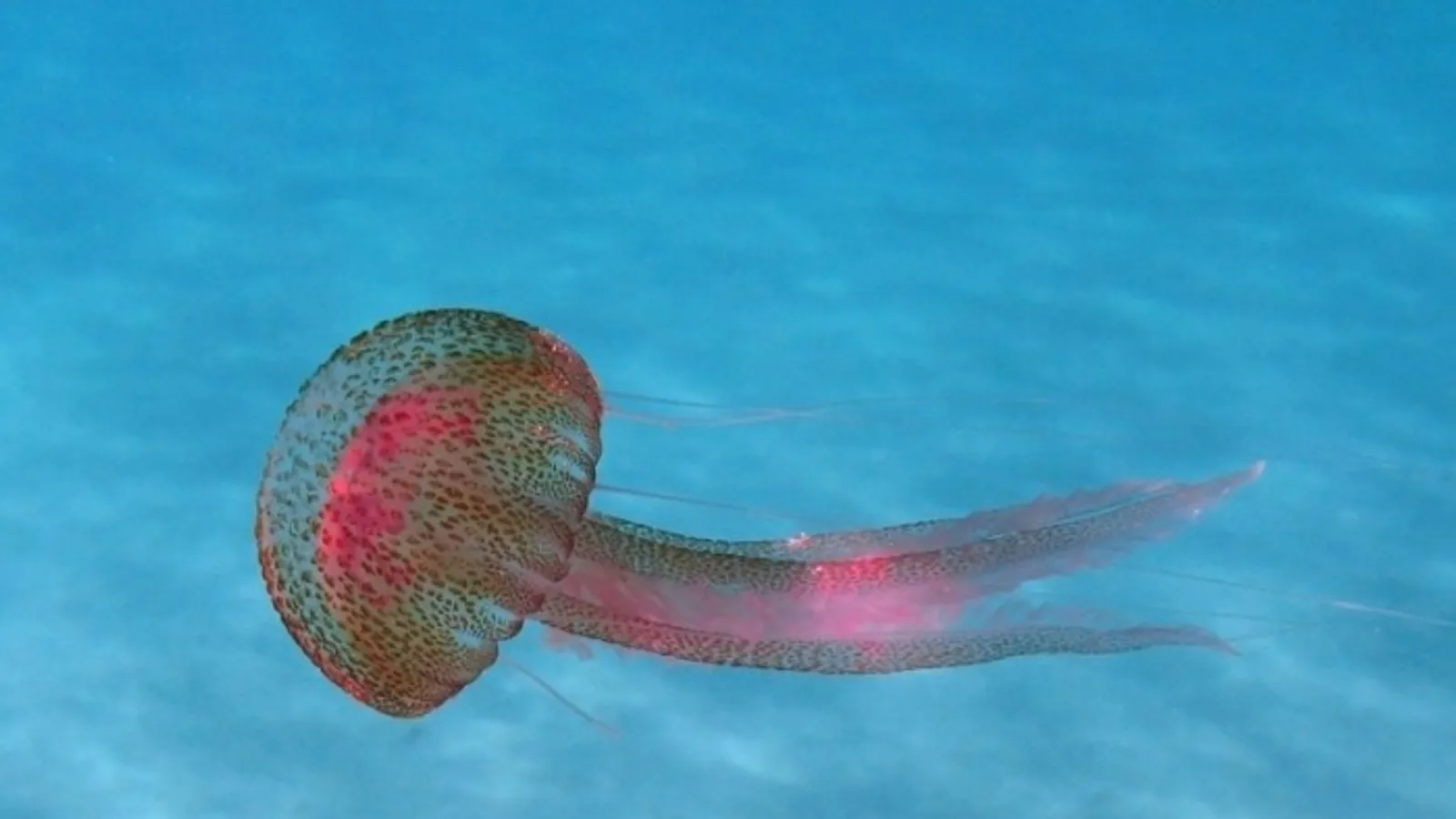
— Where the name comes from
Pelagia is “of the open sea”, from pélagos: unlike almost all jellyfish it has no stage fixed to the bottom, and spends its whole life in open water. Noctiluca is Latin, “that shines by night”, and it is not a metaphor: disturbed, it emits a blue light. The word jellyfish in Italian, medusa, comes instead from the Gorgon with snakes for hair — which is what the tentacles look like from close by.
— Facts
- Group
- Cnidarians · Cnidaria
- Order
- True jellyfish
- Habitat
- Open water, from the surface to a few hundred metres
- Range
- Mediterranean and eastern Atlantic
- Size
- Bell 6–12 cm; tentacles up to 2 metres
- Diet
- Plankton, fish eggs and larvae, other jellyfish
- Lifespan
- 9–12 months
— Characteristics
- 01
It is bioluminescent: rubbed or shaken it gives off a blue light.
- 02
It has no fixed bottom stage: a jellyfish hatches straight from the egg.
- 03
Its blooms close Mediterranean beaches every summer.
— What sets it apart
It is the jellyfish that ruins Italian summers, and it has increased for reasons that chiefly concern us: fewer fish to eat its larvae, warmer water lengthening the breeding season, and fewer competitors for plankton. Having none of the fixed bottom stage other jellyfish must pass through, it depends on no substrate and can multiply anywhere, at the mercy of the currents. As for the pain, fresh water is the worst thing: it bursts by osmosis the stinging capsules still intact on the skin, and the rule is to rinse with seawater.
