
Moon jellyfish
Aurelia aurita
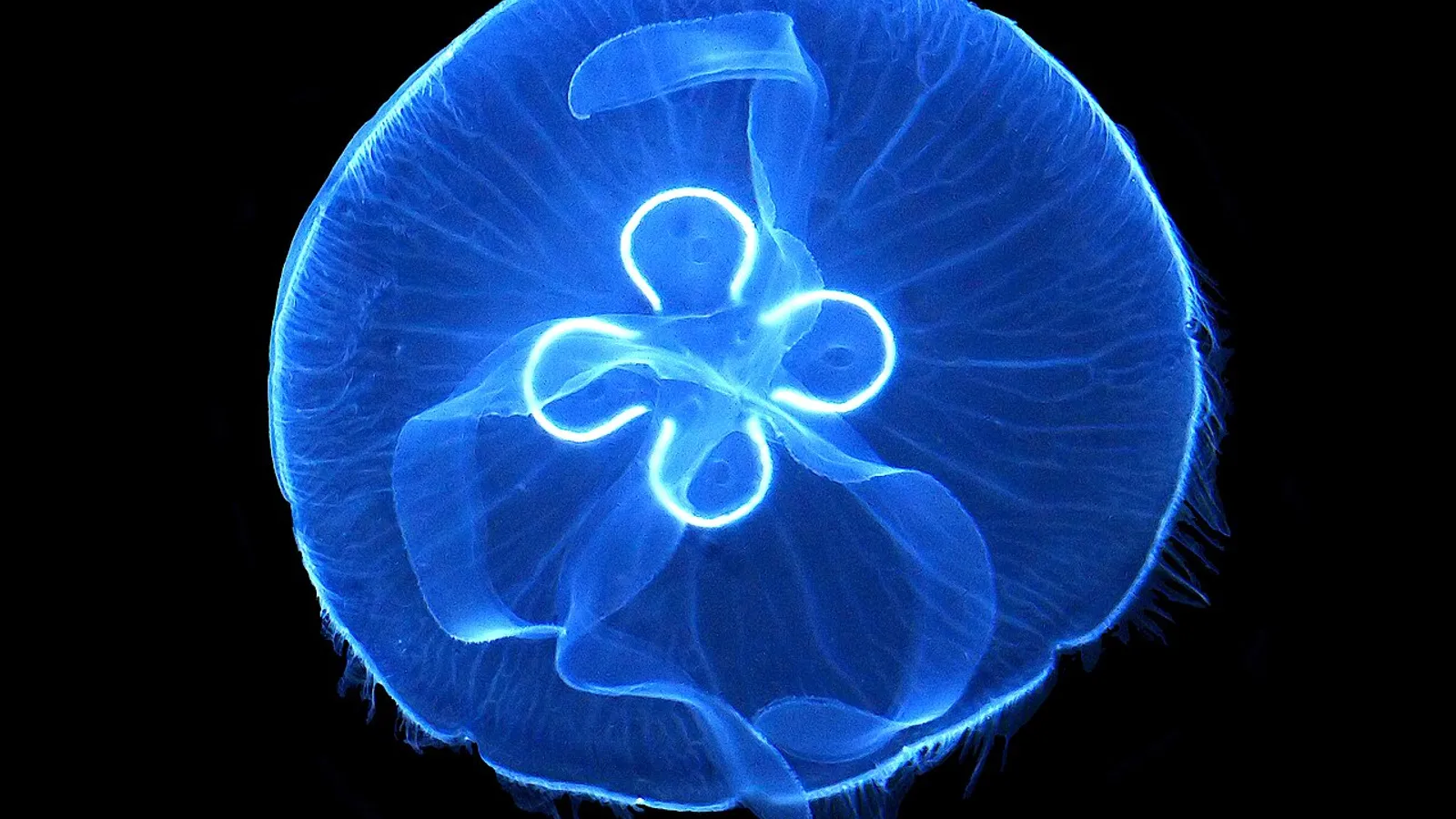
— Where the name comes from
Aurelia recalls the Latin aurum, gold, for the golden sheen of the body; aurita means “having ears”. The four horseshoe-shaped gonads, clearly visible through the translucent centre of the bell, do indeed look like four ears or four rings. This is the jellyfish everyone recognises: almost invisible, with that pale four-leaf clover in the middle.
— Facts
- Group
- Cnidarians · Cnidaria
- Order
- True jellyfish
- Habitat
- Coastal waters, harbours, lagoons
- Range
- Cosmopolitan, in nearly every sea in the world
- Size
- 10–40 cm across
- Diet
- Plankton and small organisms caught in mucus
- Lifespan
- Less than a year in the adult phase
— Characteristics
- 01
The body is more than 95% water: out of the sea it all but disappears.
- 02
It has no brain, no heart and no blood; a diffuse nerve net coordinates the pulsing.
- 03
The four central rings are the gonads, often pink or violet.
— What sets it apart
The moon jellyfish was taken into space to find out how a body develops without gravity: thousands of small medusae were born aboard the Space Shuttle. Grown weightless, once back on Earth they could no longer orient themselves — their balance organs had formed with no “down” to refer to. An experiment that said something about us too: about the way every body learns gravity in the moment it takes shape.
