
Yellow-bellied marmot
Marmota flaviventris
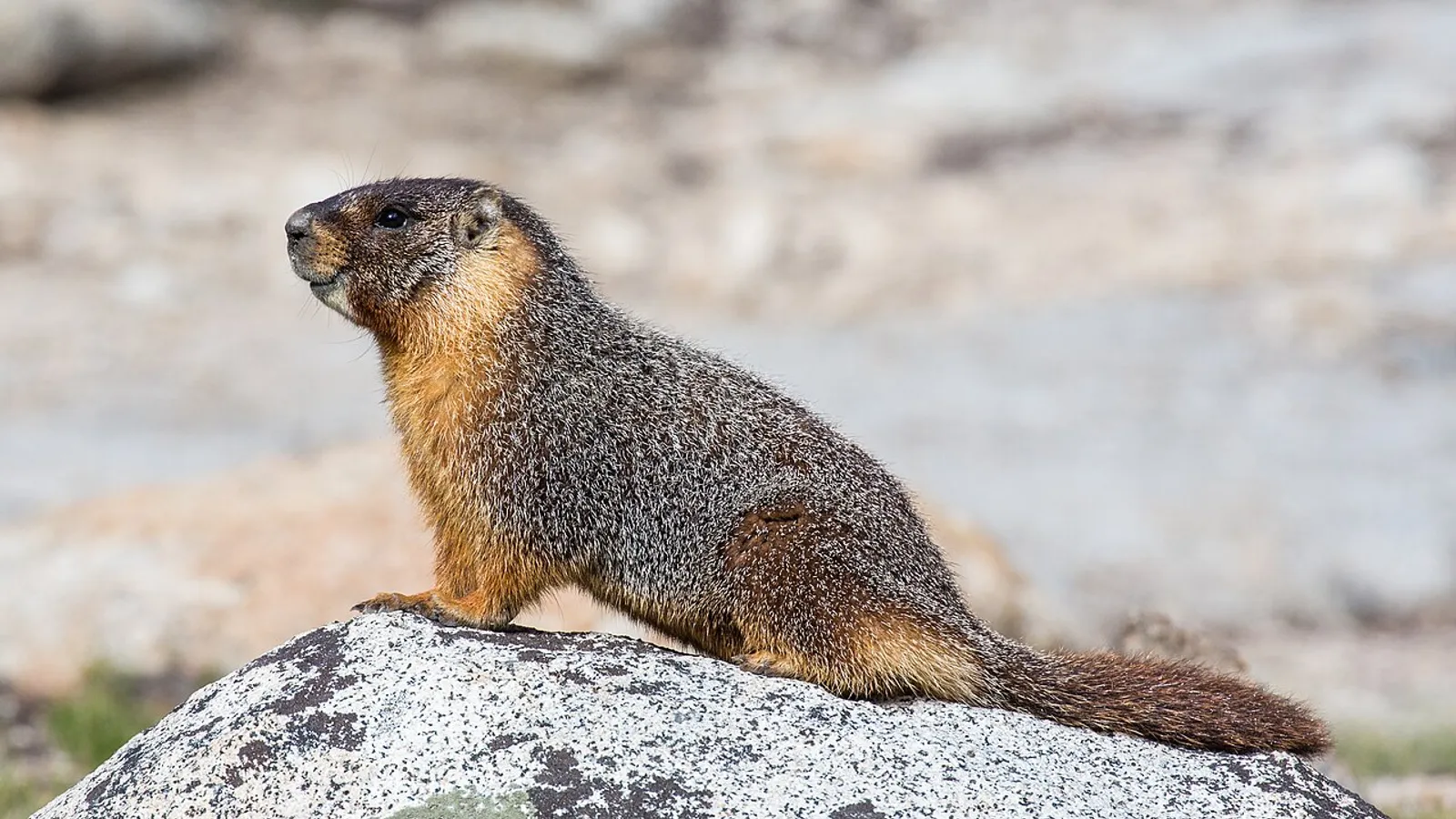
— Where the name comes from
Flaviventris is the sum of flavus, “golden yellow”, and venter, “belly”: the warm colour of the underside, seen when the animal rises on its hind legs to check the horizon. Americans call it the rock chuck, to distinguish it from the groundhog of the meadows.
— Facts
- Group
- Mammals · Mammalia
- Order
- Rodents
- Habitat
- High-altitude grassland, scree, moraine, up to 3,500 m
- Range
- The mountains of western North America, from British Columbia to New Mexico
- Size
- 47–70 cm, 1.6–5.2 kg
- Diet
- Herbivore — grasses, flowers, seeds, occasionally insects
- Lifespan
- 13 years
— Characteristics
- 01
It lives in colonies with a dominant male and several females.
- 02
It hibernates for up to eight months a year, from August to the following April.
- 03
It whistles to warn of danger, with different calls for eagle and for coyote.
— What sets it apart
It is one of the most closely studied wild animals in the world for a banal reason: it stays put. The colony at the Rocky Mountain Biological Laboratory in Colorado has been watched without a break since 1962, and every marmot born there in sixty years has a tag and a history. From that mass of data have come discoveries about animal personality — some marmots are constitutionally bold, others shy, and the character stays the same for life.
