
Rhesus macaque
Macaca mulatta
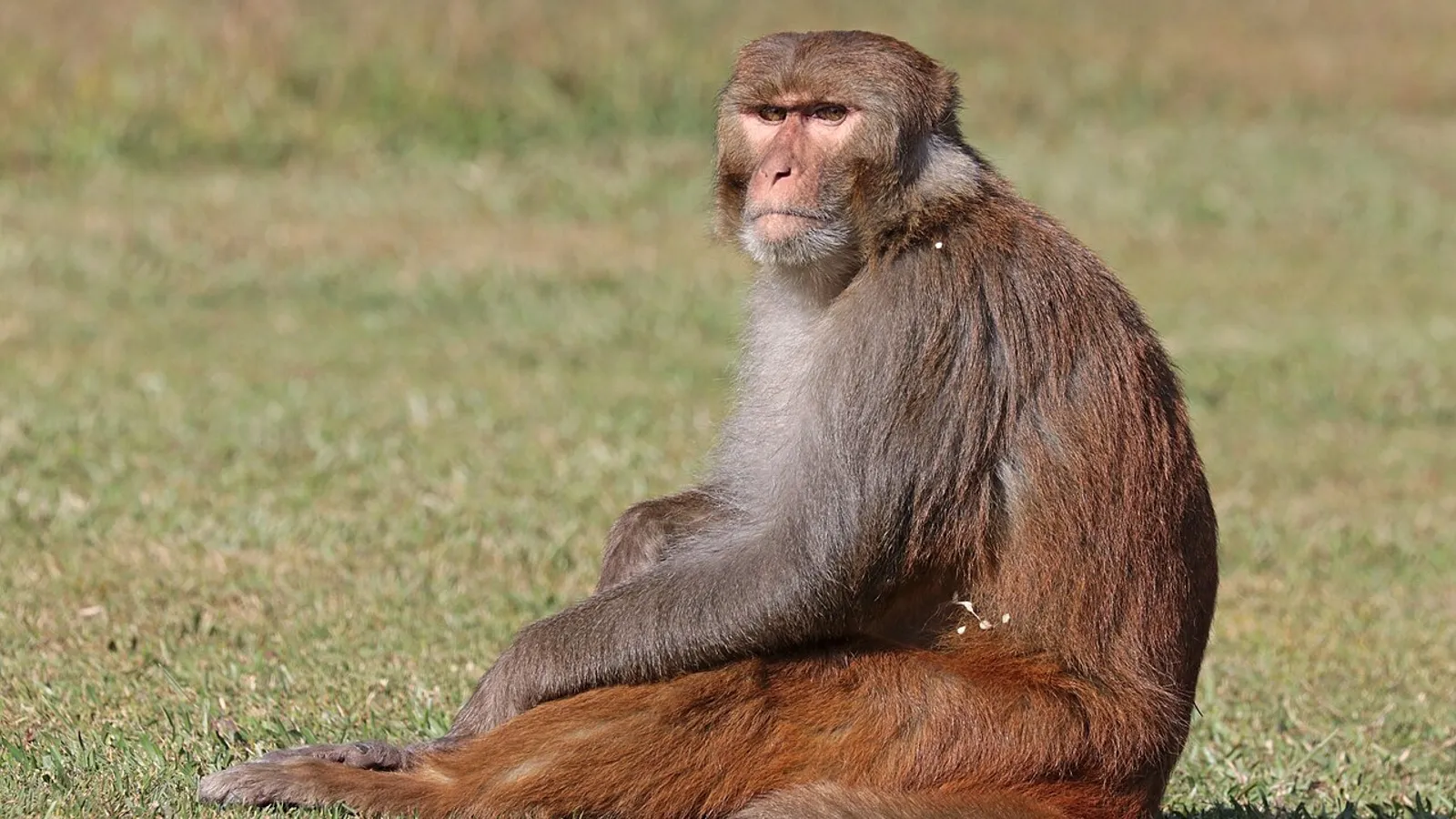
— Where the name comes from
Mulatta is late Latin and alludes to the mixed colour of the coat. Rhesus, by contrast, is a name lifted from mythology — a Thracian king of the Iliad — which the naturalist Audebert chose out of pure convenience, admitting he had picked it for no reason. From that arbitrary name, however, comes one of the most used words in medicine: the Rh factor of our blood, identified in 1937 in this monkey’s red cells.
— Facts
- Group
- Mammals · Mammalia
- Order
- Primates
- Habitat
- Forests, farmland, temples, markets and city centres
- Range
- Southern Asia: Afghanistan, India, southern China, South-East Asia
- Size
- 45–64 cm long, 5–11 kg
- Diet
- Omnivore — fruit, seeds, roots, insects, human food
- Lifespan
- 25–30 years
— Characteristics
- 01
It is the non-human primate with the widest natural range after us.
- 02
It lives in groups with strict matrilineal hierarchies, where rank is inherited from the mother.
- 03
It lives alongside people in Indian cities, where religious tradition protects it.
— What sets it apart
Its blood changed the history of medicine: from this species’ red cells was isolated in 1937 the antigen we call the Rh factor, and from that discovery came the understanding of haemolytic disease of the newborn, which killed thousands of babies a year. The animal’s name has stayed attached to every blood group report in the world. In the same period a rhesus macaque named Albert II became, in 1949, the first primate to reach space.
