
Northern pike
Esox lucius
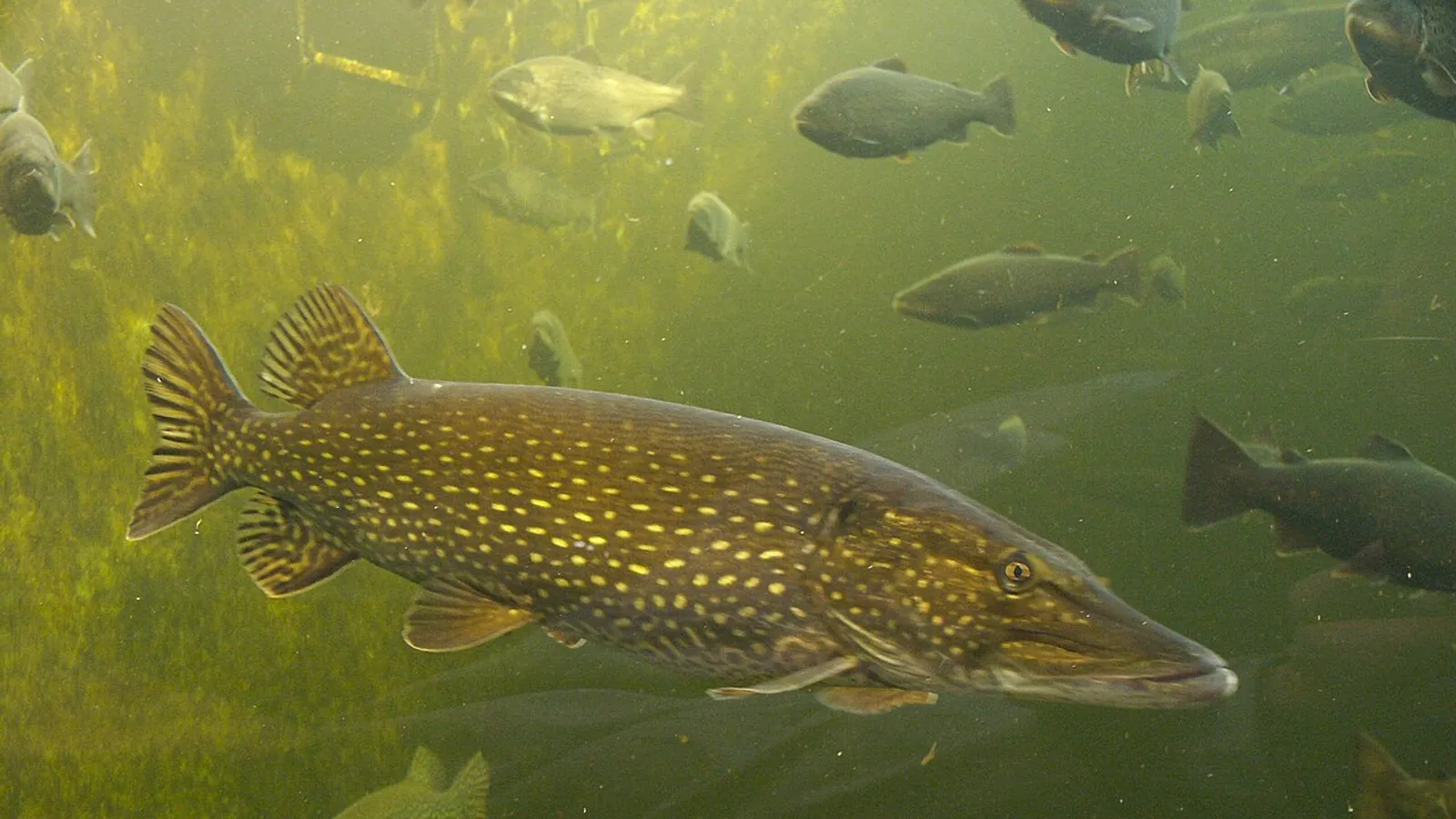
— Where the name comes from
Esox is a Gaulish word recorded by Pliny, one of the few Celtic terms to enter scientific nomenclature; lucius is the Latin name of the fish, which some derive from lupus, the wolf — “the wolf of the rivers” was already its nickname then. The Italian name comes straight from lucius.
— Facts
- Group
- Fish · Actinopterygii · Chondrichthyes
- Order
- Pikes
- Habitat
- Still or slow weedy water: lakes, oxbows, canals
- Range
- Europe, northern Asia, North America
- Size
- 50–100 cm, up to 150 cm; 2–15 kg, records over 25 kg
- Diet
- Fish, frogs, mice, small waterbirds
- Lifespan
- 15 years, some over 25
— Characteristics
- 01
It has over seven hundred backward-pointing teeth, on the tongue and palate too.
- 02
It lies motionless among the weed and strikes with lightning acceleration.
- 03
Females grow far larger than males.
— What sets it apart
In 1497, the story goes, a pike was caught in the lake at Kaiserslautern wearing a bronze ring stating that it had been released by the Emperor Frederick II in 1230: two hundred and sixty-seven years. The skeleton was displayed for centuries in Mannheim cathedral, until in the nineteenth century an anatomist examined it and counted the vertebrae: there were too many. It had been assembled from the spines of several pikes. It is one of Europe’s longest-lived zoological hoaxes, and it outlasted the fish by a wide margin.
