
Sea otter
Enhydra lutris
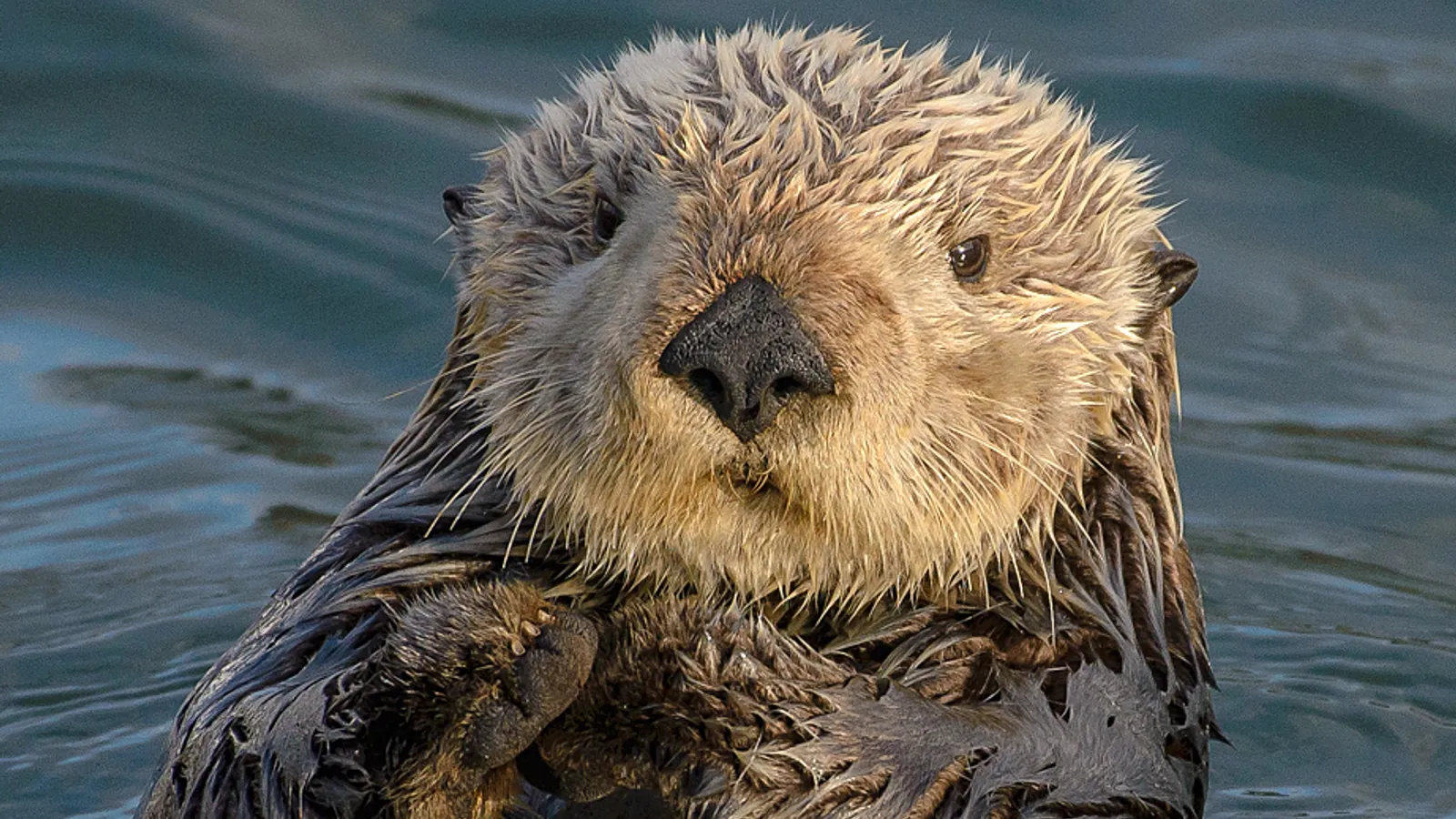
— Where the name comes from
Enhydra is Greek, én-hydros, “within the water”: the same root as the hydra of the Lernaean marsh. Lutris comes instead from the Latin lutra, “otter”, a word related to the Greek enydrís and to the English otter, all descended from an Indo-European root that simply meant “of the water”. A doubled and redundant name, then: the water creature of the water.
— Facts
- Group
- Mammals · Mammalia
- Order
- Carnivores
- Habitat
- Shallow coastal waters, kelp forests
- Range
- The North Pacific, from California to the Aleutian and Kuril Islands
- Size
- 100–150 cm long, 14–45 kg
- Diet
- Carnivore — sea urchins, molluscs, crabs
- Lifespan
- 15–20 years
— Characteristics
- 01
It has the densest fur in the animal kingdom: up to 150,000 hairs per square centimetre, against 200 for a human head.
- 02
It has no insulating blubber: to stay warm it must eat a quarter of its own weight every day.
- 03
It sleeps at the surface wrapped in kelp, and mothers hold hands so as not to drift apart while asleep.
— What sets it apart
It holds a stone on its chest and smashes urchins against it until they give: it is one of the very few non-primate mammals to use tools, and each otter tends to keep its favourite stone in a pouch of skin under the armpit. The consequence is ecological, not anecdotal: by eating urchins it stops them devouring the kelp forests. Where the otter was wiped out for its fur, the kelp vanished and the seabed was reduced to a desert of urchins. It is the textbook example of a keystone species.
