
Globe skimmer dragonfly
Pantala flavescens
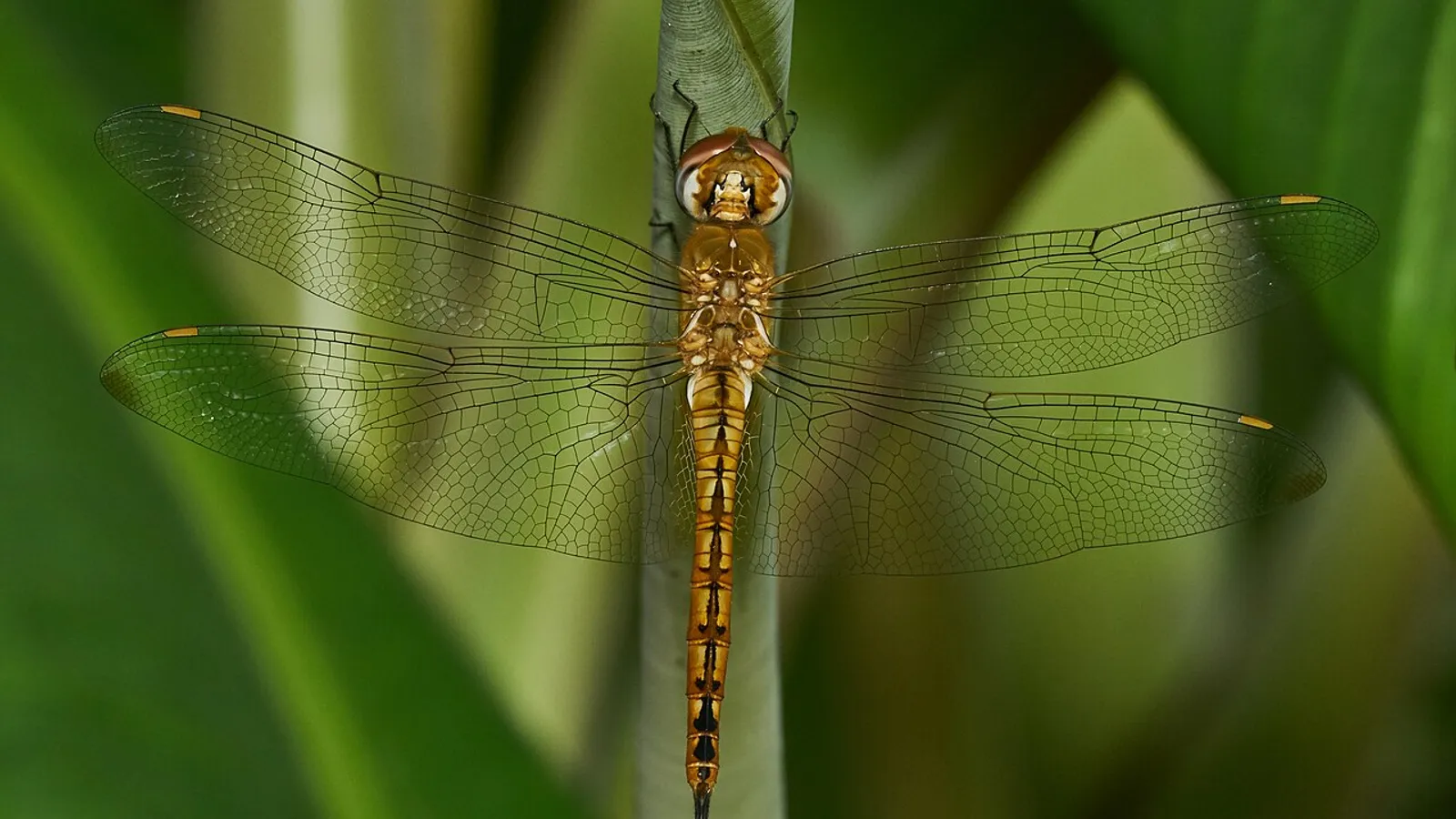
— Where the name comes from
Flavescens is Latin for “turning yellow”, the amber colour of the abdomen. But the name that counts is the English one, globe skimmer, because it describes the one truly extraordinary thing about this animal: no insect in the world travels further. The Italian word libellula comes instead from the Latin libella, the builder’s little level, after the way the insect holds itself perfectly horizontal in mid-air.
— Facts
- Group
- Insects · Insecta
- Order
- Dragonflies
- Habitat
- Temporary pools, rice paddies, any newly formed still water
- Range
- Every continent except Antarctica
- Size
- 4.5–5 cm; hindwings very broad at the base
- Diet
- Insects caught in flight, mosquitoes above all
- Lifespan
- A few weeks as an adult; the nymph develops in 40 days
— Characteristics
- 01
It rides high-altitude winds and glides for hours without beating its wings.
- 02
The nymphs develop in five weeks, before the pool dries.
- 03
It has been sighted at over six thousand metres above the Himalaya.
— What sets it apart
It makes the longest migration of any insect: a loop of almost eighteen thousand kilometres between India, the Maldives, East Africa and back, riding the intertropical convergence zone — the belt of rains that shifts with the seasons, carrying with it the pools in which to lay. No individual completes the circuit: it takes four generations. Genetic analysis has shown that the populations of South America, Asia and Africa are indistinguishable, which means these animals interbreed across the oceans: a single population the size of the planet.
