
California sea lion
Zalophus californianus
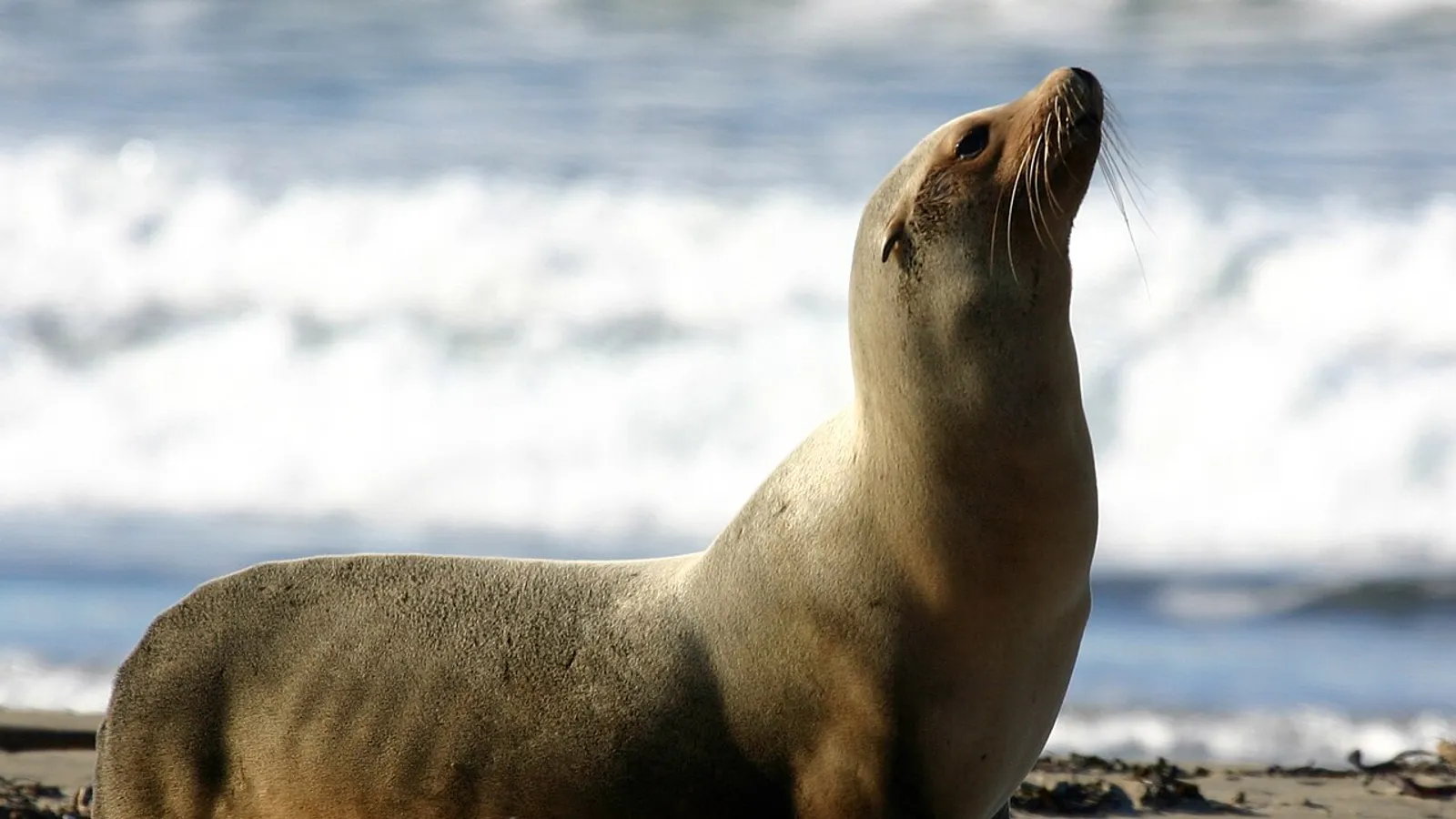
— Where the name comes from
Zalophus is Greek: za-, an intensive prefix meaning “very”, and lóphos, “crest”. It is not a crest of hair but of bone — the sagittal keel that in the skulls of adult males rises into a blade, visible in life as a bump on the forehead. Sea lion translates the old image of the roar and the massive neck, though there is no mane about it.
— Facts
- Group
- Mammals · Mammalia
- Order
- Carnivores
- Habitat
- Rocky coasts, islands, jetties and harbour pontoons
- Range
- The north-eastern Pacific, from Mexico to British Columbia
- Size
- 2–2.4 m and 200–400 kg for the male, 1.8 m and 90 kg for the female
- Diet
- Carnivore — pelagic fish, squid
- Lifespan
- 20–30 years
— Characteristics
- 01
Unlike seals it has external ear flaps and turns its hind flippers forward, walking on land.
- 02
It reaches 40 km/h in water and cruises at the surface with flippers held up, like a sail.
- 03
The colonies are extremely noisy: mother and pup find one another among thousands by recognising the voice.
— What sets it apart
It is the animal that performs balancing acts in the documentaries, and the choice is no accident: its working memory and its ability to reason by equivalence have been measured in the laboratory for decades. A female named Rio learnt in the 1990s to grasp that if A goes with B and B goes with C, then A goes with C — transitive inference, a pillar of logical thought once thought reserved to primates. She still remembered it ten years later, without revision.
