Llama
Lama glama
— Where the name comes from
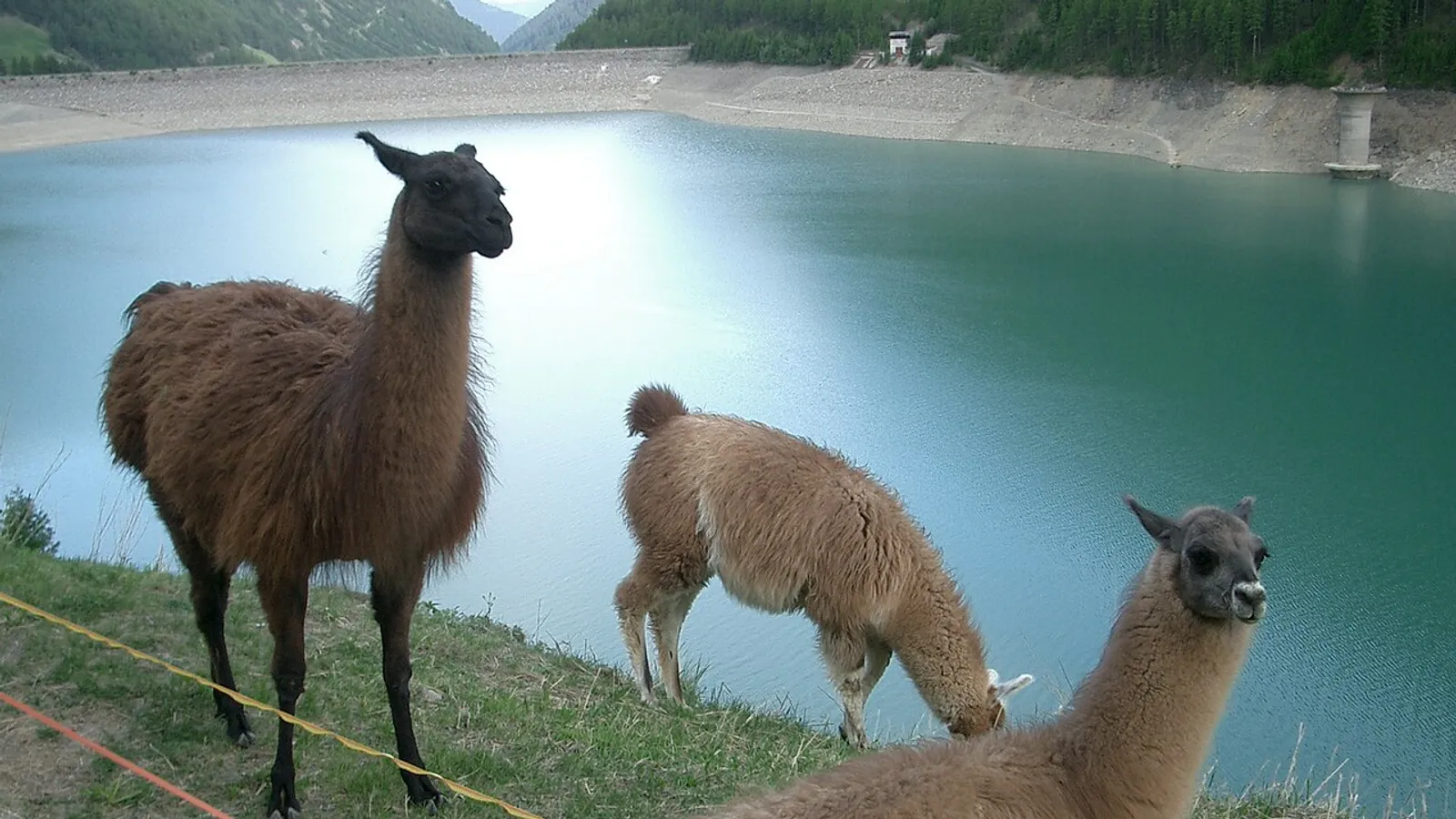
Lama and glama render one and the same word: the Quechua llama, gathered by the Spanish chroniclers of the 16th century and later latinised by Linnaeus into glama. The scientific name is therefore an Andean word repeated twice, a tautology that has survived three centuries of taxonomic revision. Before the indigenous term prevailed, the Spanish called these animals carneros de la tierra, “sheep of the country”, not knowing which European category to file them under. In the end it was Peru that imposed its word on Latin, and not the other way round.
— Facts
- Group
- Mammals · Mammalia
- Order
- Even-toed ungulates
- Habitat
- Arid altiplano and high grassland (puna) between 2,500 and 4,500 m
- Range
- The Andes of Peru, Bolivia, northern Chile and north-western Argentina; introduced to North America, Europe and Oceania
- Size
- 170–200 cm long, 110–120 cm at the shoulder, 130–200 kg
- Diet
- Herbivore — tough highland grasses, shrubs and lichens
- Lifespan
- 15–20 years, up to 25 in husbandry
— Characteristics
- 01
It has no hooves but two toes with soft footpads, which do not cut into the fragile high-altitude soil.
- 02
It carries 25–45 kg for twenty or thirty kilometres a day, and sits down refusing to go on if the load is too heavy.
- 03
It spits by bringing up the contents of the rumen, a gesture aimed almost always at other llamas to settle rank.
- 04
It descends from the wild guanaco, domesticated in the Andes four to five thousand years ago.
— What sets it apart
The llama’s blood is built for thin air. Its red cells are not discs but ellipses, among the smallest and most numerous of any mammal, and its haemoglobin binds oxygen with an affinity markedly higher than ours: at 4,000 metres, where an unacclimatised person staggers, a llama walks under load. To that are added a large lung volume and a high breathing rate even at rest. The llama does not adapt to altitude, as we do over weeks of struggle: it is born inside it, with the physiology of something that has never known sea level.