
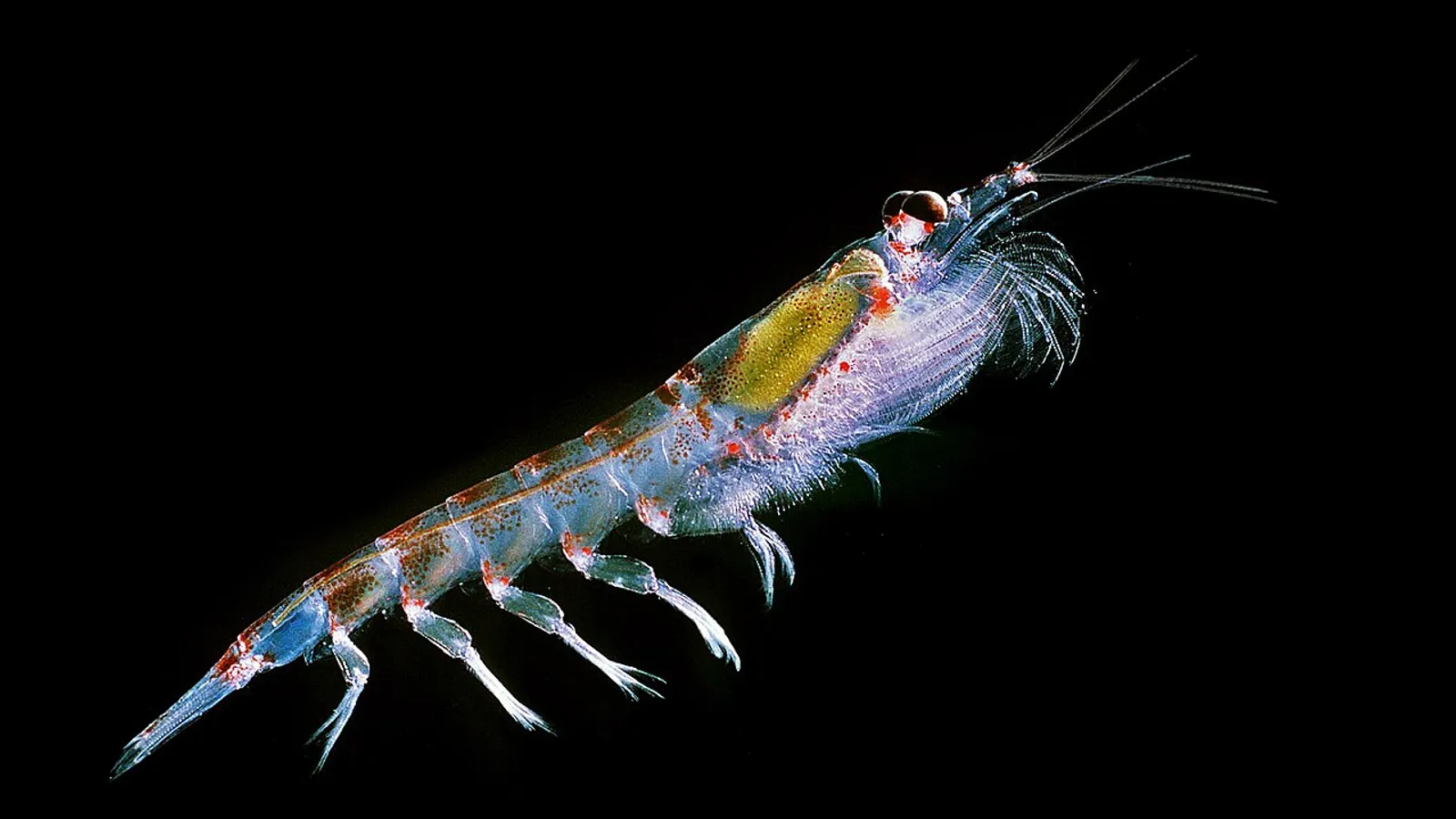
Antarctic krill
Euphausia superba
— Where the name comes from
Euphausia is “that shines well”, from eu- and phaûsis, the shining: the body carries light organs that glow a dense blue, and a swarm lighting up at night is one of the most cited spectacles of the southern ocean. Superba is Latin. Krill is not a scientific word at all but Norwegian, and in whalers’ slang meant simply “fry”, that is, whale food.
— Facts
- Group
- Crustaceans · Malacostraca · Maxillopoda
- Order
- Krill
- Habitat
- Surface waters of the Southern Ocean, in enormous swarms
- Range
- The Southern Ocean, around Antarctica
- Size
- 4–6 cm, up to 2 g
- Diet
- Phytoplankton, and algae scraped from the underside of sea ice
- Lifespan
- 5–6 years
— Characteristics
- 01
It forms swarms exceeding ten thousand individuals per cubic metre.
- 02
If food runs short it shrinks, moulting back to a smaller size.
- 03
The larvae overwinter scraping algae beneath the sea ice.
— What sets it apart
The biomass of this single species is put at around four hundred million tonnes: it is probably the most abundant wild animal on the planet by total weight, and the whole Antarctic food chain rests on it — whales, seals, penguins, seabirds. It also does something almost no animal can: when food is scarce, instead of merely losing weight it moults backwards to a smaller stage, and can repeat the trick for months. Its fate depends on the sea ice, because that is where the larvae spend the winter, and the ice is retreating.
