
Lord Howe Island stick insect
Dryococelus australis
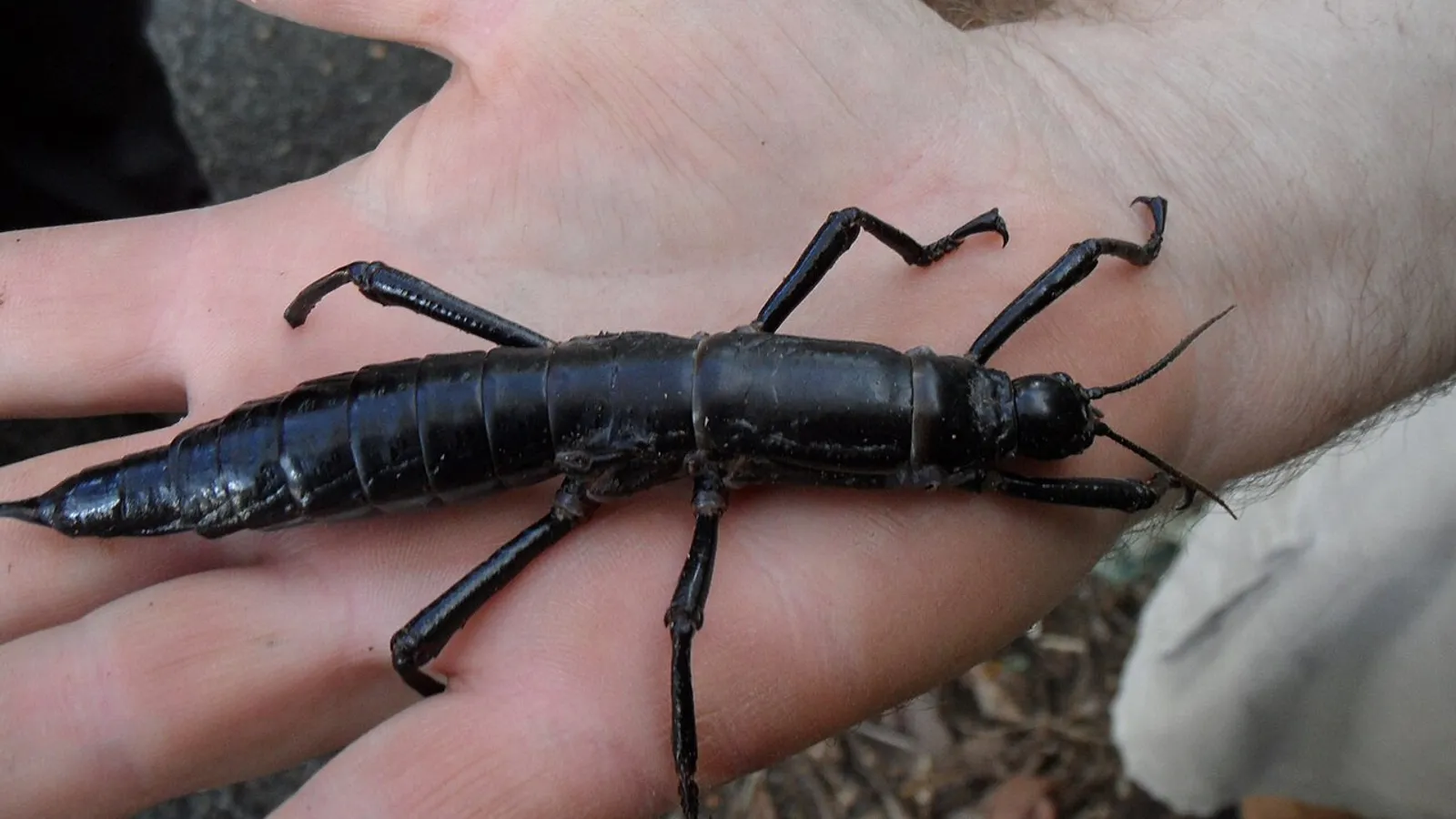
— Where the name comes from
Australis is “southern”, and there is not much more to draw from the scientific name. The name this animal really carries is the one the island’s fishermen gave it: land lobster, for the glossy armour, the sturdy legs and the size — fifteen centimetres of black insect walking among the roots. No scientific name has ever competed with that.
— Facts
- Group
- Insects · Insecta
- Order
- Stick insects
- Habitat
- Cavities and debris at the base of shrubs; one known bush in the wild
- Range
- Lord Howe Island, Australia; survived on Ball’s Pyramid
- Size
- 12–15 cm, up to 25 g
- Diet
- Shrub leaves, above all Melaleuca
- Lifespan
- 12–18 months as an adult
— Characteristics
- 01
It has no wings and does not fly: it walks, and runs surprisingly fast.
- 02
Pairs sleep embraced, the male with three legs over the female.
- 03
The female can reproduce without a male.
— What sets it apart
In 1918 a ship ran aground at Lord Howe and rats came ashore: within two years the insect was extinct, and for eighty years it was given up for lost. But climbers on Ball’s Pyramid — a volcanic stack twenty-three kilometres away, an obelisk of rock five hundred metres high — had reported large droppings beneath a single Melaleuca bush. In 2001 two entomologists climbed it by night and found twenty-four individuals, the last in the world, all on that one shrub. Two pairs were taken into captivity and one died; the surviving female, named Eve, fell ill and was nursed by hand with calcium and nectar by a keeper at Melbourne Zoo. From her descend the thousands now bred, waiting for the island to be free of rats.
