
Impala
Aepyceros melampus
— Where the name comes from
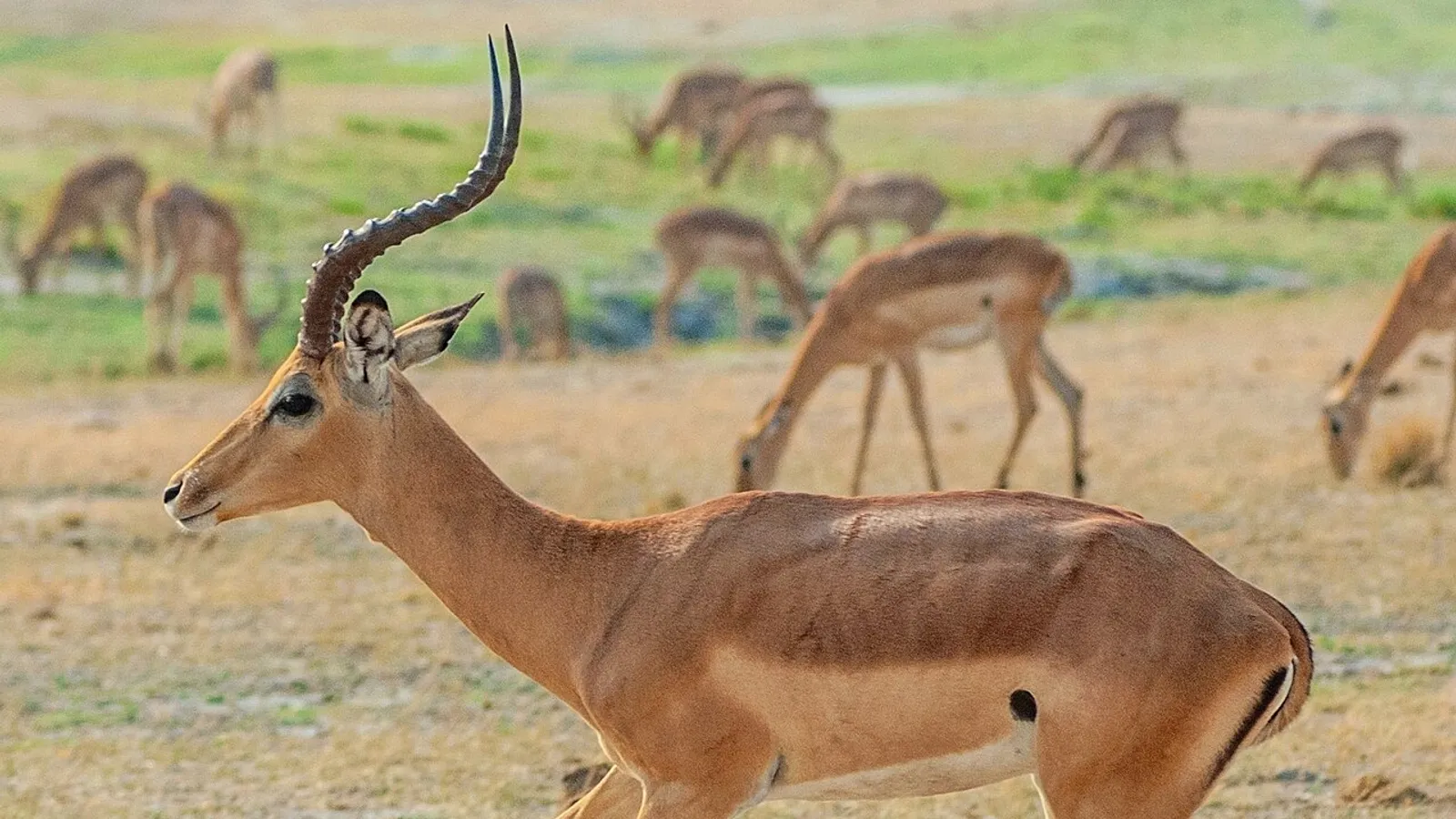
Aepyceros joins the Greek aipýs, “tall, steep”, and kéras, “horn”: the lyre-shaped horns of the males, slender and curving. The epithet melampus adds mélas, “black”, and poús, “foot”, and alludes to the dark tufts on the hind legs that hide the metatarsal glands. The common name comes instead from the Zulu impala, related to the Tswana phala, which names the reddish antelope in general. It is one of the rare cases where scientific and popular nomenclature describe the same beast from opposite ends: the horns and the feet.
— Facts
- Group
- Mammals · Mammalia
- Order
- Even-toed ungulates
- Habitat
- Wooded savannah and open bushland, always near water
- Range
- Eastern and southern Africa, from Kenya to South Africa; an isolated black-faced subspecies between Namibia and Angola
- Size
- 70–92 cm at the shoulder, 40–76 kg; males’ horns 45–92 cm
- Diet
- Herbivore — tender grasses in the wet season, leaves and shoots in the dry
- Lifespan
- 12–15 years in the wild, up to 20 in captivity
— Characteristics
- 01
It leaps up to 3 metres high and 10 long, often in seemingly random bounds to bewilder a predator.
- 02
Only the males carry horns, which describe a double lyre-shaped curve.
- 03
In the dry season it alternates grazing and browsing, an adaptation that lets it stay where other antelope leave.
— What sets it apart
The impala is the only African antelope that practises mutual grooming under an explicit exchange: one animal scrapes its companion’s neck with its incisors for six or seven strokes, then stops and waits to be repaid. If the other does not reciprocate, the session ends there. It works between unrelated animals too, and serves to remove ticks from the places an animal cannot reach alone. It is one of the cleanest field demonstrations of reciprocity among vertebrates: a contract in which the currency is cleaning and the sanction is to stop.
