
Greater kudu
Tragelaphus strepsiceros
— Where the name comes from
Tragelaphus is a creature of ancient zoology: trágos, “goat”, and élaphos, “deer”, a fabulous hybrid the Greeks listed among imaginary animals and which modern naturalists disinterred for a group of striped antelope. The epithet strepsíceros adds stréphō, “to twist”, and kéras again: “twisted horns”. The name kudu entered European languages through the Afrikaans koedoe, which had itself taken it from a Khoisan language of southern Africa. A mythological animal, then, named twice for its spirals.
— Facts
- Group
- Mammals · Mammalia
- Order
- Even-toed ungulates
- Habitat
- Thorn scrub and wooded savannah, often on broken hilly ground
- Range
- Eastern and southern Africa, from Chad and Ethiopia to South Africa
- Size
- 120–150 cm at the shoulder, 120–270 kg; horns up to 180 cm measured along the spiral
- Diet
- A browsing herbivore — leaves, shoots, acacia pods, tubers and fallen fruit
- Lifespan
- 7–8 years in the wild, up to over 20 in captivity
— Characteristics
- 01
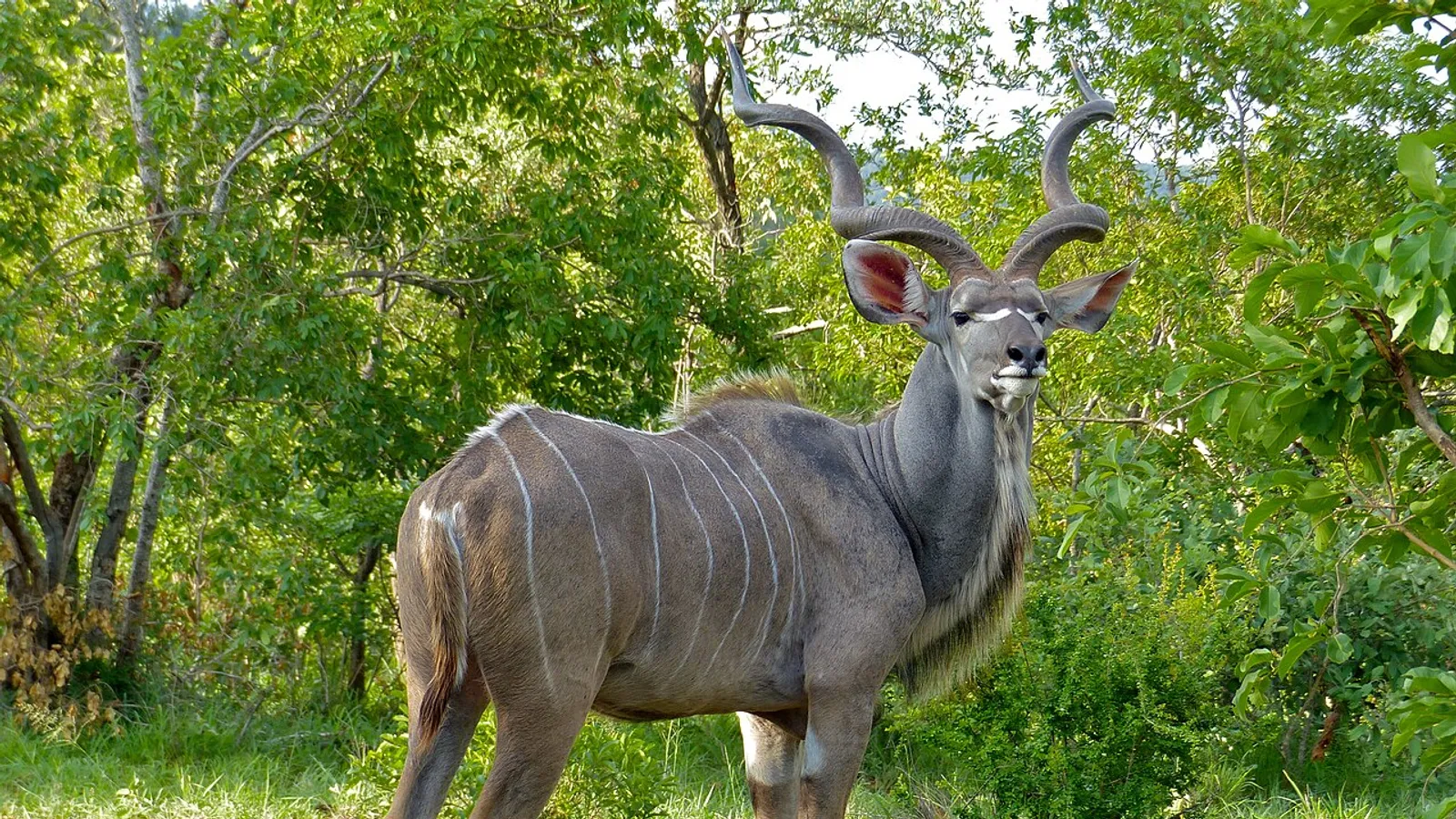
The males’ horns turn two and a half spirals and are the longest of any antelope.
- 02
The flank carries six to ten vertical white stripes that break up the outline in the bush.
- 03
For all its size, it clears fences of over two metres in a single bound.
— What sets it apart
Between 1977 and 1985 Namibia saw tens of thousands of greater kudu die of rabies, an epidemic without precedent in a herbivore. The disease normally passes through the bite of a carnivore, but the stricken kudu were too many and too scattered for jackals or foxes to explain them. The strongest surviving hypothesis is that the virus passed mouth to mouth during mutual grooming and on the shared thorny branches of acacias, through the cuts the thorns open in the mucous membranes. An antelope had turned a disease of predators into a contagion among peaceable browsers.
