
African buffalo
Syncerus caffer
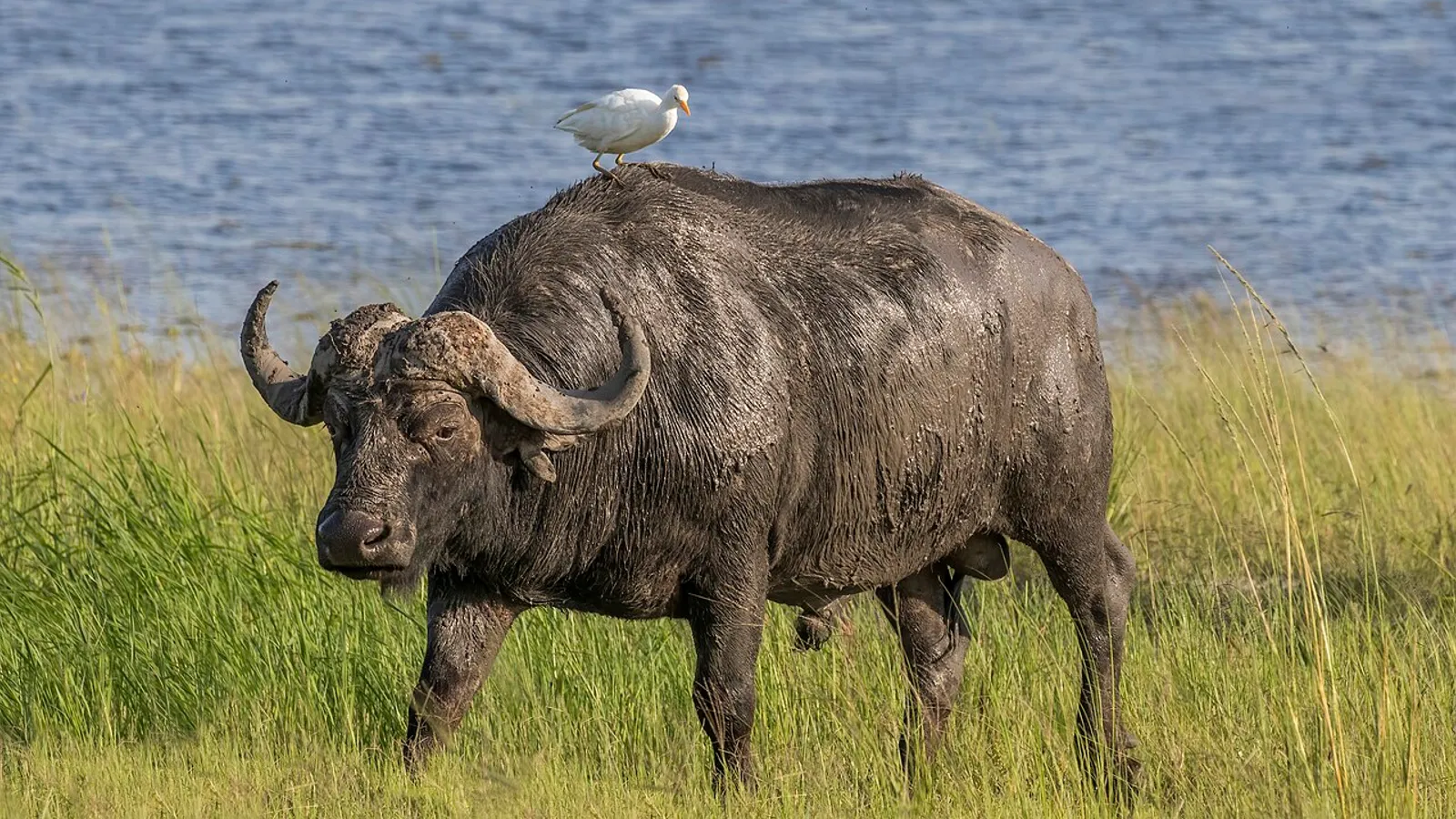
— Where the name comes from
Syncerus comes from the Greek sýn, “together”, and kéras, “horn”: in adult males the bases of the horns fuse across the forehead into a continuous shield of bone, the so-called “boss”. The epithet caffer points to Kaffraria, the name European cartography gave to southern Africa, itself from the Arabic kāfir, “infidel” — a word that in South Africa later became a grave racial slur, surviving in zoology only through the inertia of the rules of nomenclature. The Italian bufalo descends instead from the Greek boúbalos through the late Latin bufalus, and has nothing to do with the American bison.
— Facts
- Group
- Mammals · Mammalia
- Order
- Even-toed ungulates
- Habitat
- Grassy savannah, wet grassland and forest, always within a few kilometres of water
- Range
- Sub-Saharan Africa, from Senegal to Ethiopia and down to eastern South Africa
- Size
- 170–340 cm long, 100–170 cm at the shoulder, 300–900 kg
- Diet
- Herbivore — tall coarse grasses, supplemented with herbs and shrubs
- Lifespan
- 18–20 years in the wild, up to 29 in captivity
— Characteristics
- 01
In males the horns form a frontal shield thick enough to stop small-calibre bullets.
- 02
It has never been domesticated, unlike the Asian buffalo, and remains one of the most unpredictable of cattle.
- 03
Herds can pass a thousand head and counter-attack en masse against lions that cut out a companion.
— What sets it apart
African buffalo herds decide where to go by something that resembles a vote. In the resting hours the adult females stand, fix on a direction for a few moments and then lie down again: the ethologist Herbert Prins observed that the route the group takes matches the average of the directions indicated, not the choice of the dominant animal. The males count, large as they are, but only as much as any female. It is one of the few democratic assemblies documented among large mammals, and it is held in silence, lying in the grass.
