
Common warthog
Phacochoerus africanus
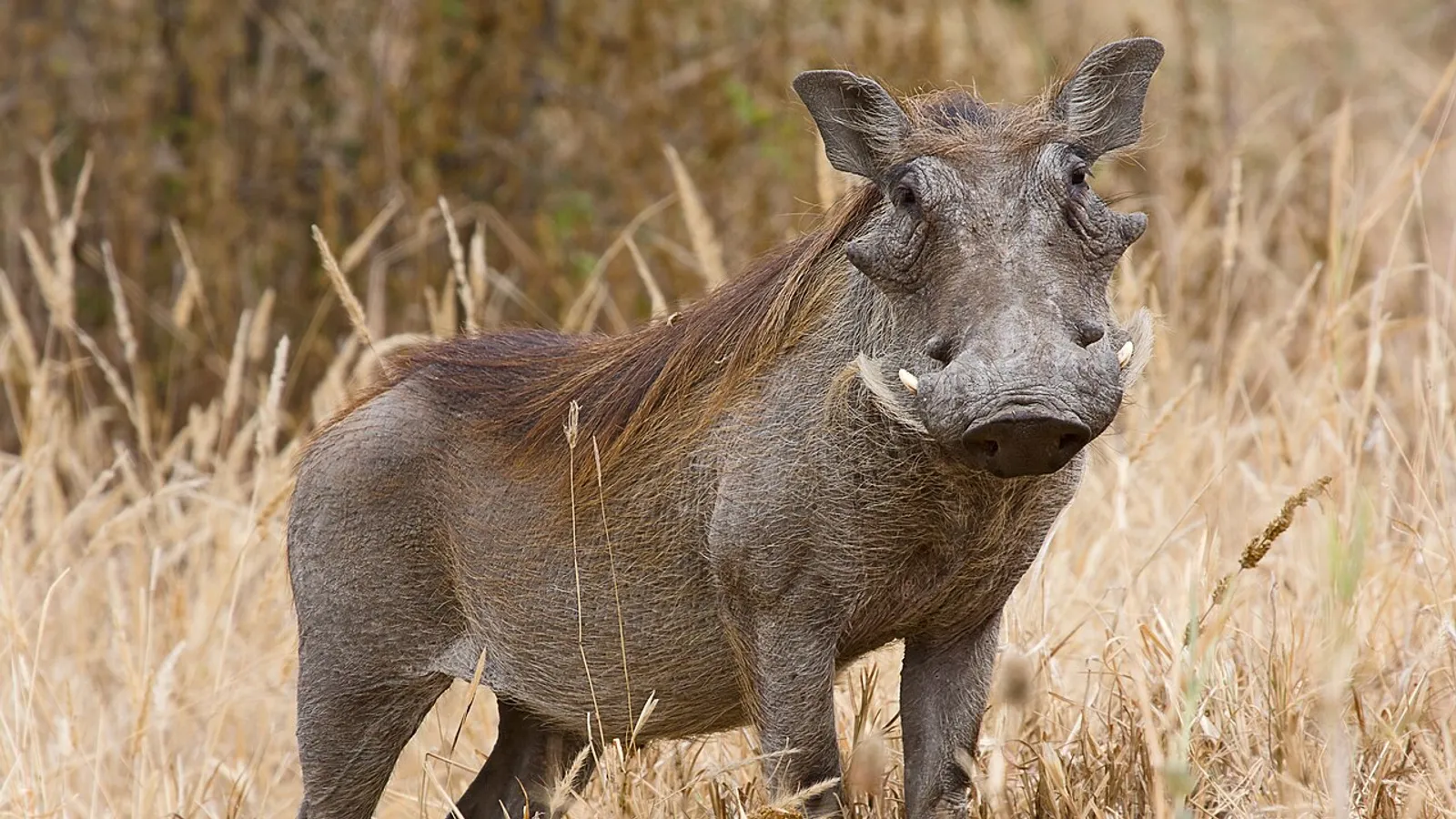
— Where the name comes from
Phacochoerus is a description disguised as a name: the Greek phakós, “wart” (properly the lentil, and by likeness the skin growth), joined to choîros, “pig”. The fleshy lumps on the sides of the face are not blemishes but bumpers, pads that in duels between males shield the eyes from an opponent’s tusks. The Italian facocero transliterates that Greek directly, while the English warthog is its literal translation: both languages looked at the same animal and saw the warts first.
— Facts
- Group
- Mammals · Mammalia
- Order
- Even-toed ungulates
- Habitat
- Open savannah, grassland and light bush, avoiding closed forest
- Range
- Sub-Saharan Africa, from the Sahel to South Africa, with wide gaps in forested regions
- Size
- 90–150 cm long, 63–85 cm at the shoulder, 45–150 kg
- Diet
- Omnivore — short grass, rhizomes and bulbs dug up, fruit, invertebrates and the odd carcass
- Lifespan
- 12–15 years in the wild, up to 18 in captivity
— Characteristics
- 01
It grazes kneeling on its wrists, protected by thick callosities that appear already in the young.
- 02
It sleeps in abandoned aardvark burrows and enters them backwards, keeping its tusks towards the opening.
- 03
It runs with its tail held straight up, a visual signal that keeps the family together in tall grass.
— What sets it apart
In Queen Elizabeth National Park, in Uganda, warthogs lie down and stay still while bands of banded mongooses climb over them to pick ticks from among the bristles and the folds of skin. It is the warthogs themselves who solicit the session, approaching the mongoose colonies and adopting the inviting posture. The relationship is entirely voluntary on both sides: the mongooses gain a meal, the pigs lose their parasites. It is one of the very few cleaning associations documented between two wild mammals, and it arose without anyone teaching it to anyone.
