
Freshwater hydra
Hydra vulgaris
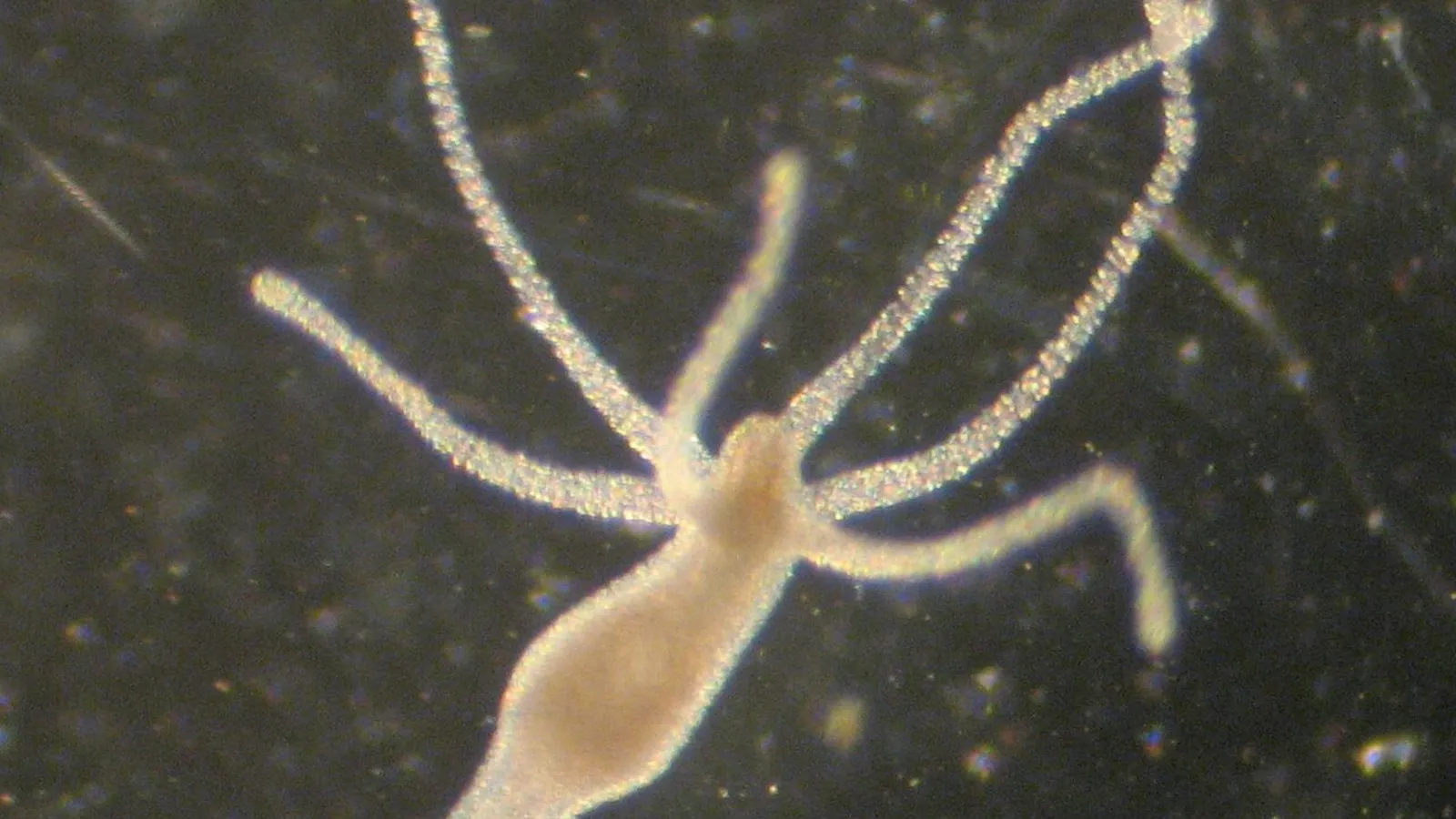
— Where the name comes from
It is the Hydra of Lerna, the monster that grew two heads for every one Heracles cut off. Linnaeus chose the name after Abraham Trembley had published, in 1744, the experiment that astonished Europe: he had cut these little animals into pieces and every piece had become a complete individual. For once the mythological name is no ornament — it describes exactly what the animal does.
— Facts
- Group
- Cnidarians · Cnidaria
- Order
- Hydrozoans
- Habitat
- Ponds, ditches and still fresh water, attached to plants and leaves
- Range
- Northern hemisphere
- Size
- 2–20 mm
- Diet
- Water fleas, insect larvae and other small invertebrates
- Lifespan
- Indefinite under laboratory conditions
— Characteristics
- 01
It reproduces by budding: a copy sprouts from its side and detaches.
- 02
It walks by somersaulting, head over foot.
- 03
A fragment of a few hundred cells rebuilds the whole animal.
— What sets it apart
It does not appear to age. Its stem cells divide without limit and continually replace every part of the body, which renews itself entirely within a few weeks: laboratory studies following populations for years find none of the rise in mortality with age that defines senescence in almost every other animal. In 1744 Trembley cut it, turned it inside out like a glove, grafted different pieces together, and every fragment made itself whole again: it was one of the first experiments of modern biology, and it threw into crisis the idea that a living being’s soul was indivisible.
