
Giant ichneumon wasp
Rhyssa persuasoria
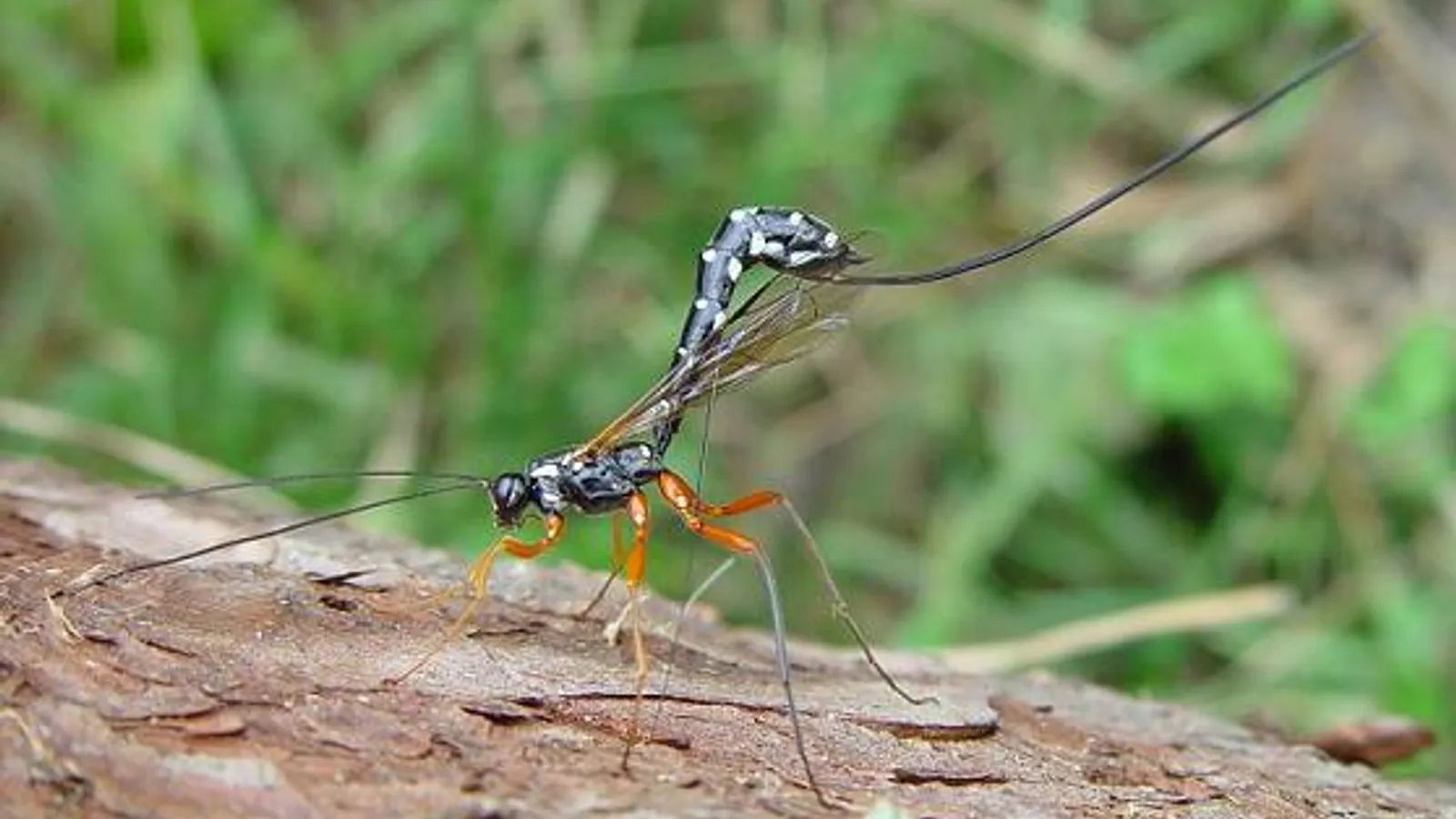
— Where the name comes from
Persuasoria is a joke of a name, and Linnaeus knew it well: “the persuasive one”, for an animal that persuades by drilling. Rhyssa comes from the Greek rhyssós, wrinkled, after the folds of the abdomen. Ichneumon, the family name, is ichneúmōn, “the tracker, he who follows the trail” — and no other word better describes what this wasp does for a living.
— Facts
- Group
- Insects · Insecta
- Order
- Bees, wasps and ants
- Habitat
- Coniferous woodland, on dead or declining trunks
- Range
- Europe, Asia, North America
- Size
- Body 20–40 mm; the female’s ovipositor up to 40 mm
- Diet
- Nectar as an adult; horntail larvae as a larva
- Lifespan
- A few weeks as an adult
— Characteristics
- 01
The ovipositor is as long as the insect’s entire body.
- 02
It drills four centimetres of living wood to reach its host.
- 03
It locates the hidden larva through the wood, without seeing it.
— What sets it apart
It walks the trunk drumming with its antennae and listens: the horntail larvae gnawing inside produce vibrations and a smell of symbiotic fungi that filters through the wood, and from these two clues the wasp works out where the prey lies four centimetres down. Then it rears up, sets the ovipositor perpendicular to the bark and begins to bore, alternating the two valves like a drill bit, for an hour or more. The egg is laid on the larva, which will be eaten alive. It was thinking of parasitoids like this one that Darwin wrote he could not reconcile the idea of a benevolent creator with the existence of such habits.
