
Weaver ant
Oecophylla smaragdina
— Where the name comes from
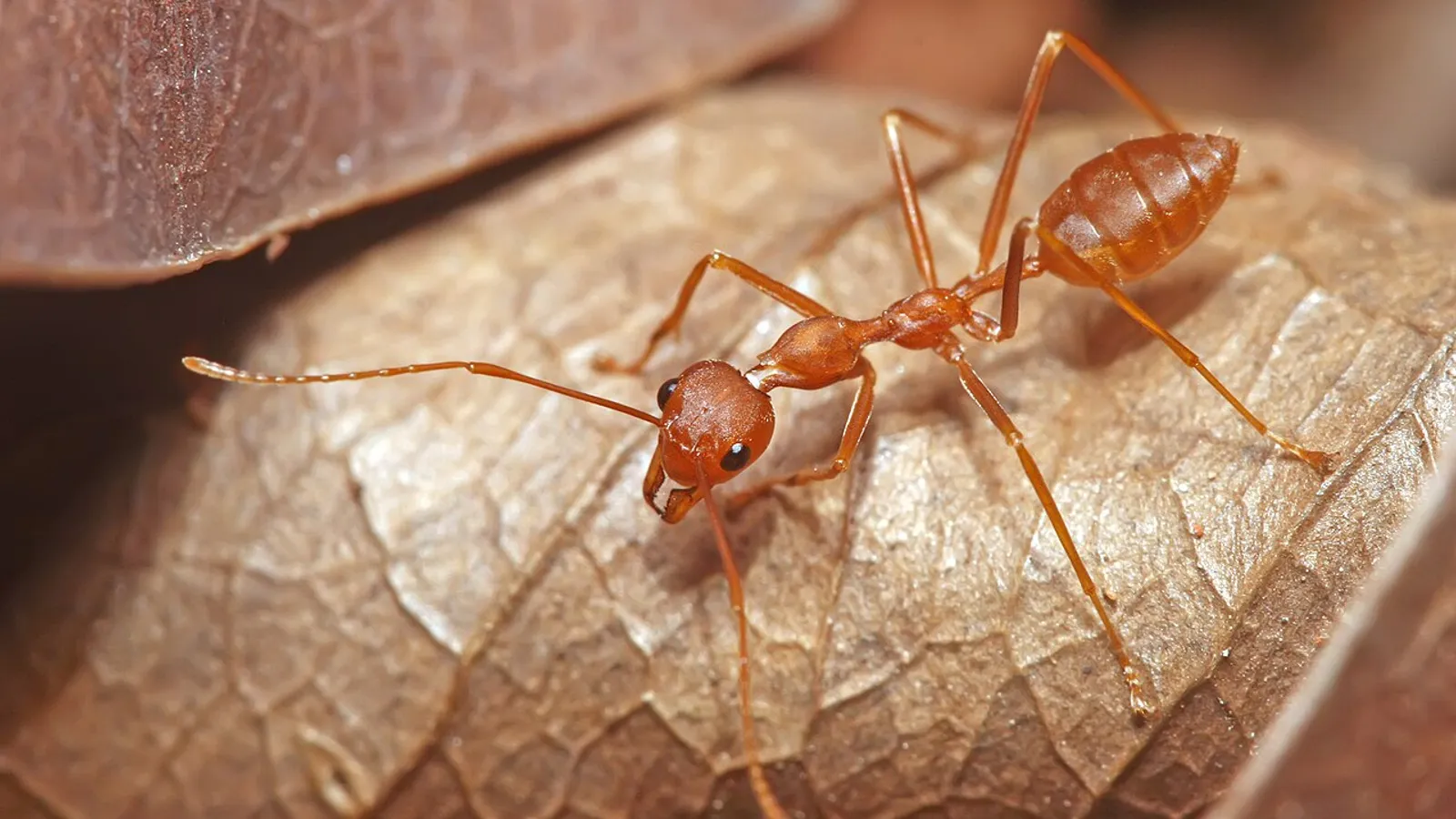
Oecophylla is “house of leaves”, from oîkos, the house, and phýllon, the leaf: the nest is made of living leaves still attached to the branch, drawn together and sewn. Smaragdina means “of emerald”, from the Greek smáragdos, after the green abdomen of some populations. It is a name that describes the architecture and the colour, and for once there is nothing to add: the animal is exactly that.
— Facts
- Group
- Insects · Insecta
- Order
- Bees, wasps and ants
- Habitat
- Tree canopies in tropical forest and plantations
- Range
- From India to northern Australia, across South-East Asia
- Size
- Workers 5–10 mm
- Diet
- Captured insects and the honeydew of the bugs it farms
- Lifespan
- The colony many years; the queen as much as eight
— Characteristics
- 01
It uses its own larvae as tubes of glue to sew the leaves.
- 02
A colony occupies several trees and numbers half a million individuals.
- 03
It forms bridges and chains of bodies to draw two leaf edges together.
— What sets it apart
The adult workers produce no silk: only the larvae do, and so the adults take them in their jaws and use them as tubes of glue, passing them back and forth between the two leaf edges to be joined while the larvae release thread on cue. It is one of the very few documented cases of an animal using a living tool. These same ants are also the oldest biological pesticide in history: as early as the fourth century a Chinese text describes citrus growers buying nests of this species at market and tying them from tree to tree with bamboo ropes so that the ants would patrol the orchard.
