Northern bald ibis
Geronticus eremita
— Where the name comes from
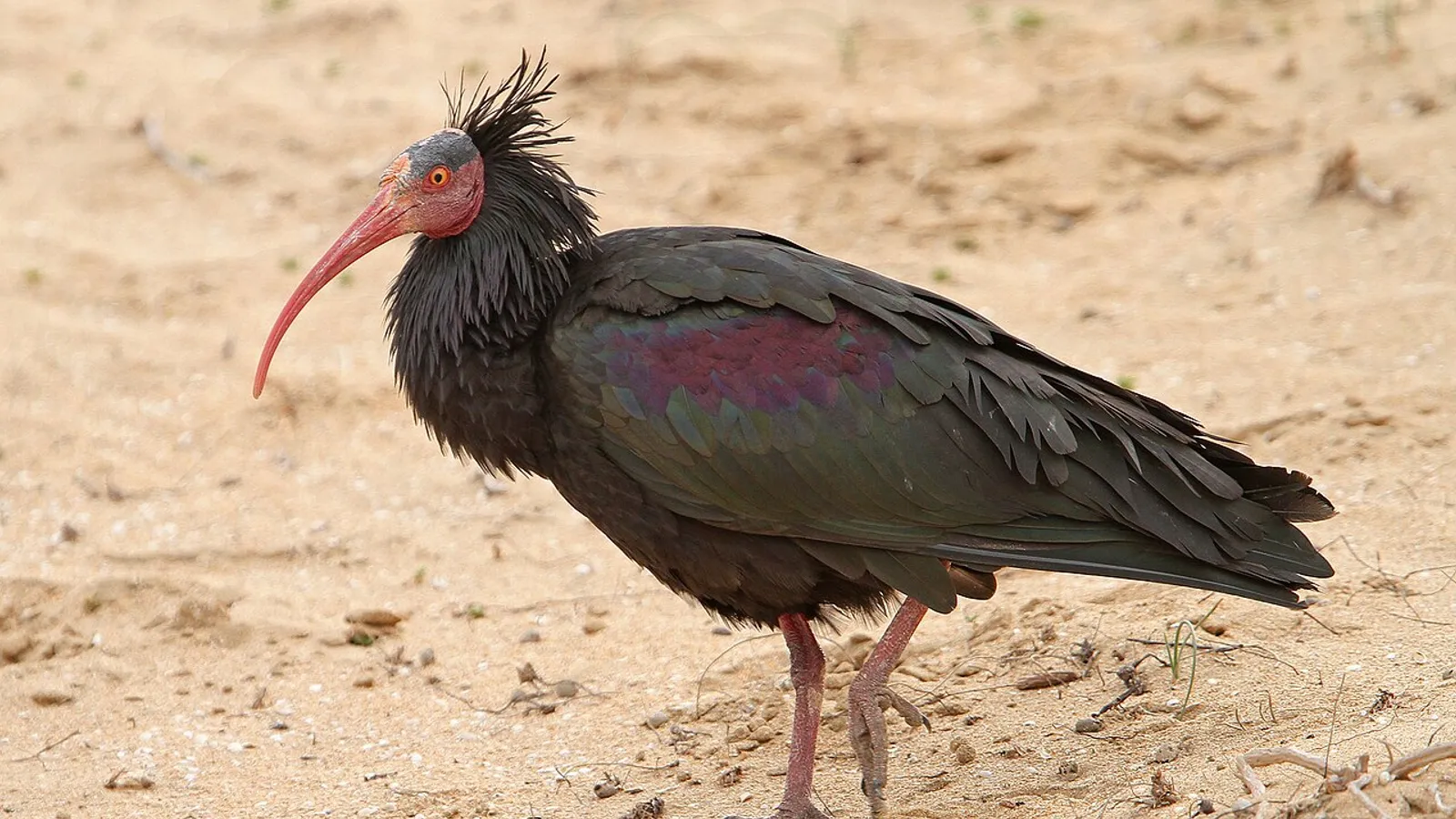
Geronticus comes from the Greek gerontikós, “of an old man”, for the bald, wrinkled head. Eremita, “the hermit”, alludes to the dry, rocky places where it lives. In ancient Egypt its crested profile was a hieroglyph, the one for the word akh, the luminous spirit of the dead.
— Facts
- Group
- Birds · Aves
- Order
- Pelicans and allies
- Habitat
- Semi-arid steppe and cliffs, pasture
- Range
- Morocco; reintroduced populations in Austria, Germany, Spain and Italy
- Size
- 70–80 cm, wingspan 125–135 cm, 1–1.3 kg
- Diet
- Insects, larvae, lizards, small animals
- Lifespan
- Over 20 years
— Characteristics
- 01
It has a bare red head and a ragged tuft of feathers on its nape.
- 02
Its black plumage has metallic green and purple sheens.
- 03
It nests in colonies on rock ledges.
— What sets it apart
In the sixteenth century it lived in central Europe, and the Swiss naturalist Conrad Gessner described it as the “forest raven”. Shortly afterwards it vanished, and for three centuries Gessner’s description was taken for fantasy, until it was realised that it matched an African bird still alive. Today an Austrian project is bringing it back to Europe in spectacular fashion: since the migration route is learnt from parents, young birds born in captivity are led by a microlight aircraft from the Alps to the Orbetello lagoon, in Tuscany, where they spend the winter.