
Eurasian eagle-owl
Bubo bubo
— Where the name comes from
Bubo is Latin, and imitates the owl’s deep call, a hollow “boo-hoo” in the night. It is an onomatopoeic word, as the names of nocturnal raptors are in many languages. It is the largest owl in the world, a predator that rules the darkness of European woods.
— Facts
- Group
- Birds · Aves
- Order
- Owls
- Habitat
- Forests, rocky gorges, mountains, open country with crevices
- Range
- Eurasia, from Europe to Japan
- Size
- 58–75 cm, wingspan 160–188 cm
- Diet
- Carnivore — from mice to young roe deer, from other raptors to hedgehogs
- Lifespan
- 20 years
— Characteristics
- 01
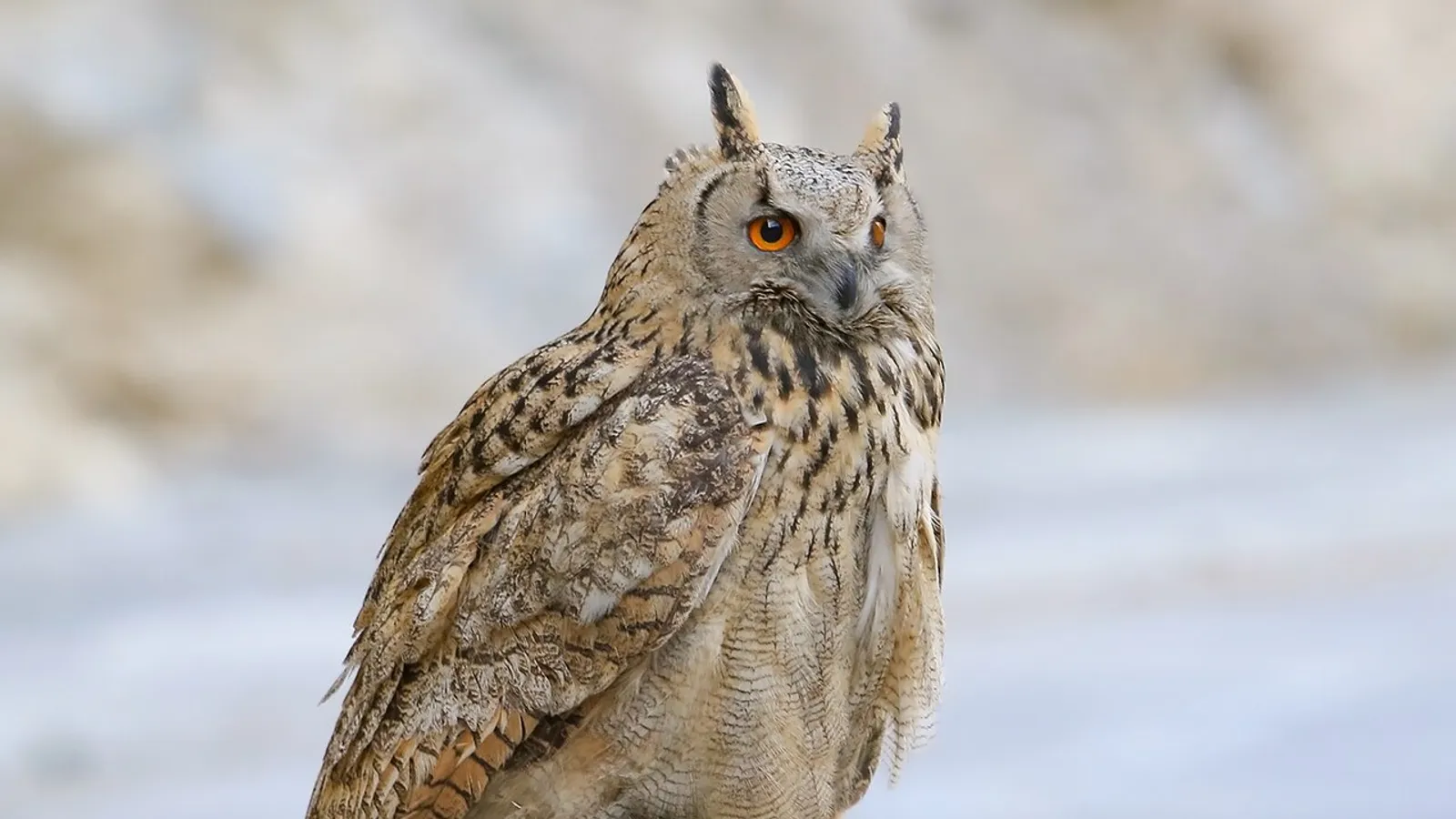
The “tufts” on the head are not ears but feathers, used for signalling and for camouflage.
- 02
Fringed feather edges make the flight completely silent.
- 03
The huge orange eyes do not swivel: to look around it turns the whole head, up to 270°.
— What sets it apart
The eagle owl’s flight is silent by design: the leading edge of the flight feathers is serrated, breaking the airflow into a thousand tiny eddies and cancelling the rush that would give it away. The prey does not hear it coming, and the owl, gliding, goes on hearing the least movement in the undergrowth. Engineers study those edges to build quieter wind turbine blades and fans.
