
Short-eared owl
Asio flammeus
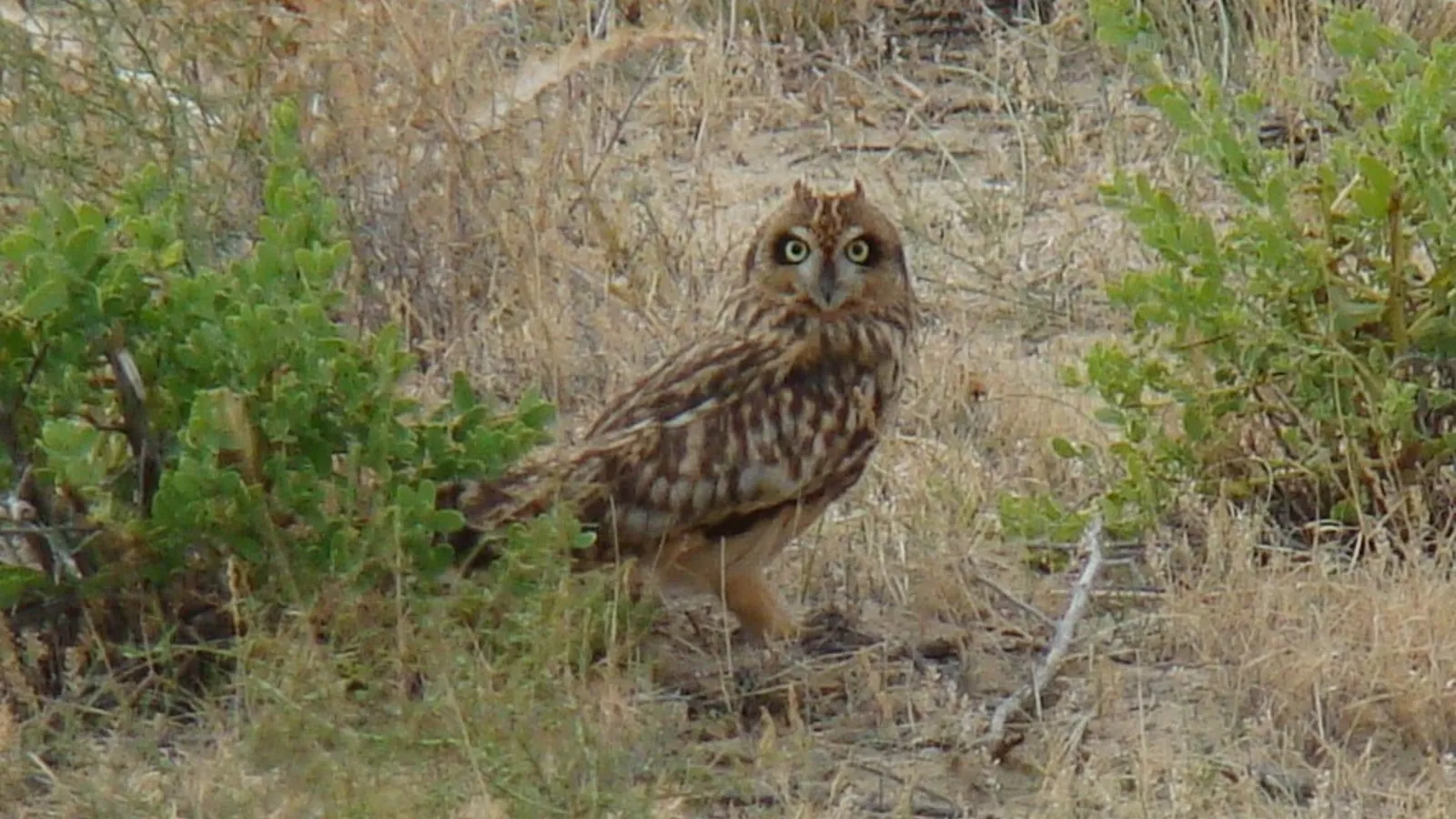
— Where the name comes from
Asio was the Latin name of a tufted owl, taken up by Linnaeus for this genus; flammeus means “flame-coloured”, for the bright tawny plumage. In this species the tufts are so short that they usually cannot be seen at all: the genus name describes the relative, not the bird.
— Facts
- Group
- Birds · Aves
- Order
- Owls
- Habitat
- Marshes, bogs, grassland, dunes, steppe, tundra
- Range
- Europe, Asia, the Americas and many oceanic islands
- Size
- 33–43 cm, wingspan 85–110 cm, 200–500 g
- Diet
- Voles, mice, small birds
- Lifespan
- 12 years in the wild
— Characteristics
- 01
It hunts by day, flying low and slow over the grass like a butterfly.
- 02
It nests on the ground, in a hollow among tussocks.
- 03
It claps its wings together beneath the body during courtship.
— What sets it apart
It has no fixed address: it follows the voles. Rodent populations in cold climates boom and crash on three- or four-year cycles, and this owl moves accordingly, appearing in thousands where there were none the year before and gone the year after. That readiness to go anywhere has carried it to islands in mid-ocean — the Galápagos, Hawaii, the Falklands, the Canaries — where it settled and formed populations of its own. It is one of the most widespread birds of prey on the planet, and it is attached to nothing.
