
Oilbird
Steatornis caripensis
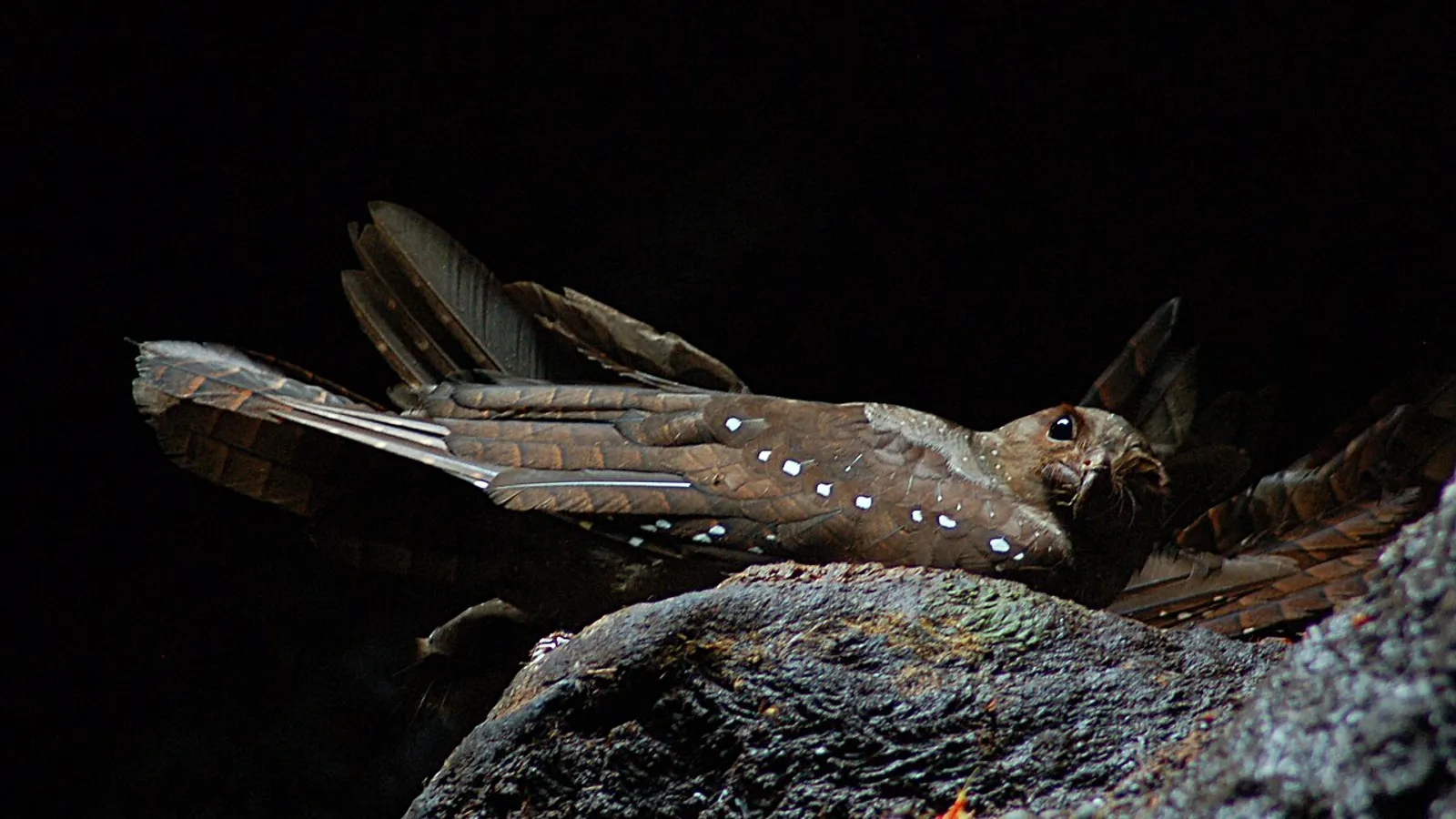
— Where the name comes from
Steatornis is “suet bird”, from stéar, fat: the chicks, fed entirely on oily fruit, grow heavier than their parents, and for centuries they were taken from the caves and boiled down for a clear, odourless lamp oil. Caripensis comes from the Cueva del Guácharo in Venezuela, where Alexander von Humboldt described it in 1799.
— Facts
- Group
- Birds · Aves
- Order
- Oilbird
- Habitat
- Deep caves; tropical forest for feeding at night
- Range
- From Panama to Peru, Venezuela, Trinidad and the Guianas
- Size
- 40–49 cm, wingspan 95–110 cm, 350–475 g
- Diet
- Exclusively the oily fruit of palms and laurels
- Lifespan
- 20 years in the wild
— Characteristics
- 01
It lives in colonies of thousands in the total darkness of caves.
- 02
It emerges only at night and flies up to a hundred kilometres to find fruit.
- 03
It is the only nocturnal bird in the world that feeds solely on fruit.
— What sets it apart
In the darkness of the cave it navigates by echo, like a bat, but with clicks we can hear ourselves: anyone entering a colony hears a continuous deafening crackle mixed with cries that struck Humboldt as human wailing — guácharo, in the local Spanish, means “one who whimpers”. It is one of only two groups of birds ever to have invented echolocation. Going out each night, it seeds the forest with the stones it regurgitates: the woods around a guácharo cave are, in large part, a catalogue of what these birds have eaten.
