
Black-bellied sandgrouse
Pterocles orientalis
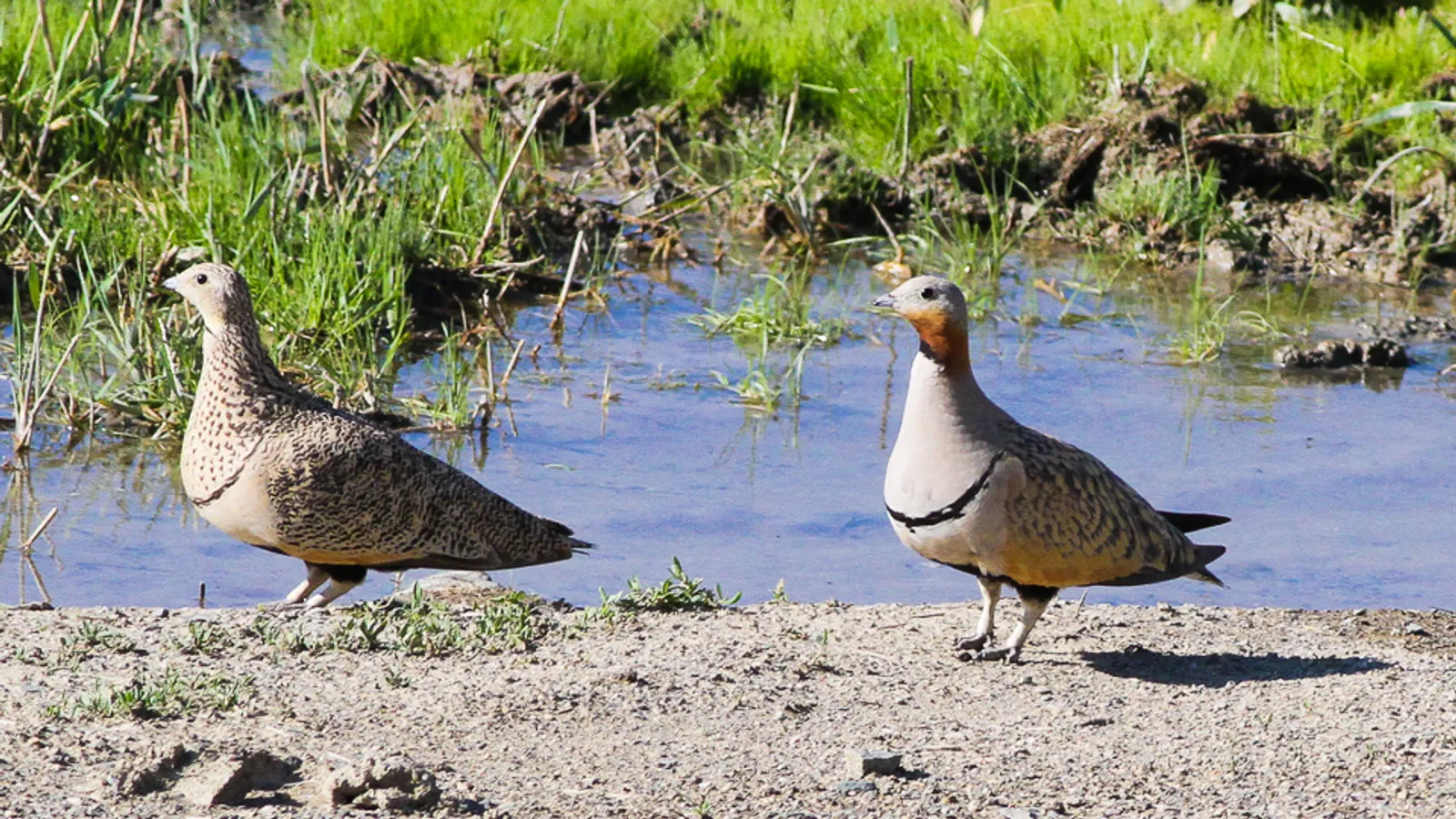
— Where the name comes from
Pterocles contains the Greek pterón, the wing, joined to a second root the lexicographers do not agree on; orientalis says only that the first specimen came from the east. For a long time these birds were placed among the pigeons and among the gamebirds without anyone knowing where they truly belonged: today they have an order of their own, and their nearest relatives turn out to be the small waders.
— Facts
- Group
- Birds · Aves
- Order
- Sandgrouse
- Habitat
- Arid steppe, cereal pseudo-steppe, stony desert
- Range
- Iberia, North Africa, the Middle East, Central Asia
- Size
- 30–35 cm, wingspan 70–73 cm, 400–550 g
- Diet
- Seeds of legumes and dry grasses
- Lifespan
- 10 years in the wild
— Characteristics
- 01
It flies fast and straight, in flocks that move at dawn.
- 02
The plumage reproduces exactly the colour of the ground it nests on.
- 03
It goes to water always at the same hour, in parties arriving from far off.
— What sets it apart
The male carries water to his young in his belly feathers. Those feathers have a microstructure found nowhere else in the world — barbules coiled into spirals that unwind on contact with water and hold it by capillary action — and work like a sponge: the bird wades in to the breast in a pool, soaks itself, flies as much as thirty kilometres back to the nest, and there the chicks draw their bills through the feathers to drink. It is the only bird that has solved the desert by turning its own plumage into a water bottle.
