
Atlantic marsh fiddler crab
Minuca pugnax
— Where the name comes from
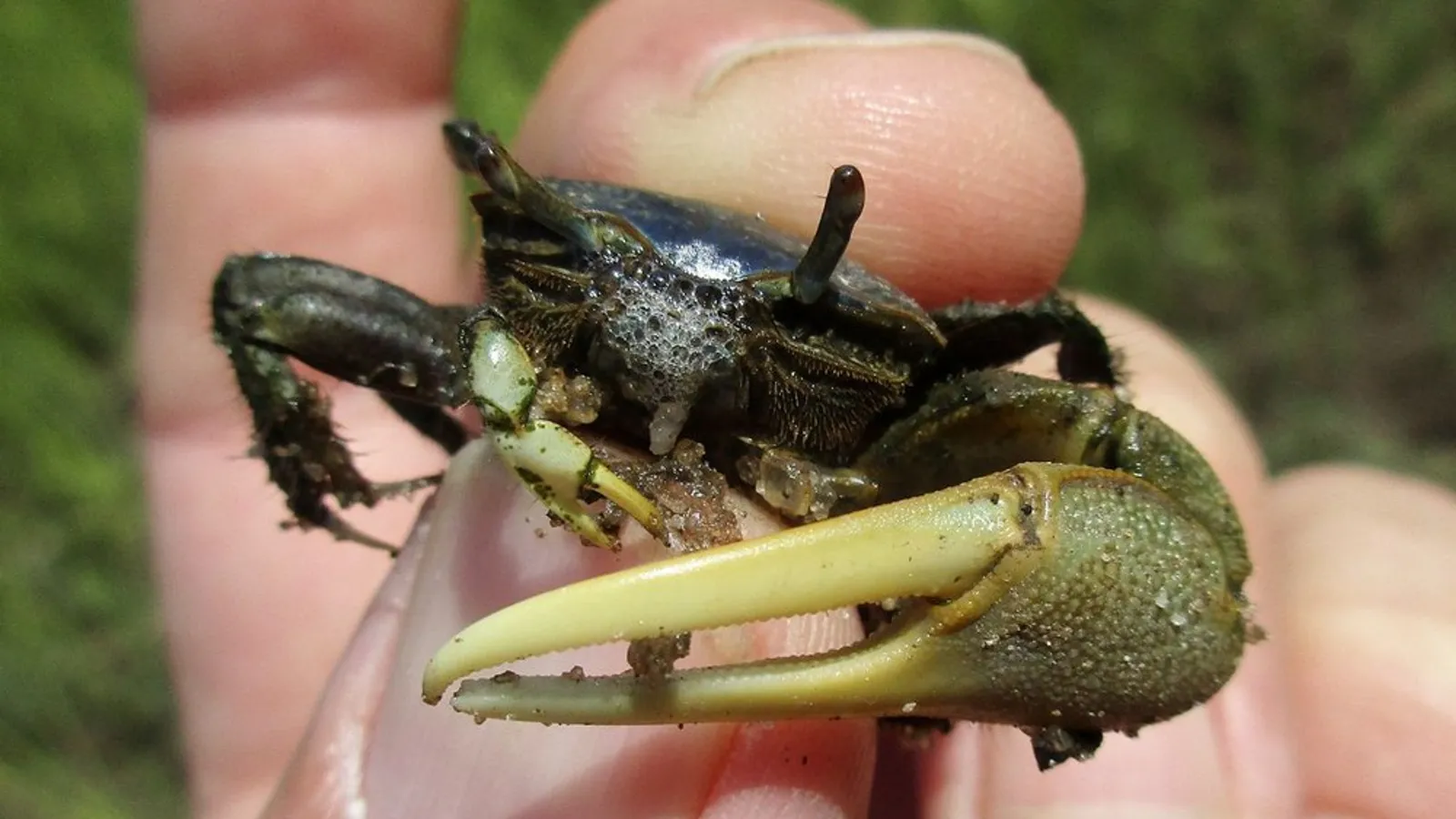
Pugnax is Latin for “combative”. The common names look instead at the gesture: the male has one enormous claw and one tiny one, and when he waves the large one in front of his burrow he seems to be drawing a bow across a fiddle held in the other hand. English calls it fiddler crab, Spanish cangrejo violinista, Italian granchio violinista — three languages that saw a musician where there was a courtship.
— Facts
- Group
- Crustaceans · Malacostraca · Maxillopoda
- Order
- Crabs, lobsters and shrimps
- Habitat
- Salt marshes, in burrows dug in the mud
- Range
- Atlantic coast of North America, from Massachusetts to Florida
- Size
- 2–3 cm carapace; the male’s claw nearly as much
- Diet
- Detritus and algae sifted from the mud
- Lifespan
- 1–2 years
— Characteristics
- 01
The male’s big claw weighs as much as a third of his whole body.
- 02
It feeds by sifting mud with the small claw and spitting out waste pellets.
- 03
It has an internal clock set to the tides, not to the sun.
— What sets it apart
It carries a tide clock inside. Kept in the laboratory in constant darkness, with no water rising and falling, it goes on for weeks changing colour and activity on a cycle of twelve hours and twenty-five minutes — exactly the interval between two high tides, and not the twenty-four hours of the solar day. It is one of the first non-circadian biological rhythms ever demonstrated, and it was found on these crabs in the 1950s. The oversized claw meanwhile costs: it slows escape, and a male who loses it regrows a lighter, weaker one, good for display but not for fighting.
