
Coconut crab
Birgus latro
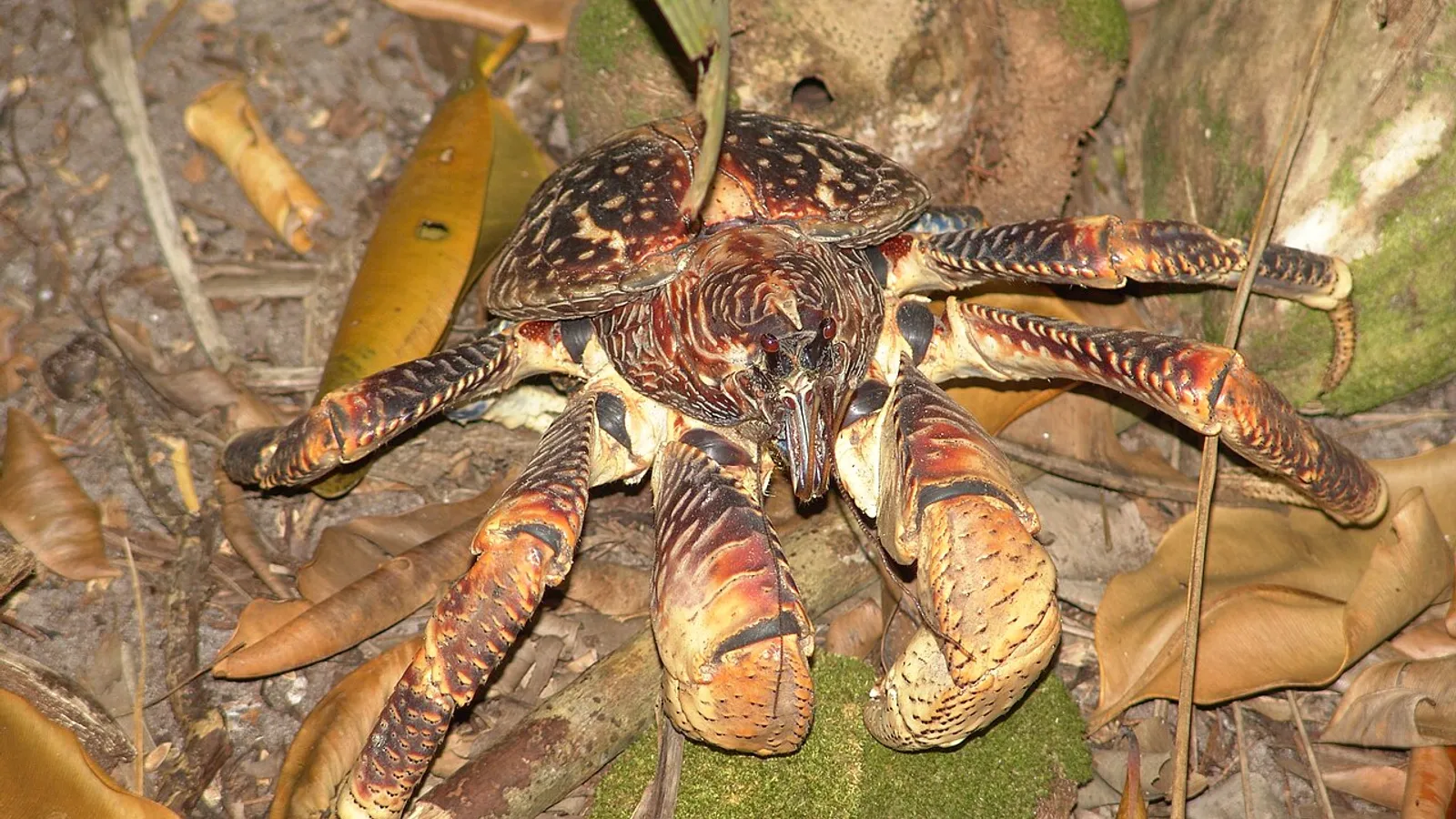
— Where the name comes from
Latro in Latin is the thief, the brigand: the first Europeans who saw it were convinced it stole from huts, and the reputation has stuck in every language — robber crab in English, “thief crab” across half of Europe. In truth it steals very little, but it is strong enough to carry off whatever it decides to take, and that is what frightened people.
— Facts
- Group
- Crustaceans · Malacostraca · Maxillopoda
- Order
- Crabs, lobsters and shrimps
- Habitat
- Forest and scrub of tropical islands, in burrows among roots
- Range
- Islands of the Indian Ocean and western Pacific
- Size
- Up to 40 cm of body and 1 metre leg span; 4 kg
- Diet
- Fruit, coconuts, carrion, other crabs
- Lifespan
- Over 60 years
— Characteristics
- 01
It is the largest land arthropod in the world.
- 02
As an adult it drowns if held under: it breathes organs adapted to air.
- 03
Its claw grips with a force comparable to a lion’s bite.
— What sets it apart
It is a hermit crab that has stopped carrying its house. When young it uses a shell like the rest, then the abdomen hardens and it abandons it for good: as an adult it not only has no need of water but drowns if it ends up in it. It opens coconuts by sheer force of claw, work that takes it days, and its grip has been measured at over three hundred newtons per kilogram of body mass, the most powerful of any crustacean. On Christmas Island it is protected, and there is a celebrated — never confirmed — suggestion that one of these animals disposed of Amelia Earhart’s remains.
