
Mediterranean feather star
Antedon mediterranea
— Where the name comes from
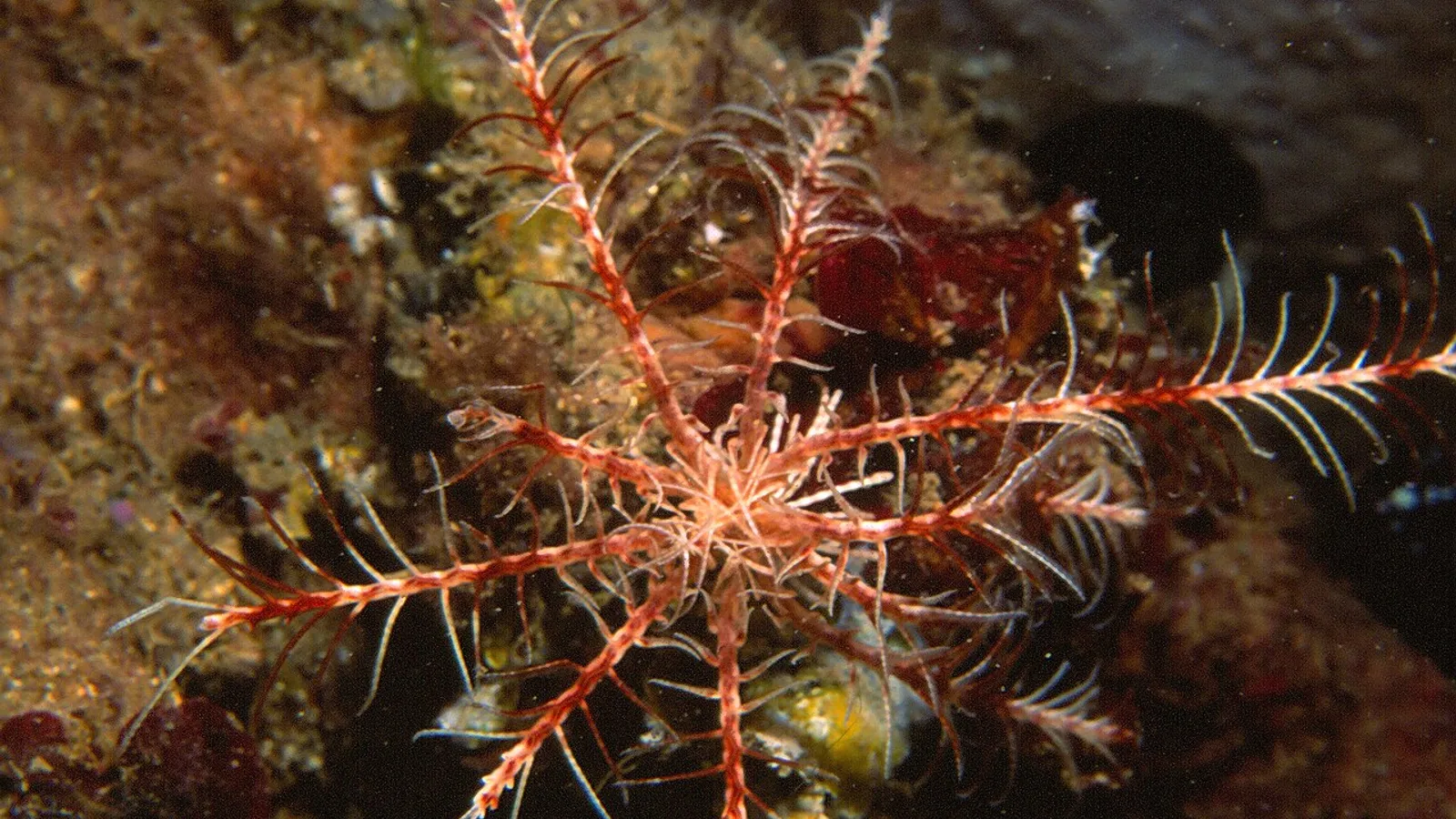
The class name is the part that tells the story: Crinoidea comes from krínon, the lily, because these animals look like flowers — a cup at the centre and ten feathery arms opened into a corolla. For centuries they were held to be plants, and the fossils of their stalks, extremely common in rock, were called “star stones” and worn as charms before anyone understood what they were.
— Facts
- Group
- Echinoderms · Echinodermata
- Order
- Feather stars
- Habitat
- Rocky and coralligenous bottoms between 10 and 200 metres
- Range
- Mediterranean
- Size
- 10–20 cm across with arms extended
- Diet
- Plankton caught by the feathery arms
- Lifespan
- 5–10 years
— Characteristics
- 01
As an adult it has no stalk: it grips with hooked appendages and moves.
- 02
It swims by waving its arms alternately, in a hypnotic motion.
- 03
It has ten branched arms covered in adhesive pinnules.
— What sets it apart
It is the oldest branch of the living echinoderms, and in Palaeozoic seas its relatives formed true meadows of stalks: whole limestone formations are made almost entirely of their remains, and the discs of the stalk — pierced through the centre — were threaded as beads by English monks, who called them “Saint Cuthbert’s beads”. Modern forms like this one have lost the stalk as adults and become mobile: they detach, swim by waving their ten arms in alternating sequences, and reattach elsewhere. It is a flower that has learned to leave.
