
Lar gibbon
Hylobates lar
— Where the name comes from
Hylobates joins the Greek hýle, “wood, forest”, and bátes, “one who walks”: literally “he who walks among the trees”, a perfect portrait of a wholly arboreal existence. The epithet lar points to the Lares, the household guardian spirits of the Romans. The common name “gibbon” reached Europe through 18th-century French, of uncertain and perhaps Asian origin, while “white-handed” fixes the most recognisable trait: pale hands and feet standing out against an otherwise dark coat.
— Facts
- Group
- Mammals · Mammalia
- Order
- Primates
- Habitat
- Tropical rainforest, in the canopy.
- Range
- South-East Asia: the Malay peninsula, Thailand, eastern Myanmar, Laos and northern Sumatra.
- Size
- 42–59 cm, 5–7 kg; tailless
- Diet
- Frugivore — ripe fruit, leaves and insects
- Lifespan
- Up to 25 years in the wild, over 40 in captivity
— Characteristics
- 01
It moves by brachiation, swinging between branches on outstretched arms, and can clear gaps of several metres.
- 02
Pairs are monogamous and defend their territory with sung duets at dawn, male and female taking turns.
- 03
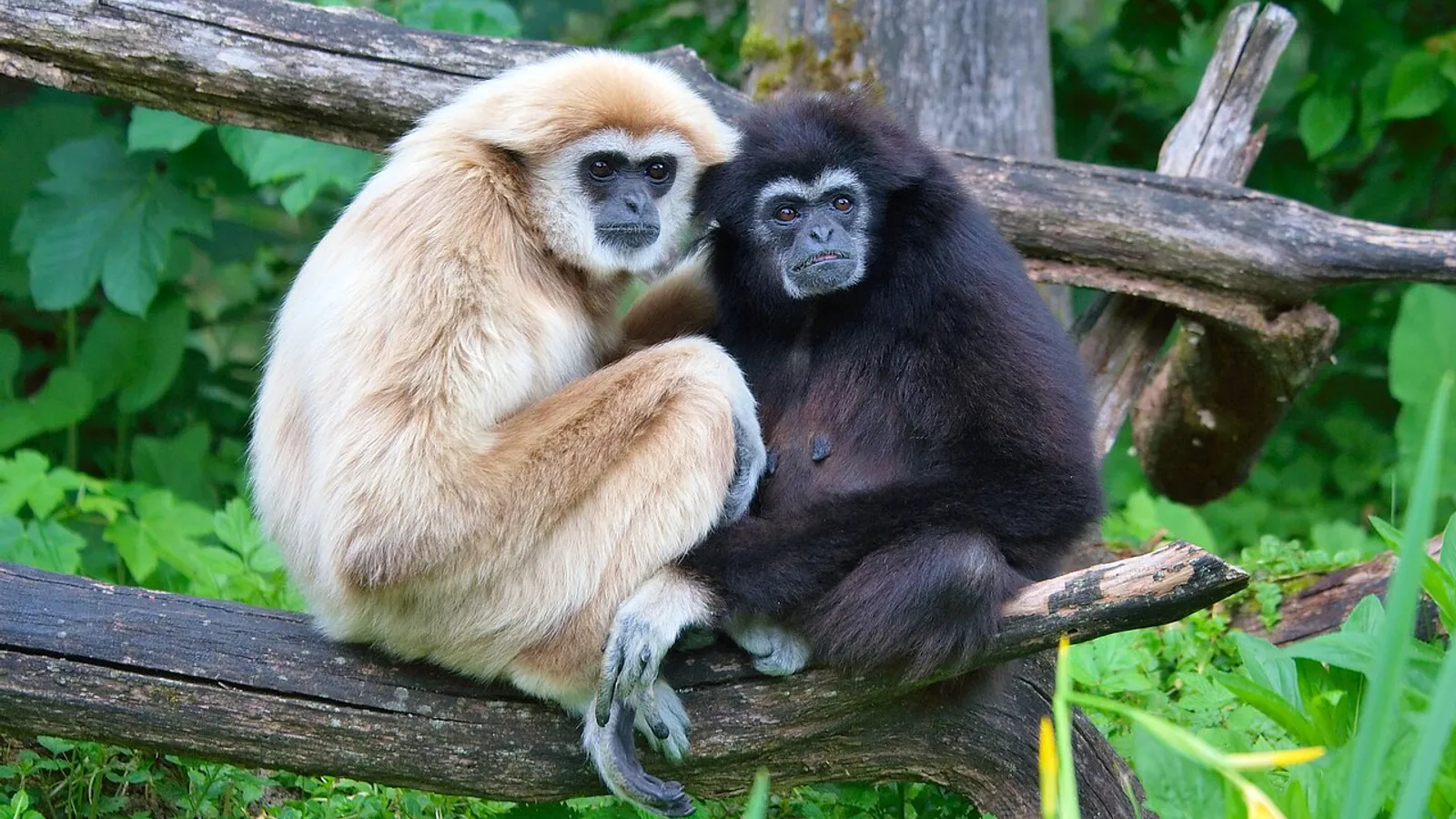
Coat colour ranges from cream to black, but hands and feet stay a clear white.
— What sets it apart
The secret of the gibbon’s agility is in the wrist: it has a ball-and-socket joint, almost a shoulder in miniature, which lets the hand rotate around the branch while the body swings forward. This adaptation, rare among primates, allows it to cross the forest at a surprisingly low energy cost, like a pendulum keeping itself in motion. Little wonder that gibbons are reckoned the fastest and most elegant of all tree-dwelling animals.
