Common kestrel
Falco tinnunculus
— Where the name comes from
Falco derives from the Latin falco, which many trace to falx, “sickle”, for the curved outline of the wings in flight or of the talons. The epithet tinnunculus is a diminutive of the Latin tinnulus, “ringing”, and alludes to the sharp repeated call, a shrill “kee-kee-kee”. The Italian gheppio is of uncertain origin, probably onomatopoeic, born likewise of the echo of that insistent cry.
— Facts
- Group
- Birds · Aves
- Order
- Falcons
- Habitat
- Open country: farmland, grassland, coasts and city edges.
- Range
- A wide range across Europe, Asia and Africa.
- Size
- 32–39 cm, wingspan 65–82 cm; 130–300 g
- Diet
- Carnivore — small rodents, insects and lizards
- Lifespan
- A few years on average, up to about 16
— Characteristics
- 01
It is the only European raptor that can hold still in mid-air, hovering into the wind.
- 02
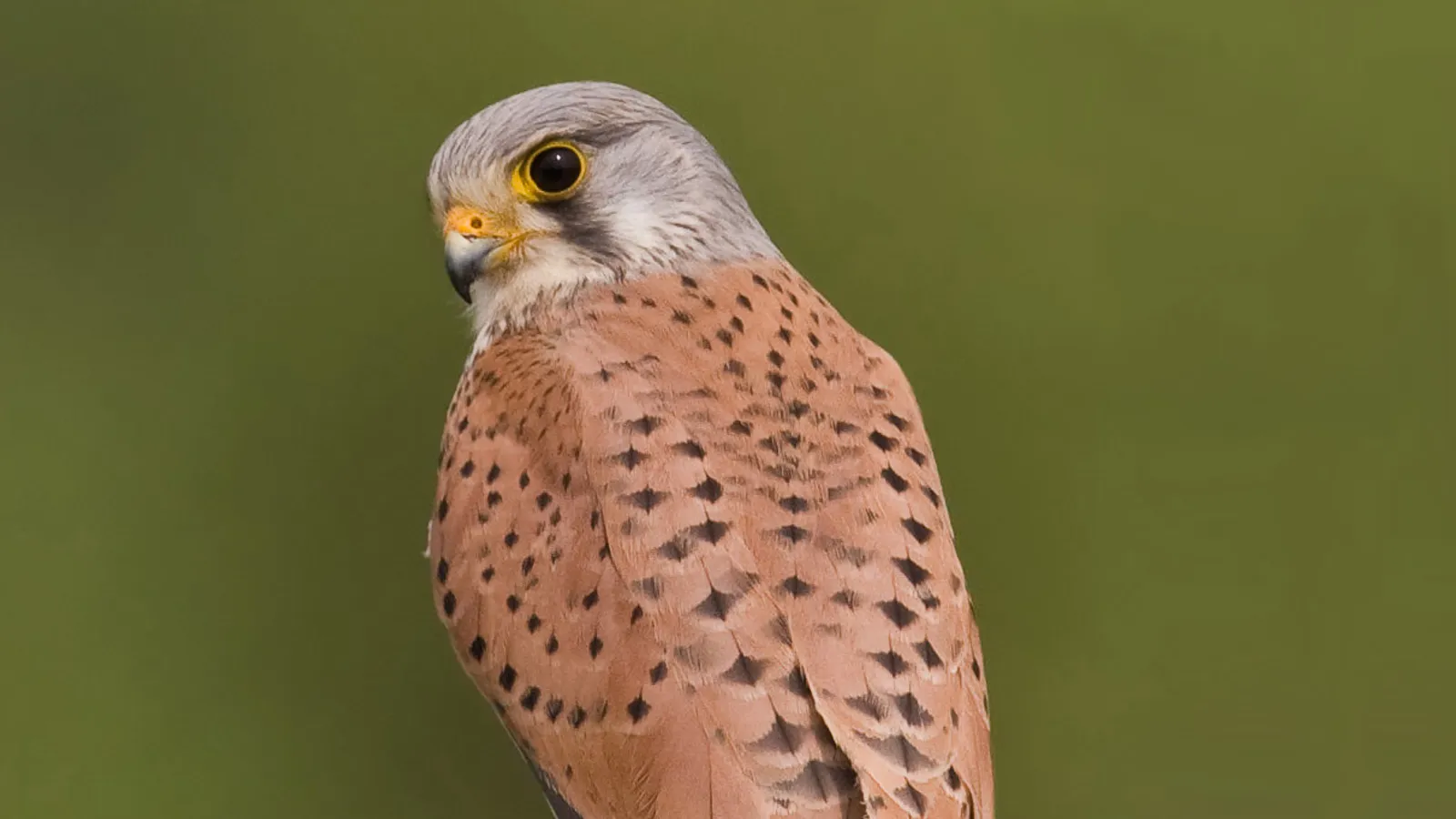
The male has a blue-grey head and tail, the female is more uniformly brown and barred.
- 03
It often nests on buildings, ledges and old quarries, adapting well to cities.
— What sets it apart
The kestrel hunts what we cannot see: it perceives ultraviolet light and can pick out the traces of urine mice leave along their runs. Because those trails reflect ultraviolet, the busiest corridors glow to its eyes like maps of prey. Hanging motionless in the wind, the bird is not simply scanning the ground: it is reading the invisible footprints of the rodents’ passage.