
Lesser Egyptian gerbil
Gerbillus gerbillus
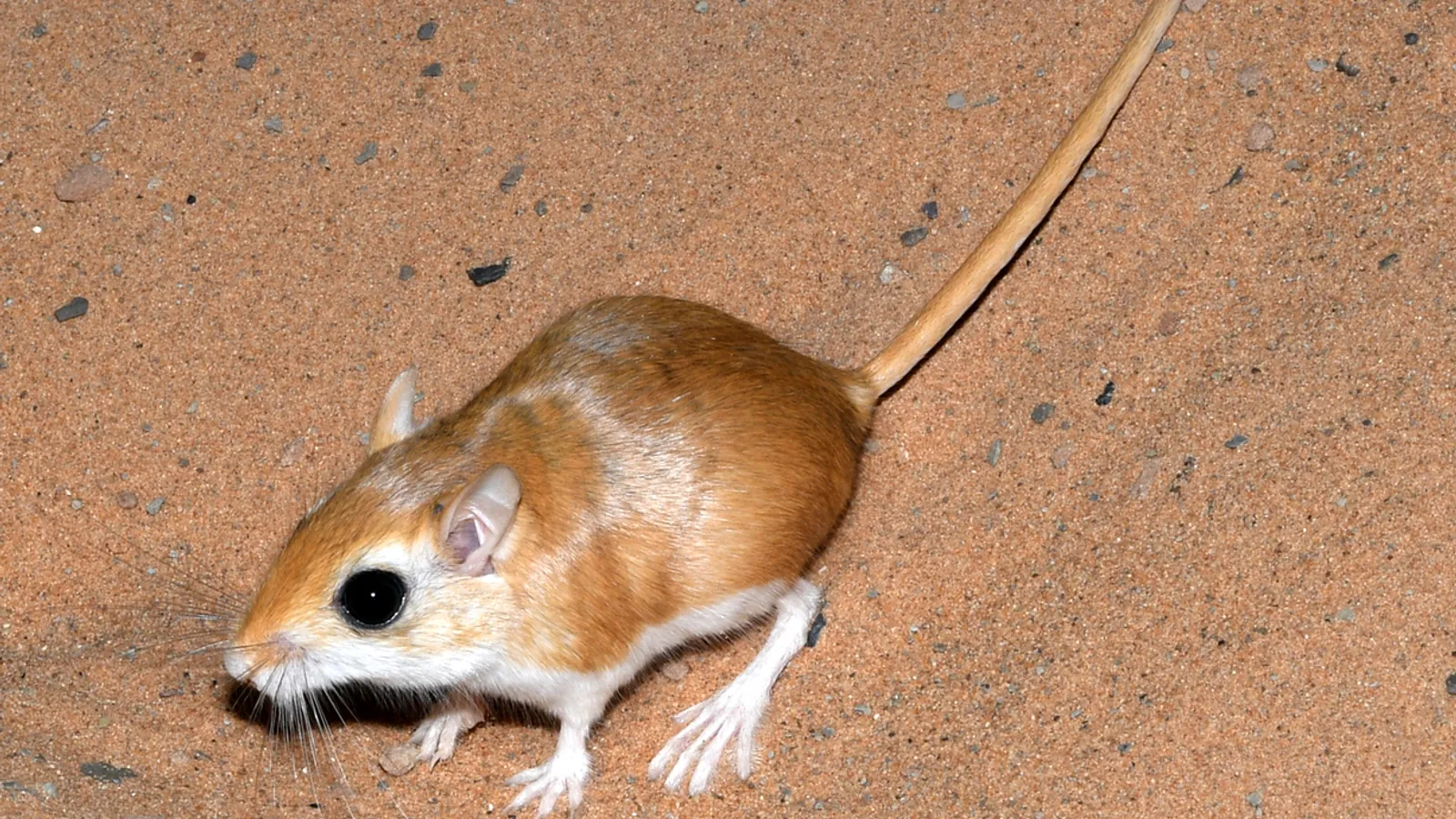
— Where the name comes from
Gerbillus is the latinised diminutive of jerboa, which comes from the Arabic yarbū‘, the word the Bedouin use for the leaping rodents of the desert. It is therefore “the little yarbū‘”, a diminutive of a loanword: one of those names in which one can hear naturalist knowledge passing from the Arab world to Europe through translation.
— Facts
- Group
- Mammals · Mammalia
- Order
- Rodents
- Habitat
- Dunes, shifting sand, deserts with sparse vegetation
- Range
- North Africa from Morocco to Egypt and Sudan, Israel, Arabia
- Size
- 9–12 cm of body, tail 10–14 cm, 20–40 g
- Diet
- Seeds, roots, leaves, insects
- Lifespan
- 3 years
— Characteristics
- 01
The soles of its feet are furred, working as snowshoes on sand.
- 02
It does not drink: it takes its water from seeds and from its own metabolism.
- 03
It plugs the entrance of its burrow from inside to hold in the daytime humidity.
— What sets it apart
The tympanic bullae of its skull are enormous relative to the rest, and the reason is acoustic: a large air chamber amplifies the very lowest frequencies, those made by the wingbeat of a barn owl or the slide of a viper over sand. In the desert, where there is nothing to hide behind, the only defence is to hear the predator coming before it is in range — and half these gerbils’ skulls is given over to that task.
