
Pallas's cat
Otocolobus manul
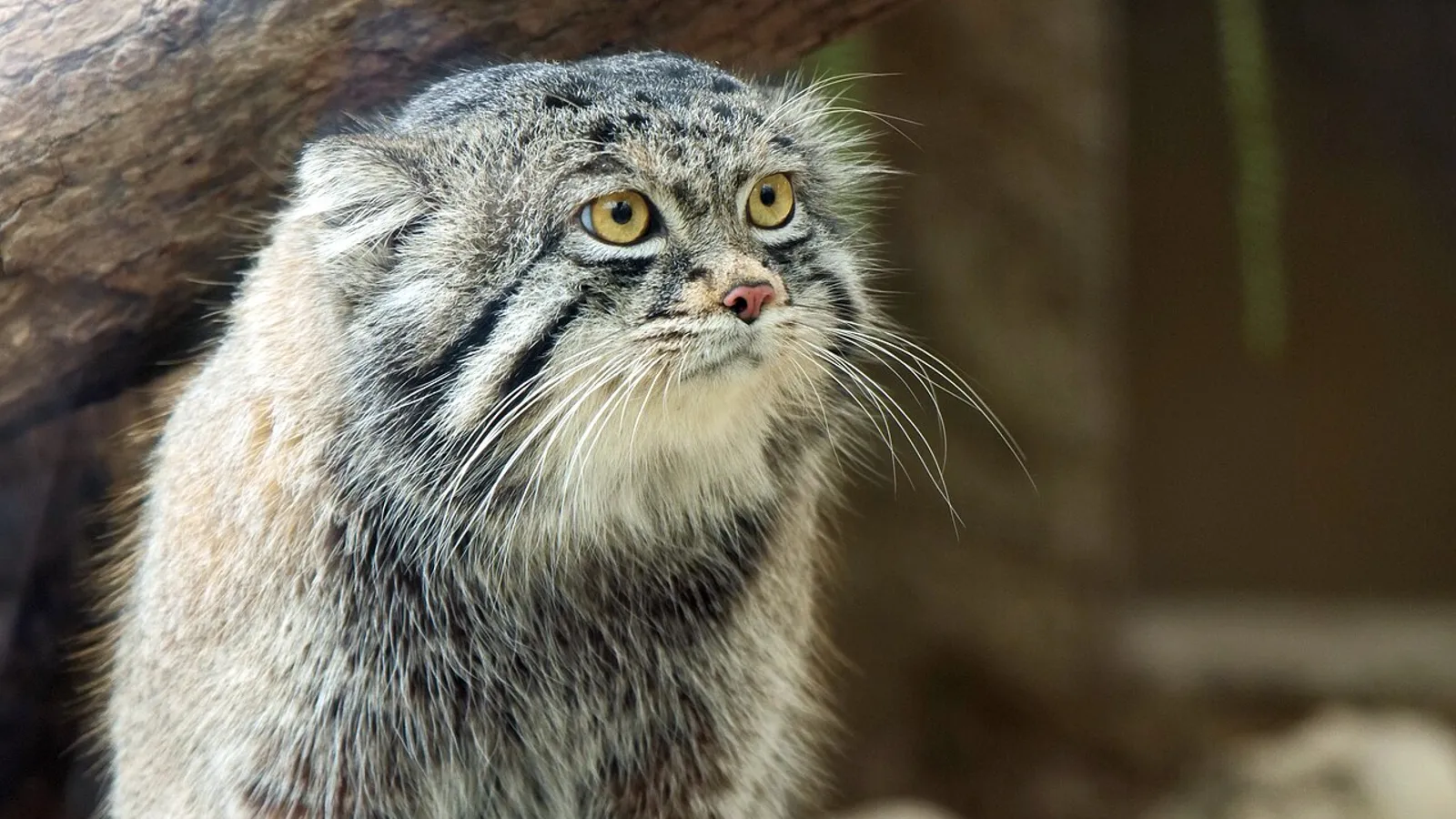
— Where the name comes from
Otocolobus is Greek and sounds abrupt: oûs, ōtós, “ear”, and kolobós, “docked” — the animal with cropped ears, for the tiny pinnae set low on the sides of the skull. Manul is the Mongolian word for the animal. The common name recalls Peter Simon Pallas, a German naturalist in Russian service, who described it on the shores of the Caspian in 1776.
— Facts
- Group
- Mammals · Mammalia
- Order
- Carnivores
- Habitat
- Cold steppe, semi-desert, rocky slopes between 1,000 and 5,000 metres
- Range
- Central Asia: Mongolia, western China, Iran, the Tibetan plateau
- Size
- 46–65 cm long, 2.5–4.5 kg
- Diet
- Carnivore — pikas above all, rodents, small birds
- Lifespan
- 11–12 years
— Characteristics
- 01
It has the densest, longest fur of any cat, twice as thick on the belly for sitting on snow.
- 02
Its pupils stay round even in bright light, instead of narrowing to a slit as in other cats.
- 03
The low-set ears let it peer over a rock without giving away its outline.
— What sets it apart
Every feature of its appearance — the broad flat face, the flattened ears, the permanently outraged expression that has made it famous online — is an adaptation to ambush on a treeless steppe. Where there is nothing to hide behind, the only cover is the lie of the land: so the head goes down, the ears withdraw, and the eyes are the only thing showing above a stone. That comical face is the shape a predator takes when the landscape grants it no hiding place at all.
