
Common prawn
Palaemon serratus
— Where the name comes from
Palaemon is a Greek sea god: he was Melicertes, a child whose maddened mother threw him into the sea along with herself, and whom the gods turned into a deity of the waters who saves the shipwrecked. Serratus is Latin for “serrated”, after the toothed rostrum the animal carries between its eyes like a small blade. A god of castaways and a saw: the name does not even try to be coherent.
— Facts
- Group
- Crustaceans · Malacostraca · Maxillopoda
- Order
- Crabs, lobsters and shrimps
- Habitat
- Rock pools and rocky bottoms with algae, down to 40 metres
- Range
- Eastern Atlantic from Denmark to Mauritania, Mediterranean
- Size
- 5–11 cm
- Diet
- Algae, detritus, small invertebrates
- Lifespan
- 3–4 years
— Characteristics
- 01
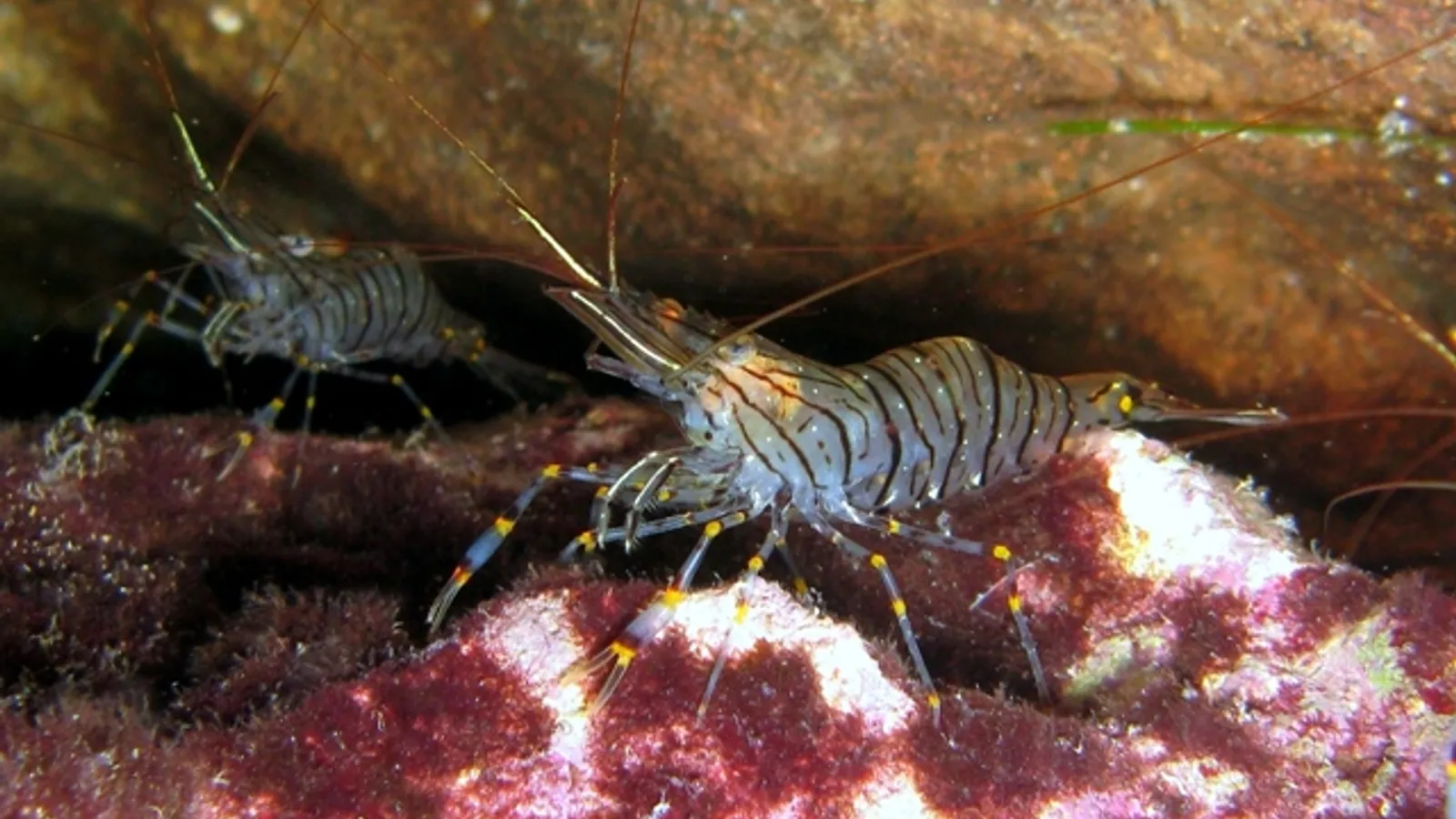
The body is almost transparent, crossed by very fine brown lines.
- 02
It shoots backwards by flexing its abdomen, and vanishes in a flash.
- 03
In winter it moves into deeper water and returns inshore in spring.
— What sets it apart
The escape is a reflex that never reaches the brain. A violent contraction of the abdominal muscles slaps the tail fan against the water and throws the animal backwards several centimetres in a few thousandths of a second: the signal runs along giant neurons, thick enough to conduct the impulse almost instantly, and the decision is taken before anything like perception has occurred. On these giant neurons — in prawns, in crayfish, in squid — much of what we know about how a nerve impulse travels was built.
